The COP Illusion: Why India needs to lead the Global South Axis at COP31


 an hour ago
For more than three decades, the United Nations Framework Convention on Climate Change (UNFCCC) Conference of the Parties (COP) has played out as a grand annual theatre. Tens of thousands of diplomats, corporate and NGO lobbyists, and private jet travellers gather under the guise of saving the planet, only to deliver sanitized communiqués, non-binding targets, and creative accounting. As COP31 approaches in Antalya Turkey during 10thNovember to 20th November 2026, the rhetoric from the developed world will predictably continue. But for the countries of the Global South, the illusion has shattered long back and this CoP may be expected to end on similar lines.
The reality is staring at the face of humanity. the developed West built its wealth on two centuries of unbridled fossil fuel consumption, exporting the environmental invoice to the Global South. When there is need to atone for the past, the industrialized world offers carbon markets, debt-inducing loans, and empty promises instead of actual compensations. If COP31 is to be anything more than another expensive jamboree, the Global South must stop flirting or gamesmanship in negotiations and should bargain in straightforward manner. The time has come to forge a defiant South-South bloc—led by nations like India, Brazil, and South Africa—to rewrite the terms of global climate governance. China should be invited to join the group.
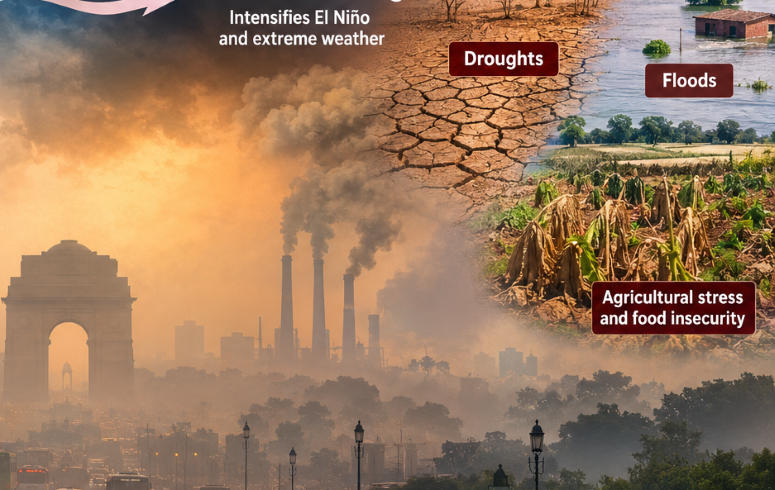
The primary agenda of COP31 should not be setting distant net-zero targets for 2050 or debating draft texts but to pledge a unified approach for the welfare of humanity by shedding the hypocrisy. It must be a direct confrontation with the systemic failures of the Western-led climate framework. The developed world consistently boasts about mobilizing billions for climate finance, but a closer look reveals that it is nothing but a bait. Over 70% of public climate finance provided to developing nations comes in the form of loans, not grants. The West is essentially telling countries suffering from floods, droughts, and heat waves: "We polluted the atmosphere to get rich; now you must borrow money from our banks at market rates to clean up our mess." COP31 must mandate that climate finance consist strictly of non-debt-creating grants and low-interest concessions, explicitly categorized as reparations for historic ecological damage, not charitable aid. The recent catastrophic floods and glacier melt in Tibet, Nepal and India have killed thousands of people and destroyed properties and infrastructure worth billions have clearly demonstrated that those innocent people are bearing the maximum brunt of climate related disasters who historically had no role at all in damaging the climate.
Further, developed economies are continuing sophisticated trade barriers to protect their own industries while penalizing developing nations. Mechanisms like Europe’s Carbon Border Adjustment Mechanism (CBAM), from the point of view of developing world is highly controversial and tantamount to green protectionism. It violates the UNFCC’s cardinal principle of Common but Differential Responsibilities conveniently ignoring historical emissions and per-capita footprints and penalizes the South for industrializing late and working for the livelihood of their population. The West preaches rapid decarbonization while locking the vital technologies behind stringent Intellectual Property Rights (IPR). If climate change is an existential crisis for humanity, high-efficiency solar cells, advanced grid storage, and green hydrogen technology cannot remain the sole property of any country more so of developed countries. COP31 must devise a framework for the rapid, low-cost transfer of green technology to the developing countries as is done during global health emergencies.
While the bureaucracies may engage in negotiations the concrete action must happen at ground level. Climate amelioration requires micro-targeted planning for both urban concrete rural eco-systems. For example, modern cities operate as artificial heat traps as concrete and asphalt exacerbate urban heat island effects and cause flash floods.
Cities must incorporatepermeable pavements, bio-swales (landscaped channels planted with vegetation like in Agartala City), urban wetlands, and subterranean retention tanks. The city of Wuhan, China, transformed from a flood-prone metropolis into a Sponge City model by converting 38 square kilometres of land into urban rain gardens, parks, and permeable roads, drastically reducing runoff and cooling local air temperatures by up to 1.5°C. Indian planners must devise a similar plan of action for major cities. Already Ahmedabad, have demonstrated that low-cost lime-based high-albedo paint on rooftops reduces indoor temperatures by 2°C to 5°C, saving energy and saving lives during severe heatwaves. Municipal codes must mandate green roofs, solar canopies, and mandatory tree canopy cover percentages on all urban thoroughfares. Urban planning in Indian scenario must improve its public transport system so that people have faith on it so that vehicular pollution is reduced.
For better adaptation and mitigation landscape restoration & climate-resilient agriculture practices must focus on ecosystem restoration and soil-water conserve. In this regard several examples of India’s micro-level ridge-to-valley watershed treatment recharges groundwater tables and prevents soil erosion should be replicated on priority. Further, rural development planning must incentivize multi-layered cropping systems, integrating nitrogen-fixing trees with drought-tolerant crops (e.g., millets like Sorghum and Pearl Millet). This enhances carbon sequestration, preserves topsoil, and stabilizes farm incomes during extreme weather events. There is also ned to extend the Roof Top Prime Minister’s Solar Energy scheme to create further decentralized renewable mini-grids. In rural planning wherever possible, we should decentralize energy production via agrivoltaics—placing solar panels above cropland—allowing farmers to generate energy while growing shade-tolerant crops beneath. This writer has always been arguing for adopting climate resilient life style at the individual and family level because the government policies remain abstract without individual and household compliance.
As a fast-growing economy striving to lift millions out of poverty while deploying renewable energy at a historic scale, India carries the weight and moral authority to lead the Global South. Indian negotiators at COP31 must adopt an aggressive, uncompromising strategy.Negotiators should demand that any revenues collected by Western nations through unilateral green tariffs be automatically redirected into the UNFCCC Loss and Damage Fund to compensate developing countries. The developed world frequently attempt to reset the clock, treating emissions from recent decades as the primary benchmark. Indian negotiators must bring the core metric back to cumulative historical emissions from 1850 to the present day. Western nations have consumed more than 70% of the global carbon budget while housing less than 20% of the world’s population.
South-South Technology Partnerships should be the core agenda. Building on initiatives like the International Solar Alliance (ISA), Indian negotiators should propose a Global South Green Tech Consortium. This body would facilitate open-source sharing of renewable innovations, joint manufacturing of clean-energy components, and direct climate-resilient agricultural, and knowledge transfer across Asia, Africa, and Latin America. The annual UN climate summit will remain a hollow exercise as long as the world's primary polluters write the rules and shirk responsibilities. The Global South can no longer afford to wait for Western altruism that will never arrive. The COP31 must be the moment for taking a unified decisive stance by ensuring South-South strategy and Indian negotiators can help transform COP from an elite talk shop into a genuine road map for global climate justice. 1211 words
(The author, a former Director-General of ICFRE and Chancellor of FRI deemed University, is the Chairman of Centre for Resource Management and Environment.)










[[comment.comment_text]]