Blood on Rawalakot's Hills: Pakistan's Crisis of Conscience
 35 minutes ago
There are moments when the silence of institutions is more troubling than gunfire in the streets. For the people of Rawalakot, one such moment came on the morning of 5 November. For the families of Balochistan who stand outside press clubs holding photographs of missing sons, and for the Pashtun communities of Khyber Pakhtunkhwa who bury their dead between militant violence and military operations, that moment has lasted for years.
These are three regions with three histories, and one question runs through all of them: when those entrusted with protecting citizens are accused of violating them, who protects the citizens? The question is addressed first to Rawalpindi and Islamabad, and then to the world.
This article separates what is documented from what is alleged, and says so where the evidence runs out. Many allegations cannot be proven, precisely because the doors through which proof might enter have been closed: communications suspended, organisations banned, courts unable to compel answers. Its argument is nonetheless firm. The pattern recorded by Amnesty International, by United Nations human rights experts and by Pakistan’s own Human Rights Commission demands an independent reckoning, and no institution of the state, military or civilian, can stand outside it.
THREE PERIPHERIES, ONE PATTERN
To see why these regions belong in a single argument, it helps to recall that none emerged from 1947 with a settled relationship to the centre. In Pakistan-occupied Jammu and Kashmir (PoJK), nominal self-government has always coexisted with heavy dependence on Islamabad, and the twelve assembly seats reserved for post-1947 refugees remain a standing reminder that its politics were shaped from outside. In Balochistan, the 1948 accession of the Khan of Kalat opened a dispute that has produced repeated insurgencies and, since the killing of Nawab Akbar Bugti in 2006, a long cycle of militancy, enforced disappearances and protest. In Khyber Pakhtunkhwa, the former tribal areas were governed under colonial-era frontier law until their merger with the province in 2018, and the Pashtun Tahafuz Movement rose to national prominence that same year after the police killing of Naqeebullah Mehsud in Karachi.
The histories differ, but the method of governance has converged. Peaceful protest is met with exceptional legal instruments, communications are cut, and the courts and the press are left unable to test what the security forces say. The argument of this article is that this convergence, more than any single incident, is the real subject. When security institutions become the first resort for political grievance, citizens lose their remedies, and the accountability gap widens in every region at once.
A CHARTER OF BREAD, ELECTRICITY AND DIGNITY
Nowhere is that pattern easier to trace than in the story of the Jammu and Kashmir Joint Awami Action Committee (JAAC). It was not born in a conspiracy. It grew out of the ordinary humiliations of daily life: electricity tariffs that rise in a land of rivers, the price of flour, thin public services, and a political system that many residents feel was never fully theirs. Its charter of demands, reported to run to 38 points, contains little that a functioning democracy would find alarming. Its most explosive demand is also its most basic: the abolition of the twelve reserved refugee seats, which critics say allow Islamabad’s preferences to shape governments that local voters never chose [1]. Pakistan’s Supreme Court has ruled that removing them would require a constitutional amendment, which makes this a question for parliament and the negotiating table.
Instead came the ban. On 5 June 2026, the day elections for 27 July were announced, the AJK cabinet proscribed the committee under the Azad Jammu and Kashmir Anti-Terrorism Act, 2014. Amnesty International called the move a dangerous escalation and reported more than a hundred related detentions on 6 and 7 June [1]. Six UN special rapporteurs have since warned Islamabad that the designation may have been imposed in retaliation for political, labour and human rights advocacy, and cited reports that 205 people, women among them, had been placed on the Fourth Schedule of the Anti-Terrorism Act, a listing that can lead to the suspension of identity documents [2]. Local reporting suggests the lists have kept growing.
The human meaning is easy to state. A mother who joined a sit-in over the price of flour may find herself unable to use her national identity card, and a student who marched appears as a terrorism suspect in a government notification. A legal instrument designed for armed militants is being applied to the unarmed.
This sits uneasily with Pakistan’s own diplomacy. Islamabad presents itself abroad as the champion of Kashmiri self-determination and invokes the rights of Kashmiris at every international forum. Yet when Kashmiris on its own side of the Line of Control claim rights of their own, to representation, to affordable power and to peaceful association, they are treated as a security threat.
“A principle that applies only across the border is not a principle. It is a talking point.”
THE MORNING OF 5 NOVEMBER
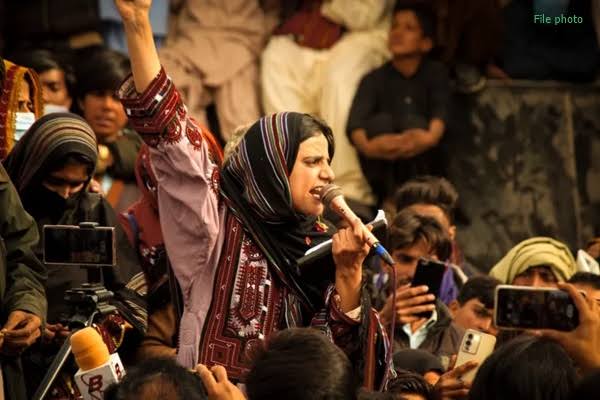
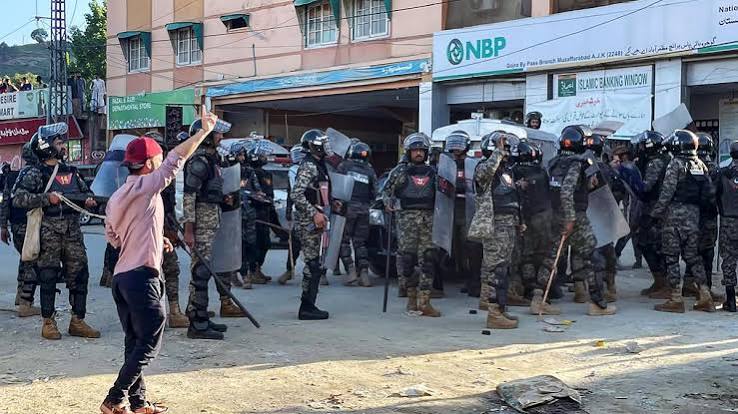
On 5 November, a security operation began at the sit-in sites that had stood since June, among them the bus terminal at Matiyal Mara and D-Chowk in Rawalakot. The police account, issued through the office of the Deputy Inspector General for the Poonch region, is that the operation aimed to remove illegal obstructions from public roads and that armed individuals fired on law-enforcement personnel. This is not the first time the police have made such a claim: AJK police said earlier in the year that four of their personnel had been killed in firing incidents since June [3]. JAAC representatives dispute the police version, allege disproportionate force and report civilian deaths, and Amnesty had already called in July for an independent investigation after earlier reports of lethal force in Rawalakot
What can and cannot be said with confidence is summarised below. The distinction matters, because a communications blackout does more than slow reporting: it leaves every claim, including the police claim, untested
Documented The JAAC was proscribed on 5 June 2026 under the AJK Anti-Terrorism Act, 2014, and Amnesty International reports more than 100 related detentions on 6 and 7 June. A security operation took place at the sit-in sites on 5 November. Mobile communications around Rawalakot were disrupted. AJK police say a Sindh Rangers soldier wounded in firing that day died on 9 November.
Alleged and contested The number of civilian deaths: reports cite three, seven and 18, all resting on JAAC or protester sources. The use of drones and heavy weapons, alleged by JAAC and allied groups. Who fired first, which the police and the protesters describe in opposite terms.
Not established Responsibility of any individual officer or commander, the content of operational orders, and the full number of the injured. Only an independent inquiry with access to the site and the records can settle these questions.
In a transparent system, a gap between accounts this wide would trigger an immediate judicial inquiry. Those most confident in their version of events should be the first to demand one.
ACCOUNTABILITY: WHAT THE LAW REQUIRES
The competing accounts of 5 November leave one question that neither side can settle for itself: who answers for what happened? That call for accountability is often framed as a political attack. It is better understood as a legal one. Pakistan ratified the International Covenant on Civil and Political Rights and the Convention against Torture on 23 June 2010. Those treaties bind the state, not any single government, and they protect the right to life, freedom of peaceful assembly and freedom of association. They also require that deaths caused by security forces be investigated promptly, independently and effectively. Under international standards on the use of force, firearms are a last resort, and force must be necessary and proportionate to a real threat. Whether those standards were met in Rawalakot is a factual question that only an inquiry can answer.
Responsibility operates at three levels. The first is the state, which is answerable for the conduct of its forces and for the legality of its emergency measures, including proscription, Fourth Schedule listings and communications shutdowns. The second is the individual officer who is shown to have used unlawful force. The third is command: under settled principles of international criminal law, a superior can be held responsible for subordinates’ crimes where he knew or should have known of them and failed to prevent or punish them. This article asserts none of this against any named person, and the public record does not support such an assertion. It asks only that the question be examined.
Two features of Pakistan’s legal landscape make that examination harder. The 27th Amendment of November 2025 created the post of Chief of Defence Forces, held by Field Marshal Asim Munir, and, according to news reports, extended to the Field Marshal, as to the President, lifetime immunity from criminal proceedings [5]. Such immunity does not reach officers below him, does not relieve the state of its duty to investigate, and does not bind international scrutiny, but it does narrow the domestic path to accountability at the very top. Pakistan has also not ratified the International Convention for the Protection of All Persons from Enforced Disappearance or the Rome Statute of the International Criminal Court.
Civilian authority carries its own, and more direct, responsibility. It was the AJK cabinet that decided on the proscription, and the civilian governments in Muzaffarabad and Islamabad oversee the police, the courts and communications licensing. So far as public reporting shows, no credible independent inquiry into the events of 5 November has been ordered. Critics describe a civilian facade behind which the real decisions are taken elsewhere. If that description is unfair, the remedy is in the government’s hands: a judicial commission with genuine authority, published terms of reference and the power to summon uniformed witnesses. An army exists to defend a nation’s people, not to discipline them, and the elected government exists to ensure that it does.
BALOCHISTAN: A GENERATION COUNTED IN PHOTOGRAPHS
If Rawalakot shows how protest is criminalised, Balochistan shows what can follow when no one is allowed to ask. There, protest takes the form of a photograph. Mothers, sisters and daughters carry portraits of men taken from their homes, shops or university hostels and never returned. For years the families have asked for one thing: a name, a place, a court date or, at the very least, a grave.
In September 2026, UN experts expressed grave concern over the alleged enforced disappearance, torture and extrajudicial killing of the Baloch student Imran Ali. They noted that at a hearing before Pakistan’s own Commission of Inquiry on Enforced Disappearances on 6 August, a police officer stated that Ali had been killed in an alleged encounter in May [6]. These are the experts’ findings of concern, and Pakistan has the right to respond. Yet the detail is telling: the fate of a missing student surfaced not through a dissident’s leaflet but through an official hearing, months after the fact.
In July, the same UN system condemned the life sentence imposed on Dr Mahrang Baloch, who leads the Baloch Yakjehti Committee, citing the misuse of counter-terrorism and murder charges to suppress peaceful protest and freedom of association [6]. Balochistan has also endured militant violence, and its victims deserve justice as well. But no insurgency licenses a state to abduct students, and no grievance, however old, is answered by making citizens vanish.
KHYBER PAKHTUNKHWA: BETWEEN THE MILITANT AND THE MILITARY
In Khyber Pakhtunkhwa, the same questions arise in a different form, because the tragedy has two authors and honesty requires naming both. Militant groups have killed soldiers, police officers and civilians, and the people of the province have every right to protection from them. But the Human Rights Commission of Pakistan, in its annual report on 2025 released in May 2026, described a severe contraction of civic space and found that counter-terrorism operations had disproportionately affected Khyber Pakhtunkhwa and Balochistan, with significant civilian as well as law-enforcement casualties [7]. Security delivered at the cost of due process does not end fear; it adds another source of it.
The treatment of Pashtun activists illustrates the problem. In April 2026, Amnesty International issued an urgent appeal on the fate of Hanif Pashteen and Noor Ullah Tareen, members of the Pashtun Tahafuz Movement who were reportedly forcibly disappeared, and called for accountability for enforced disappearances affecting Pashtun communities [8]. The scale of the wider problem is acknowledged by the state itself. Pakistan’s Commission of Inquiry on Enforced Disappearances has received more than ten thousand complaints nationwide since 2011 and reports that most have been formally closed [7]. Closing a file, however, is not the same as finding a person, and Dawn’s editorial board has argued that the commission has become better at the former than the latter. A Pashtun father should not have to choose between the militant’s threat and the state’s suspicion; he is entitled to both protection and the presumption of innocence.
WHAT THE WORLD MUST NOW DO
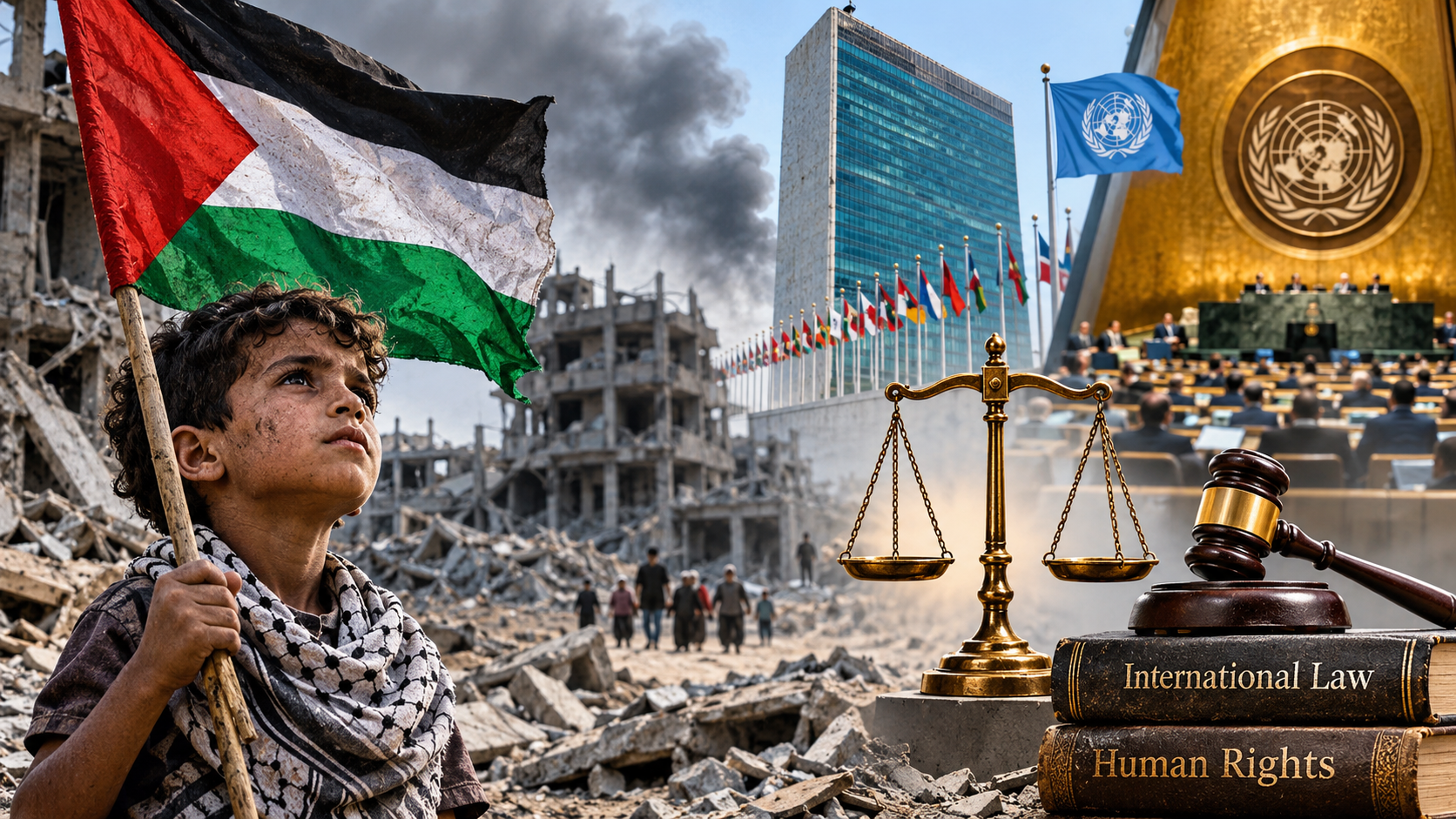
Taken together, these cases point to a remedy that no single government can supply from within. The international community has grown skilled at expressing concern and moving on. Concern is cheap, and the people of Rawalakot, Quetta, Turbat and Peshawar have learned to measure it by what follows. Pakistan sits on the United Nations Human Rights Council for the term that began in January 2026, which gives the Council, the Office of the High Commissioner for Human Rights and independent rights organisations a particular standing to press for six steps. The first four are the core of the appeal, because without them every other reform remains a promise on paper.
1. An independent investigation into the civilian deaths and alleged excessive force in Rawalakot, including the operation of 5 November, with access to the site, the injured, medical records and the operational orders of the security forces.
2. Judicial oversight of security operations, with accountability for unlawful acts regardless of rank, including a transparent examination of the chain of command and the authorisation of operations.
3. Open access: the full restoration of communications, and unhindered entry for independent journalists, lawyers and international observers.
4. Disclosure of the disappeared: the whereabouts of all detained and disappeared persons in all three regions, and Pakistan’s ratification of the International Convention for the Protection of All Persons from Enforced Disappearance.
5. A review of the JAAC proscription and of every Fourth Schedule listing, and the withdrawal of terrorism charges against peaceful activists.
6. Genuine political dialogue with elected and community representatives of each region, on that region’s own terms.
The Council should also ask Pakistan to report back publicly on each step within a defined period, so that expressions of concern become a measurable process. Pakistan has a genuine right to defend itself against terrorism, and its soldiers and police have paid a heavy price in that struggle. But sovereignty is a responsibility toward one’s people before it is a shield against scrutiny.
DIGNITY HAS NO BORDER
Rawalakot, Balochistan and Khyber Pakhtunkhwa are different places with different wounds, and they should not be forced under a single label. What connects them is a claim that belongs to every person on earth: to live without fear, to speak without intimidation and to seek justice without being declared an enemy of the state.
That claim does not depend on the passport a person holds or on the strategic value of the place where they live. It is the reason human rights cannot be defended selectively, according to the convenience of alliances, arms contracts or regional rivalries. A world that condemns abuses where it is politically cheap and ignores them where it is costly has no standing to speak of universal values, and the same standards must apply to every government that invokes them.
The families in Rawalakot, Turbat and Peshawar are asking the same quiet question, and the answer will not be found in the strength of bans or the speed of operations. It will be found in whether institutions are willing to be examined, and in whether the world is willing to insist. Justice delayed in one place weakens it everywhere.

[[comment.comment_text]]