The Kingmakers Nobody Wants to Crown
 an hour ago
Israel's 19-seat Arab bloc has frozen the country's politics. Can anyone govern with them, or without them?
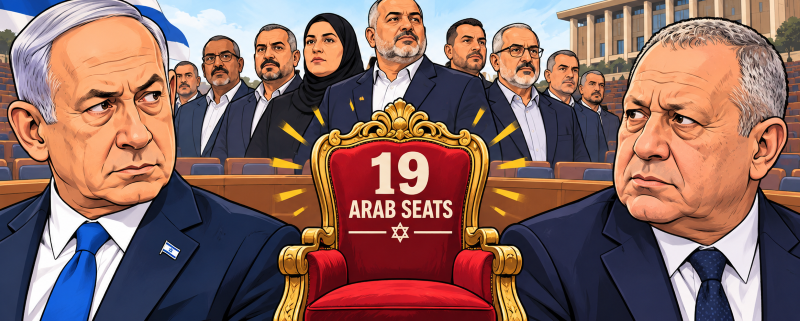
The dust has settled on Israel's October 2026 election, and what it reveals is not a victory but a standoff. Neither Prime Minister Benjamin Netanyahu nor his principal challenger, Gadi Eisenkot, can count on the 61 seats needed for a majority in the 120-member Knesset. Between them, in the exact centre of the paralysis, stands a historic bloc of 19 Arab-led seats. Overnight, the road to the Prime Minister's Office has begun to run through Israel's Arab minority, a community that the country's political establishment has long treated as an electoral afterthought. The question now consuming Jerusalem is simple to ask and brutally hard to answer: can a stable government be formed with Arab parties, and what happens if everyone refuses to cross that bridge?
The Arithmetic of a Stalemate
With all votes counted, the pro-Netanyahu bloc holds 53 seats, the Eisenkot-led opposition bloc 48, and the Arab parties, the Joint List and Ra'am, a record 19 [1]. Netanyahu's Likud remains the largest single party, with Eisenkot's Yashar close behind on 21 seats. The majority threshold is 61. The scale of the shift is striking. The governing parties held 68 seats in the outgoing Knesset, so Netanyahu's camp has lost 15. The Arab parties, meanwhile, have almost doubled their previous tally of ten [1]. Arab voters turned out in record numbers, apparently determined to unseat a government they see as hostile to them [1][2]. The numbers cut both ways. Netanyahu is eight seats short of a majority. Eisenkot is thirteen short on his own. Add the Arab parties to his bloc, however, and the opposition reaches 67, enough to remove Netanyahu on paper [3]. The mathematics are not in doubt. The politics are another matter entirely.
Scenario One: A Government With Arab Support
If the numbers decided everything, Eisenkot would already be preparing his cabinet. They do not, partly because the Arab bloc is not one voice but two, each with a very different price.
The pragmatist: Mansour Abbas and Ra'am
Ra'am, led by Mansour Abbas and holding about eight seats, is the party most open to formal participation in government. It did so once before, joining the Bennett-Lapid coalition of 2021, and it has never hidden its reasoning: Arab citizens, in Abbas's view, cannot afford to stay permanently outside the rooms where budgets are decided. His agenda is civic rather than ideological. It centres on tackling organised crime in Arab towns, equalising municipal funding, easing a chronic housing shortage and widening economic opportunity.
The ideological wall: Yousef Jabareen and the Joint List
The Joint List, with roughly eleven seats, is a harder partner to bring in. An alliance of Hadash, Ta'al and Balad, it has signalled that it would not sit in an Eisenkot cabinet, though it might offer parliamentary backing from outside the government. Its demands are rooted in foreign policy: an end to military operations in Gaza and Lebanon, a halt to West Bank settlement expansion, and a credible path to Palestinian statehood. That last demand collides directly with Eisenkot's own platform, which does not embrace a two-state solution. A minority government resting on the Joint List's tolerance would therefore be exposed to a confidence vote on almost every major security decision it took.
The wall inside the opposition
Yet the largest obstacle may not be Netanyahu at all. It is the opposition's own right flank. Naftali Bennett and Avigdor Liberman, both partners in Eisenkot's alliance, have ruled out any government that depends on Arab votes. Even Eisenkot himself ruled out including Arab parties in a coalition during the campaign [3]. This is the central paradox of the moment. A camp that promised to replace Netanyahu now hesitates to accept the only votes that could do it. The more thoughtful strategists in that camp are exploring a middle path: a government without Arab ministers that nonetheless survives because Arab lawmakers decline to vote it down. Even before any government exists, Arab support could help the opposition replace Knesset Speaker Amir Ohana, a close Netanyahu ally, and shift control of the legislative agenda [3].
Israeli politics has seen versions of this before, and each time the arrangement proved fragile. A government that relies on parliamentary goodwill it cannot publicly acknowledge is a government permanently one controversy from collapse.
Scenario Two: Governing Without the Arab Parties
If both camps refuse to deal with Arab factions, the arithmetic becomes punishing. Netanyahu would still have to find eight additional seats from somewhere. Analysts point to three routes, each volatile. The first is defection. Netanyahu, a veteran of coalition engineering, would try to peel individual lawmakers from centrist or right-wing opposition parties and assemble a razor-thin majority. It is possible, but hunting for eight defectors is a slow, public and unstable business, and every defector extracts a price. A majority built this way can be undone by a single resignation. The second is a grand national unity pact. Pressure from the public and from abroad could push Netanyahu and Eisenkot into a rotating or power-sharing arrangement, setting aside a bitter rivalry in the name of stability. Such a deal would be a gift to political centrism but a risk to both men. Eisenkot would be accused of betraying the central promise of his campaign, which was to end the Netanyahu era. Netanyahu would have to share the control he has guarded for so long. Liberman's refusal to cooperate with either Netanyahu or the Arab parties adds yet another layer of difficulty.
The third is simply failure, and failure has its own constitutional script.
The Constitutional Clock
A failed negotiation does not mean an automatic election. Under Basic Law: The Government, President Isaac Herzog first has seven days to consult every elected faction and then entrusts one Knesset member with forming a government [4][5]. That candidate has 28 days, and the president may add up to 14 more, making 42 in total. If the first attempt fails, the president may assign a second candidate for another 28 days, with no extension. A group of at least 61 Knesset members can also ask the president to give the task to a third candidate. Only when these routes are exhausted, or when 61 members vote for it, does the Knesset dissolve and the country return to the polls [4][5].
Time itself is not the enemy. According to the Israel Democracy Institute, forming a government in Israel has historically taken anywhere from 20 to 100 days, not unusual by international standards [4]. Herzog has already urged the parties to avoid a fresh election. The more serious danger is not delay but a pattern of exhausted voters being sent back to the ballot box again and again. Throughout this process, the existing government stays in office as a caretaker. That is the quiet advantage that makes some commentators describe the stalemate itself as a Netanyahu victory: if nobody can assemble 61 seats, he remains prime minister while the country drifts toward a vote in 2027.
A Charge That Complicates Everything
Into this already fragile moment, Netanyahu has injected a charge of his own. He has alleged that the election was "stolen by Arab parties", demanded a police investigation into voting in Arab areas, and claimed that serious criminal activity took place [2]. Allegations of foreign interference have also surfaced and are under investigation, while Israeli officials have rejected claims of widespread voting irregularities [3]. No evidence of fraud on that scale has been presented. The claim, however, does political work regardless of its truth. It frames Arab votes as inherently suspect, and in doing so makes it harder for any future government to rely on them without paying a heavy domestic price. It is a reminder that this contest is about legitimacy as much as seats.
Arab Participation: A Democratic Right or a Political Necessity?
Beyond the horse-trading lies a deeper question about the character of Israeli democracy. Arab citizens, roughly a fifth of the population, vote, stand for office and sit in the Knesset. Their record turnout was an unmistakable demand for recognition, equal investment and a real role in national decision-making. Yet the reluctance of the major Jewish-led parties to treat them as legitimate coalition partners exposes an old contradiction. If Arab citizens may elect representatives, should those representatives not be allowed to negotiate on the same terms as everyone else? That does not mean other parties must agree with them. Disagreement over security, foreign policy and the Palestinian question is part of any parliamentary democracy, and it is a legitimate reason to refuse a particular policy bargain. But there is a difference between rejecting a platform and rejecting a people. Democratic participation becomes meaningful only when elected representatives are judged by their positions and parliamentary conduct, not excluded in advance because of the community they represent.
The responsibility runs both ways. Arab parties, particularly those seeking real influence, must show that their leverage can translate into concrete improvements in the lives of their constituents: safer towns, better services, more housing. They must also engage seriously with the security anxieties that shape how most Israeli voters think, anxieties sharpened by this being the first national election since the attacks of 7 October 2023.
The Verdict: Advantage Netanyahu, For Now
Who holds the stronger hand today? In purely practical terms, Netanyahu. He has a larger bloc than any rival, he has the caretaker position, and he has time. His opponents have the arithmetic but not the unity to use it. The opposition's majority exists on a spreadsheet; his minority exists in the Prime Minister's Office. That advantage is not permanent. If Eisenkot can convince Bennett and Liberman that a government sustained by outside Arab support is preferable to another round of elections, and if Ra'am and the Joint List can accept compromise on the biggest symbolic questions, the equation changes quickly. Conversely, if Netanyahu cannot find eight defectors, and if unity talks collapse on the question of who leads, he faces the same exhaustion as everyone else.
There are, in short, four roads ahead: an unprecedented partnership with Arab parties, a fractured opposition picked apart one defector at a time, a rotating unity government, or an exhausted electorate sent back to the polls. Each is possible. None is comfortable. What the world should watch is not only the headline contest but the quieter signals beneath it: whether Bennett and Liberman soften their pledges, whether Ra'am names its price in public, and whether Herzog's consultations produce a clear recommendation. In a parliament this evenly divided, a single statement by a single party leader can reorder the entire board overnight. Allies abroad, from Washington to the Gulf, will also be weighing in, because a government's composition shapes its choices on Gaza, Lebanon and regional diplomacy.
Conclusion: The Real Winner Is the Kingmaker
Israel's October 2026 election gave Netanyahu no decisive win and Eisenkot no clear mandate. What it gave, unmistakably, was a new political fact: a 19-seat Arab bloc that can no longer be treated as peripheral. Whether that influence becomes ministerial seats, quiet outside support, or merely a louder voice in opposition will define the next phase of Israeli politics. The deeper test, however, is not who becomes prime minister. It is whether Israel's leaders are prepared to accept the democratic consequences of the electorate they have. The country can choose compromise and a broader understanding of representation, or it can allow ideological walls to prolong a crisis of governance. Voters have spoken. The question that remains is whether those they elected are willing to listen.
References
[1] The Times of Israel, "With all votes counted, Netanyahu's bloc has 53 seats, Eisenkot's 48, Arab parties 19", 28 October 2026. https://www.timesofisrael.com/with-all-votes-counted-netanyahus-bloc-at-53-seats-eisenkots-48-arab-parties-19/
[2] Fox News, "Netanyahu alleges fraud as Arab parties score record gains, emerge as potential kingmakers", October 2026. https://www.foxnews.com/world/netanyahu-alleges-fraud-arab-parties-score-record-gains-emerge-potential-kingmakers
[3] Fox News, "Netanyahu's coalition falls short as Arab parties surge in Israel vote", October 2026. https://www.foxnews.com/world/netanyahu-bloc-falls-short-arab-vote-surges-qatar-election-interference-allegations-emerge
[4] Israel Democracy Institute, "Forming a government after the elections" (explainer on government formation timelines). https://www.idi.org.il/en.idi.org.il/articles/46409
[5] Basic Law: The Government (2001), Sections 7-13, Knesset text via Jewish Virtual Library. https://jewishvirtuallibrary.org/basic-law-the-government-2001
(The author is a young Economics Professor at B.R.A. University, Muzaffarpur.)









[[comment.comment_text]]