The Mahatma, the Media and My Journey of Understanding Gandhi
 2 weeks, 6 days ago
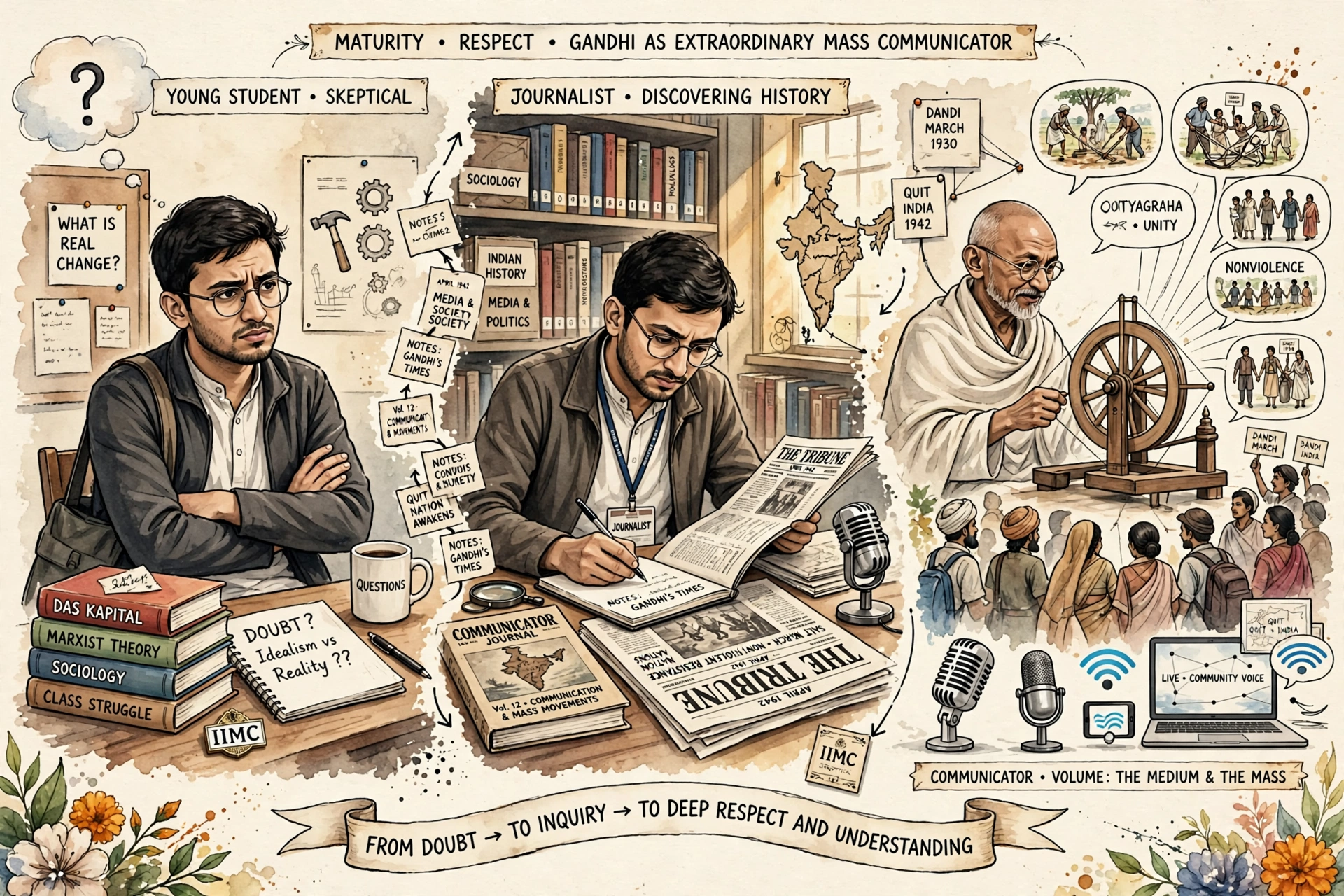
Partly because of my family’s modern and social-reformist background, and partly because of my exposure to Marxism during my college years in Kanpur, I was not an ardent admirer of Mahatma Gandhi in my youth. My disagreements with him, however, were very different from those of the bigoted and close-minded elements of the Sangh Parivar. I believed that Gandhi was not sufficiently modern or progressive for the post-Industrial Revolution world in which he operated. I also felt that he should have displayed greater revolutionary fervour and accommodated leaders such as Netaji Subhas Chandra Bose. In my view, he could also have shown greater appreciation for the sacrifices of the many warriors of the freedom struggle, from Rani Lakshmibai and Lala Har Dayal to the members of the Ghadar Party and the young revolutionaries of Bengal.
Yet, even while holding these reservations, I had immense respect for Gandhi’s contribution to India’s freedom struggle, his extraordinary moral character and his selfless dedication to the nation. I regarded his assassination as one of the greatest crimes against humanity, and those who tacitly or openly endorsed it as morally reprehensible.
When I took up journalism as a career after completing my education, a non-conformist attitude and a critical faculty became second nature to me. During the 1970s, while working with The Tribune in Chandigarh and covering Panjab University, I came into contact with a professor of management who was associated with a Centre for Gandhian Studies at the university. If my memory serves me correctly, he was from Kanpur and his name was Dr Tripathi. One day, I shared my reservations about Gandhi with him. He listened patiently and advised me not to reach conclusions without studying Gandhi and his times more deeply.
His advice stayed with me. As a student of sociology, I had always been interested in culture, society and social history. In those pre-television and pre-mobile-phone days, there was also considerably more time for reading and reflection. I began studying the contemporary history of Gandhi and the circumstances in which he shaped India’s freedom movement. The well-stocked library of The Tribune proved invaluable. Senior colleagues such as Saraswati Saran Kaif, J.M. Sharma, Jaswant Singh and L.K. Jha, who had witnessed the final years of the freedom struggle, also helped deepen my understanding. I later had the opportunity to interact with eminent social scientist Prof. S.C. Dube and others.
Gradually, I began to see Gandhi in a different light. I realised that, given the circumstances in which he operated, civil disobedience was perhaps the most effective weapon available to him against the enormous power of the British Empire. His methods could not be judged solely by the standards of a later age; they had to be understood in the political, social and cultural context of his own time.
My deeper appreciation of Gandhi, however, began only after I joined the Indian Institute of Mass Communication (IIMC) in New Delhi in 1989. After more than two decades in active journalism, I began to recognise something that had escaped me earlier: Gandhi was not merely a political leader who used communication effectively. He was, in many ways, an extraordinary mass communicator—and perhaps one of the greatest the world has known.
At IIMC, I began as Head of Publications and editor of its research-oriented journals, Communicator and Sanchar Madhyam. While examining literature on mass communication for these publications, I repeatedly encountered examples of Gandhi’s extraordinary ability to communicate with ordinary people. He possessed an exceptional understanding of the psychology of the people he met, interacted with and led. He could reach millions, elevate their thinking and persuade them to undertake difficult tasks while maintaining an unusually high standard of personal and public ethics.
This took me back to my school days, when I had encountered a poem by Sohan Lal Dwivedi, popularly known as Rashtra Kavi for his nationalist poetry. The poem described the extraordinary influence Gandhi exercised over millions of Indians, who followed him with faith and discipline wherever he led them. What I had once read simply as patriotic poetry, I later came to understand as a remarkable description of Gandhi’s power as a communicator and leader.
Gandhi’s greatest strength was perhaps his ability to understand the public mind and then transform that understanding into constructive action. He could elevate the level of people’s thinking, persuade them to accept difficult challenges and keep them committed to a larger moral purpose. He combined this ability with an insistence on ethical conduct that was rare among public leaders.
That is one reason why Gandhi was respected not only by his followers but also by many of his political opponents and by leading figures across the world. His legacy continues to inspire institutions and movements internationally. Statues of Gandhi have been installed in numerous countries, while institutions and centres dedicated to the study of his life and ideas continue to function around the world.
In India, Gandhi is widely revered, even if he is not always adequately understood. We commemorate him, invoke him and sometimes even appropriate his legacy for political purposes. But understanding Gandhi requires something deeper than ceremonial remembrance. It requires understanding the way he connected with ordinary people and converted that connection into collective action.
This lesson is particularly relevant to the media and public life today. Political leaders, social activists, administrators and journalists possess communication tools that Gandhi could never have imagined. We have television, digital platforms, social media, instant messaging and artificial intelligence. Yet, despite this extraordinary technological reach, we often struggle to understand what people actually think, feel and aspire to.
The real connection with people cannot be created merely through emotional appeals or narrow and sectarian issues. It requires a deeper understanding of the social and cultural context in which people live. Gandhi understood this context remarkably well. He used that understanding not merely to mobilise people against colonial rule but also to challenge apathy, indifference and inaction and to encourage them to work towards larger social goals.
That, perhaps, is the most enduring lesson of Gandhi for our times. We do not need to agree with everything he said or did to recognise the extraordinary power of his understanding of society and human behaviour. If our political leaders, public figures, intellectuals, administrators and media professionals can imbibe even a part of that understanding, public life and nation-building will be immeasurably enriched.
The earlier we rediscover this essential dimension of Gandhism, the better it will be for a country that is searching for direction in an increasingly complex and divided world.
(Author, a veteran journalist, currently edits Media-map news network, and chairs not-for-profit MBKM Foundation.)





[[comment.comment_text]]