Inflation India’s Silent Tax: Rupee Buys Less, Family Spends Shrink

 25 minutes ago
Inflation is often discussed as a percentage in official statements, but its real meaning is felt in the household budget. It is the gradual erosion of money’s purchasing power as prices of goods and services rise. A salary may increase, a bank deposit may earn interest and the economy may continue to grow, yet families can struggle to maintain the same standard of living. The reason is simple: money buys less when prices rise faster than income.
Its impact is also reflected on the GDP. The projected gross production would be far less than the actual. The figures are good for publicity but not for the actual economic health.
A household may earn more than it did five years ago, yet find that the monthly salary runs out sooner. The grocery bill is higher, school fees have risen, medicines cost more, rent and transport take a larger share, and less is left for savings. Families are not necessarily consuming more; they are paying more for much the same standard of living. Households experience it as a steady squeeze on their budgets. Inflation erodes the purchasing power of money as prices rise than their incomes. The result is a silent reduction in living standards and erosion in savings value.
Strong Macro, Strained Household
A reported 7.8 per cent GDP growth reflects an increase in real output after adjusting for inflation. But what households and businesses experience depends on nominal growth, wages and the distribution of investment. In FY 2025–26, nominal GDP grew by only 8.9 per cent, below the budgeted 10.1 per cent assumption. ‘Low inflation’ may moderate price increases, but it also limits nominal revenue growth, corporate pricing power, tax buoyancy and the room for salary hikes. Moreover, recent growth has been driven substantially by investment, with Gross Fixed Capital Formation rising 11.9 per cent in Q1 2026-27.
Infrastructure, misnomer for growth, may create capacity and jobs over time, but does not compensate families for rising food, rent, education and healthcare costs. The macroeconomic numbers can therefore look strong while household finances remain strained.
The divide is also visible in per capita income and real wages. Even with GDP estimated at over $4.15 trillion, per capita GDP remains around $2,900. Nominal wages may have doubled over a decade, but inflation-adjusted earnings for many salaried workers have stagnated or declined. Growth in national output does not necessarily mean a proportionate rise in individual purchasing power.
Impact on Personal Finances, 2026–28
For borrowers, strong growth and persistent inflation could keep interest rates elevated, delaying relief on home, car and personal loan EMIs. Investors may find equities and mutual funds better placed to benefit from sustained economic expansion.
Real GDP growth of around 7 per cent combined with inflation of about 5 per cent implies nominal growth of roughly 12 per cent, although corporate earnings and stock-market returns will not necessarily move in step. Salaried employees may see appraisals of around 8–9 per cent in 2027, but if living costs rise by 6–8 per cent, the real improvement in income will remain modest. The central issue is not how fast the economy grows, but how much of that growth reaches wages, jobs and household purchasing power.
Compounded Misery, Money Loses 44 Percent
The effect becomes clearer when inflation is compounded over time. At an annual rate of 6 per cent, prices roughly double in 12 years. A household spending Rs50,000 a month today would need around Rs89,500 after ten years to maintain the same pattern of consumption, assuming inflation averages 6 per cent. Similarly, a basket costing Rs1 lakh today would cost approximately Rs1.79 lakh after a decade. The additional amount buys nothing more; it merely preserves the purchasing power of today’s Rs1 lakh. That is what a pay revision tries to do – maintaining a consumption level.
Inflation is therefore more than a temporary rise in prices. It changes the value of savings, wages, pensions and future financial commitments. At 6 per cent inflation, money loses roughly 44 per cent of its purchasing power over ten years. People may see the same balance in their bank accounts, but its real value has declined substantially. Those dependent on fixed incomes are particularly exposed because their earnings do not automatically adjust to the cost of living.
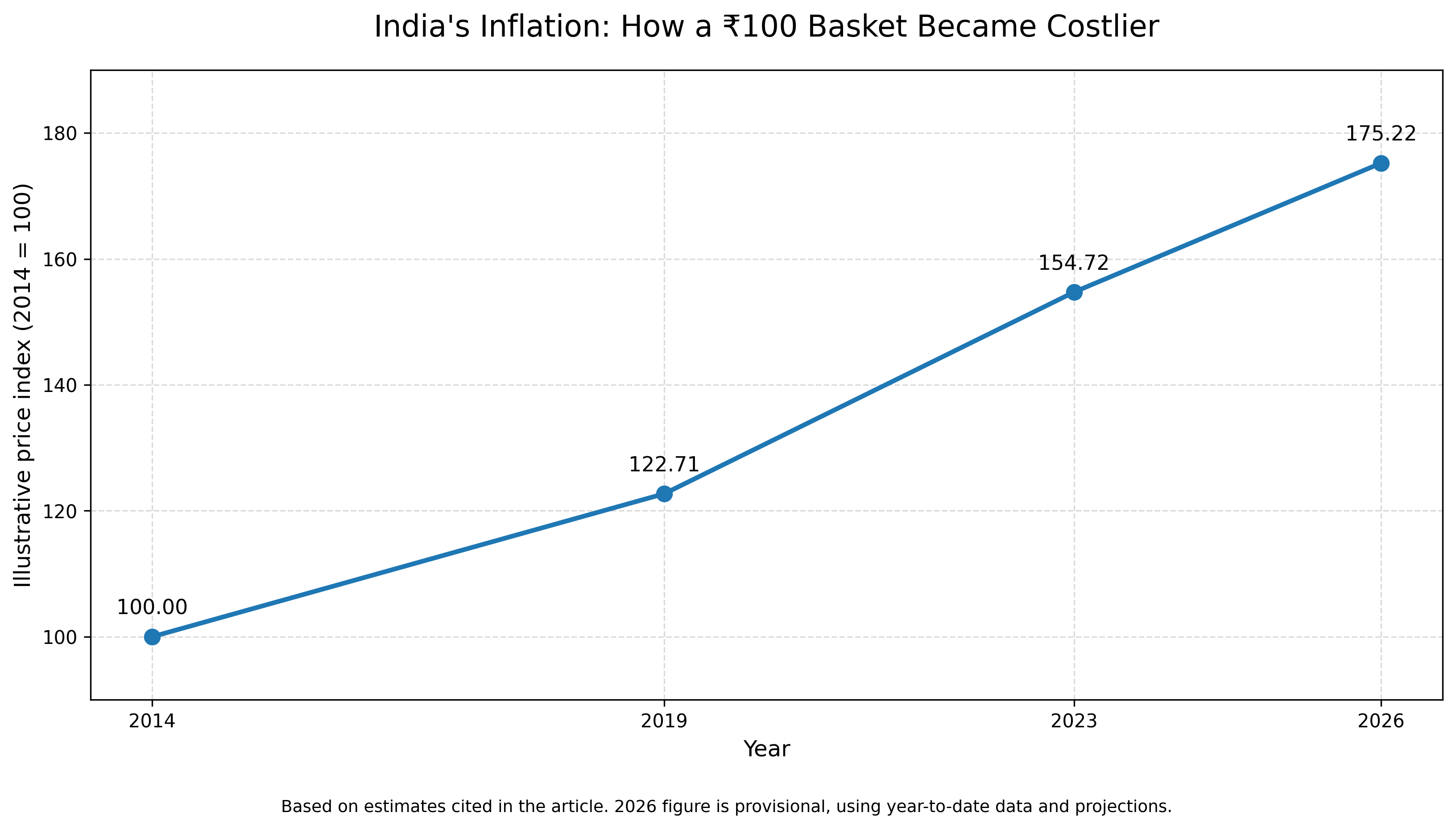
India’s experience over the past 12 years illustrates this erosion. Estimates based on different Consumer Price Index series put cumulative inflation between 2014 and 2026 at around 75 per cent. The OECD and World Bank series indicate 75.98 per cent, while the RBI-based estimate is about 75.22 per cent. This means a basket costing Rs100 in 2014 would cost roughly Rs175 to Rs176 in 2026. The average annual rate works out to about 4.8 per cent.
The increase has not been uniform. Inflation eased in some periods and accelerated in others. The figures show a Rs100 basket rising to Rs122.71 by 2019. Post-pandemic pressures pushed it further to Rs154.72 by 2023, before it reached around Rs175.22 by 2026. The 2026 figure is provisional, based on year-to-date data and projections for the remaining months, and should not be treated as a final annual reading.
A shorter comparison also shows the scale of the problem. Between 2016 and 2026, cumulative inflation is estimated at around 57.4 per cent. A basket costing Rs100 in 2016 would consequently cost about Rs157.40 in 2026. Over the longer 2014–26 period, the purchasing power of one rupee has fallen by approximately 43 per cent. In practical terms, a rupee today buys only about 57 per cent of what it bought twelve years ago.
The burden is not distributed equally. The official CPI measures the average movement of a broad basket of goods and services, but individual households have different spending patterns. A family with children may spend a large share of its income on education, transport and healthcare. An elderly couple may devote more to medicines and medical treatment. Urban households face rent, school fees and commuting costs, while lower-income families spend a larger proportion of their earnings on food and essentials. Their experience of inflation can therefore differ considerably from the headline figure.
The coming period may remain difficult for household budgets. The outlook points to renewed pressure from food and fuel prices in late 2026 and early 2027. Sharp increases in vegetables and pulses, higher transport costs and crude oil volatility can quickly affect daily expenses. Uneven monsoon conditions and lower reservoir levels may also threaten winter crop production, adding to food-price pressures. Such supply shocks are difficult to control through monetary policy alone.
The Reserve Bank of India’s inflation-targeting framework allows headline inflation to move within a band of 2 to 6 per cent. A sustained breach of the upper limit would be a concern. The current assessment also refers to a repo rate of 5.50 per cent and the possibility of further tightening if inflation remains elevated. Higher interest rates can contain demand and inflationary expectations, but they also raise borrowing costs for home, car and personal loan EMIs. Families left with less money for consumption and savings.
Medium-term projections also do not profferaoffer some relief, though not a return to lower prices. The RBI estimates inflation at around 5.2 per cent in 2026–27, with a possible peak near 6 per cent in the third quarter. The IMF projections cited are 5 per cent and 4.4 per cent for the two years. Its benefits will reach households only if jobs expand and incomes rise sufficiently.
Prices don’t Fall
There is an important distinction between falling inflation and falling prices. When inflation declines from 6 per cent to 4.5 per cent, prices do not return to earlier levels. They continue to rise, only at a slower pace. Families therefore carry the accumulated burden of past increases even when the current inflation rate looks more comfortable. A household whose income has not kept pace with prices may find that moderation in inflation brings little immediate relief.
Savings face the same pressure. Money kept in a savings account earning around 3 per cent loses purchasing power when inflation is 4.5 per cent or higher. Fixed deposits offering 6.5 to 7 per cent may appear to provide protection, but taxation on interest reduces the actual return. Depending on the depositor’s tax bracket, the post-tax return may barely keep pace with inflation. The nominal balance rises, but the real gain can be negligible.
The answer is not to chase high returns blindly. Equities, index funds and real estate may protect savings over time, but carry market and liquidity risks. Households must balance safety with growth, while salaries and pensions need periodic adjustment. If inflation stays at 4.5–5.5 per cent, income growth of 6–8 per cent may be needed to preserve purchasing power.
(Author, a well-recognised senior journalist and commentator, has served as a Professor & Dean at the capital-based IIMC.)











[[comment.comment_text]]