The Kite Flyers of Lucknow: A Forgotten Chapter of Awadh's Heritage

 an hour ago
Just as a flower adds beauty to a garden, fragrance to the air, a flame brings warmth to a lamp, a soul gives life to the body, light illuminates the eyes, joy fills the heart, and a pearl adorns an oyster shell, so does Lucknow add unparalleled splendour to the world. Lucknow is truly one of a kind, and so are its people, whose timeless elegance, refined manners, gracious hospitality, and exquisite tehzeeb make the city extraordinary.
The way festivals are celebrated in Lucknow is truly unique. Here, the festivities do not end with the festival itself; they continue into the following day! The day after Eid brings the Tarr ka Mela (Fair of Tarr), while the day after Diwali is celebrated with Jamghat. Whether it is a vibrant fair or a joyous Jamghat, every occasion is filled with enthusiasm, warmth, and a shared spirit of celebration. This is the true essence of Awadh – its timeless traditions, its celebrated Ganga-Jamuni Tehzeeb, and its rich cultural heritage, where festivities transcend boundaries and bring people together.
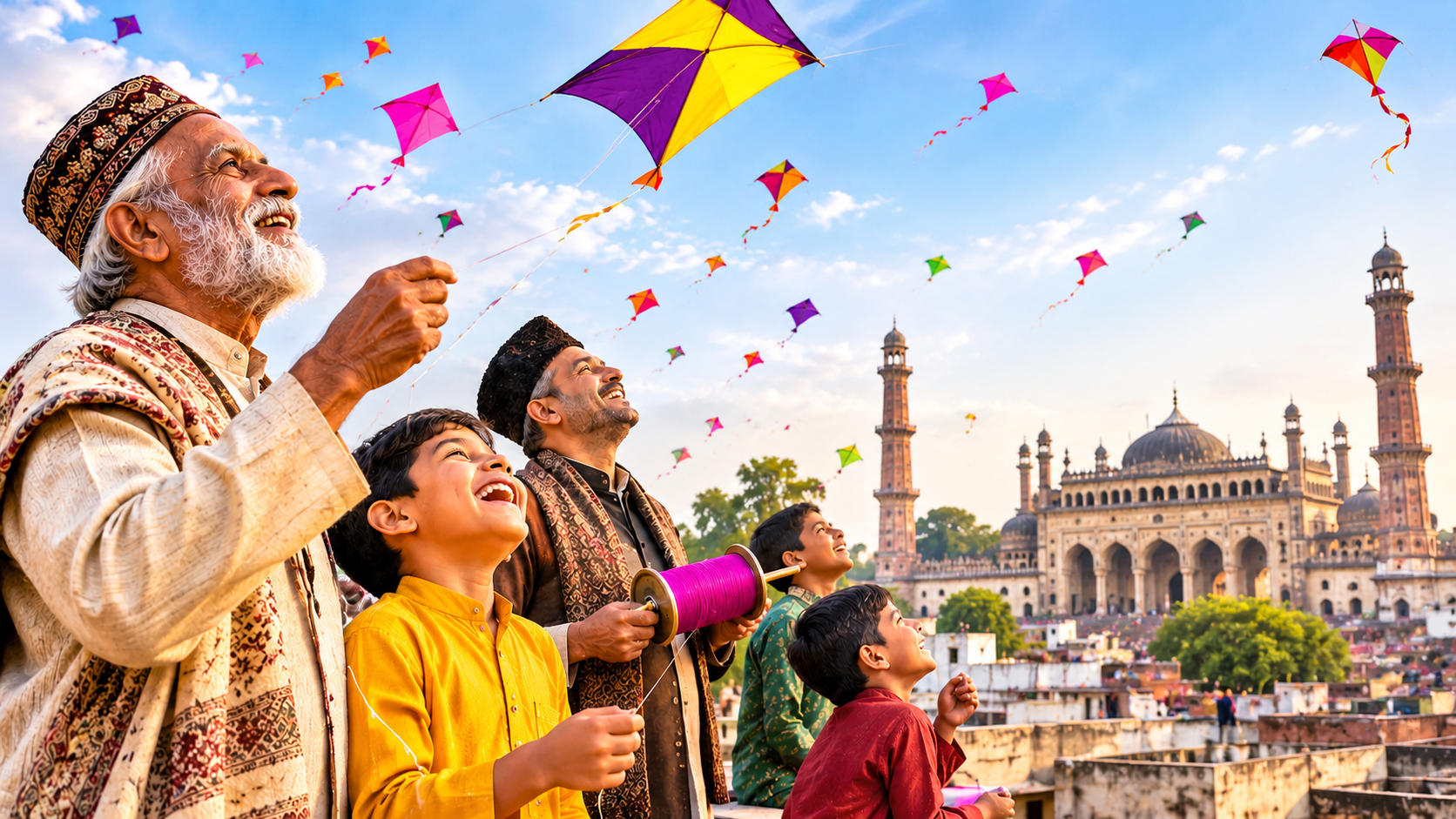
Just as patangbazi (kite-flying) is a cherished tradition during Basant Panchami in Punjab and Makar Sankranti in Gujarat, Lucknow has its own distinctive tradition of flying kites on the day after Diwali. The day following the dazzling lights and fireworks of Diwali, people gather in open grounds to fly kites, turning the occasion into a vibrant community celebration known as Jamghat.
In the old days, Jamghat was celebrated on such a grand scale that countless kites filled the skies over Lucknow, so much so that the sky itself seemed to disappear behind them. As Mushtaq Ahmed Yousufi, the famous satirist, once remarked, “Jis aasmaan meinkabootar, shafaq, patang aur sitaare na hon, aise aasmaan ki taraf nazar utha kar dekhne ko ji nahin chahta” (One does not feel like looking up at a sky in which there are no pigeons, twilight hues, kites or stars.)
Pigeons have always been an integral part of Lucknow's skyline, and kites are no less abundant. The city even has its own distinctive vocabulary for them. Locally, a kite is traditionally called a kankauwa – a term still fondly used by the older generation. Larger kites are known as kankauwas, while their smaller counterparts are called kankaiyyas. Such traditions reflect the distinctive cultural identity of Lucknow, where even the simple joy of flying a kite becomes an expression of community, nostalgia, and the enduring spirit of Awadh.
The moment Jamghat begins, people gather everywhere – in open grounds and on rooftops across the city. Young boys eagerly await the chance to chase and retrieve fallen kites, while seasoned kite flyers engage in thrilling aerial duels, attempting to outmanoeuvre their opponents. Though the kite is believed to have originated in China, the people of Lucknow have elevated kite-flying into an art form and a competitive sport. Here, it is more than a festive pastime: formal kite-flying contests are organised, complete with carefully arranged matches, wagers, and spirited celebrations of both victory and defeat.
At first glance, kite-flying may seem like an individual pursuit. In reality, however, it is very much a collective effort, with each participant playing a distinct role. One person ties the knots at the corners of the kite, another handles the reel, while someone else carefully untangles the saddi (the supporting thread). Yet another is entrusted with winding the manjha(the specially prepared abrasive kite string). Whenever the need arises, someone is sent hurrying off to fetch more kites or paan. Although the string may rest in the hands of a single flyer, the success of the entire exercise depends on the contribution of the whole team. Kite-flying is thus an occasion that celebrates collective participation and shared responsibility. In the process, it also teaches valuable lessons in discipline, cooperation and group dynamics.
According to historical accounts, the tradition of Jamghat is believed to have been initiated by Nawab Asif-ud-Daula of Awadh. He envisioned an occasion when Hindus and Muslims could put aside their differences and come together in a spirit of shared celebration. With this objective, kite-flying, or kankauwa-baazi, became an integral part of Jamghat. Over time, the tradition grew into a much-loved festival, drawing people from all walks of life, who participated with immense enthusiasm and fervour.
Lucknow has produced some extraordinary kite flyers, and their stories are still recounted with great fondness. One such anecdote is mentioned by Baqar Shams in his book Dastaan-e-Lucknow: Lucknow Ki Siyasi, Ilmi aur Adabi Tareekh.
The story dates back to 1860, three years after the Revolt of 1857, when a fierce rivalry over kite-flying arose between the princes of Lucknow and its Nawabs. A contest soon became inevitable. On one side was the Crown Prince, Mirza Waheed Shikoh Bahadur; on the other stood Nawab Ali Muhammad Khan, who resided in the Ahata of Mirza Ali Sahib. Their respective courtiers, companions and hangers-on also rallied behind them, eager to take part in the contest. After all, this was no ordinary kite-flying match – it was a matter of prestige, honour and pride.
The contest continued for an astonishingly long period. For two and a half years, kite-flying competitions were held with such intensity and determination that dozens of houses reportedly fell into ruin. Not even the monsoon could bring the spectacle to a halt. Large vessels filled with oil were kept at hand, and the kites were dipped in oil before being sent soaring into the sky. Thus, even torrential downpours failed to dampen the contestants' enthusiasm or bring an end to this extraordinary rivalry!
Although the actual kite-flying contests took place during the day, preparations would begin as early as evening, when people started gathering at the grounds. Cooks, stewards, servers, attendants and torchbearers accompanied the participants, adding to the grandeur of the occasion. Lavish delicacies were prepared, while music, dance and revelry continued late into the night. The festivities often lasted until dawn, after which, following the Fajr prayers, the kite-flying would resume. Thousands of rupees were spent on these extravagant celebrations.
Eventually, after two and a half years of rivalry, the city's religious scholars and influential nobles stepped in to mediate between the two sides. They brokered a reconciliation between the princes and the Nawabs, bringing this extraordinary contest and the uproar surrounding it to an end.
Agha Jani Kashmiri recounts another fascinating episode from the world of kite-flying in his autobiography, Sehar Hone Tak. He writes about a rather eccentric gentleman named Umrao Sahib, who was fond of playing the traditional board game of Chausar. Before throwing the dice, Umrao Sahib would routinely announce impossible combinations, only to produce precisely the numbers he had called out! In today's parlance, he was something of a high-stakes gambler, adept at employing every conceivable trick and stratagem. Such was his reputation for ingenuity that he was eventually enlisted to help win a major kite-flying wager in those days.
The Simon Commission arrived in Lucknow on November 29, 1928. By this time, it had already been greeted at several places across the country with the resounding slogan, “Simon Go Back!” The police had responded to protests by unleashing brutal lathi charges, in which Govind Ballabh Pant was seriously injured.
Meanwhile, an elaborate banquet was being organised at Qaiserbagh under exceptionally tight police security. The British authorities in Lucknow had taken every precaution to ensure that no disruption was possible. It was against this backdrop that Umrao Sahib devised an ingenious plan. Noticing that the wind was blowing towards Qaiserbagh, he suggested writing the words “Simon Go Back” on large kites and engaging in aerial duels above the venue. As the kites were cut loose, the wind would carry them straight into the banquet grounds. And, believe it or not, the plan worked exactly as intended! The kites drifted into the venue, carrying the unmistakable message of protest right into the heart of the British gathering.
The banquet was in full swing, with senior British officials in attendance and elaborate security arrangements in place. Police and military personnel had established cordons over a wide area, leaving little room for any breach. Yet, to the astonishment of those present, hundreds of kites bearing the words “Simon Go Back” began descending into the venue after being cut loose from the sky.
India's freedom struggle was never the achievement of a handful of individuals; it was a collective triumph, made possible by the efforts and sacrifices of 340 million people. The kite flyers of Lucknow, too, played their part in this historic movement, contributing to the cause in their own distinctive, imaginative and ingenious way.
Even today, kite-flying competitions remain an integral part of Jamghat celebrations in Lucknow. Kites clash in the skies as flyers engage in thrilling aerial duels, each trying to outmanoeuvre the other and sever their opponent's string. Yet, beyond the excitement of competition, lies something far more beautiful: while the kite strings may be engaged in cutting one another loose, they also weave bonds of friendship, bringing hearts and people closer together.
Ultimately, Jamghat celebrates a bond that reaches far beyond the skies—a bond rooted in shared heritage, friendship and the timeless spirit of Lucknow.
(The author is a young Economics Professor at B.R.A. University, Muzaffarpur.)






[[comment.comment_text]]