Birsa Munda’s Ulgulan and the Unfulfilled Dreams of India

 37 minutes ago
The history of India's freedom struggle is not merely a chronicle of movements led from major cities or revolutionaries who occupied the centre stage of national politics. One of its most significant streams emerged from forests, hills and tribal villages. Among the most influential figures in this tradition of resistance was Bhagwan Birsa Munda. Two words immediately evoke his legacy—Ulgulan and Ulihatu. The former symbolises his historic uprising, while the latter is the village where he was born on November 15, 1875.
Birsa Munda's Ulgulan was not simply a tribal rebellion confined to Chotanagpur or present-day Jharkhand. It represented a much wider struggle for water, forests, land, community autonomy, cultural identity and the rights of local people over natural resources. Even today, tribal communities, farmers, forest dwellers and other traditional communities across India are fighting to protect their livelihoods and collective existence. Birsa's Ulgulan, therefore, is not merely a memory of the past; it raises an urgent question for contemporary India.
Born in Ulihatu, Birsa grew up amid economic hardship and social inequalities. His family had to move between different places in search of employment and livelihood. During his stay in the Chaibasa region, he came into contact with Christian missionaries and the colonial administrative system. These experiences helped develop a deeper consciousness of his community's social and cultural identity.
Birsa also challenged the internal weaknesses of his society. He opposed alcoholism, social evils, superstition and discrimination. He emphasised cleanliness, ethical conduct, community solidarity and self-respect. His teachings gradually gave rise to the Birsait religious and social movement. For him, religion was not merely a matter of rituals and worship; it was also a source of social organisation and an inspiration to stand against injustice.
The most significant dimension of his struggle, however, was resistance against colonial rule and exploitative landlordism. British land policies severely undermined the traditional community-based land system of Chotanagpur. The influence of outside moneylenders, contractors and landlords increased, leading to the dispossession of tribal cultivators. Forced labour, excessive rents, indebtedness and exploitation made their lives increasingly difficult. Government control over forests further restricted their traditional rights and access to resources.
Historian Kumar Suresh Singh, in his acclaimed book The Dust-Storm and the Hanging Mist, examined the social, religious, economic and political dimensions of Birsa Munda's movement. His research demonstrates that Ulgulan was not a spontaneous rebellion but the historical culmination of prolonged exploitation, dispossession and accumulated resentment. It was a movement rooted in the demand for dignity, autonomy and control over ancestral resources.
During 1899–1900, Ulgulan assumed a wider form. Dombari Buru emerged as an important centre of the movement. The British forces launched a violent crackdown, killing numerous tribal people. Birsa was eventually arrested on February 3, 1900, and died in Ranchi jail on June 9 that year, at the age of just 25. His struggle compelled the colonial administration to pay greater attention to the question of tribal land rights. The historical background of the Chotanagpur Tenancy Act, 1908, was significantly shaped by tribal resistance, including the movement led by Birsa.
To understand the continuing relevance of Birsa's legacy, it is essential to look beyond Jharkhand and examine contemporary struggles over water, forests and land in other parts of India. Colonial rule ended, but the conflict over control of natural resources and the rights of local communities did not. In independent India, industrialisation, mining, large dams and infrastructure projects have repeatedly created displacement and livelihood crises for communities whose existence is closely connected with these resources.
Niyamgiri in Odisha offers an important example. For the Dongria Kondh community, these hills are not simply repositories of mineral wealth. They are central to their cultural identity, spiritual beliefs and livelihood. Their resistance to proposed bauxite mining brought a fundamental question into the national debate: can decisions concerning development projects be taken without the consent of the communities directly affected? Following the Supreme Court's directions in 2013, Gram Sabhas held in the region rejected the proposed mining project. This became an important example of community rights and the constitutional significance of local self-governance.
In Chhattisgarh's Hasdeo Aranya, concerns and protests have continued over the expansion of coal mining. The region is important for its biodiversity as well as the livelihoods of tribal communities. Destruction of forests does not merely mean the loss of trees. It affects water sources, agriculture, forest produce and traditional ways of life. The ecological consequences extend far beyond the immediate mining sites.
The struggle in the Narmada Valley of Madhya Pradesh brought the issues of large dams, displacement and rehabilitation into the national discourse. Medha Patkar, along with numerous social activists and affected communities, raised a fundamental question: who ultimately pays the price of development? In Maharashtra's Gadchiroli, Jharkhand's Saranda and several hill regions of the Northeast, different forms of resistance continue over land, forests and local autonomy.
This struggle is not confined to tribal communities. Farmers across the country face land acquisition, water scarcity and the declining economic viability of agriculture. Fishing communities in coastal regions confront the depletion of marine resources and pollution. Other traditional forest-dwelling communities are also struggling to protect their livelihoods and customary rights. The question of water, forests and land has thus become a shared concern involving social justice, democratic rights and environmental security.
The Forest Rights Act, 2006, and the Panchayats (Extension to Scheduled Areas) Act, 1996, commonly known as PESA, provide important legal foundations for addressing these concerns. The Forest Rights Act recognises individual and community forest rights, while PESA grants significant powers to Gram Sabhas in Scheduled Areas. However, a substantial gap remains between the spirit of these laws and their implementation on the ground. In several places, forest rights claims remain pending, while disputes continue over the recognition of Gram Sabha consent. Treating Gram Sabhas as merely formal institutions undermines the very foundations of democracy.
The larger debate must also address the meaning of development itself. Does development mean only mining, industrial expansion, roads, dams and large buildings? If a project benefits the national economy but deprives local communities of their land, water, forests and traditional livelihoods, can it genuinely be described as inclusive development? The benefits generated from natural resources must reach local populations, while displaced families must receive fair rehabilitation and sustainable livelihood opportunities. These are not optional considerations; they are essential conditions of just development.
Forest conservation is equally important in addressing the climate crisis. Forests sustain the water cycle, preserve biodiversity and maintain ecological balance. Traditional knowledge among tribal communities contains a deep understanding of coexistence with nature. Instead of excluding these communities from development processes, governments must make them equal partners in decision-making. Protecting tribal languages, indigenous knowledge, art and cultural traditions is also part of this broader responsibility.
These questions acquire particular significance in Jharkhand. On November 15, 2000, the birth anniversary of Birsa Munda, the separate state of Jharkhand was created. Its formation was the outcome of decades of struggle, cultural assertion, economic neglect and the aspiration for local control over natural resources. People expected that statehood would strengthen community rights over water, forests and land. Yet, 26 years later, displacement, unemployment, migration, malnutrition and inadequate basic services remain serious challenges. The continuing hardships of local communities in a mineral-rich state raise fundamental questions about the prevailing development model.
The same contradiction is visible in other resource-rich regions of the country. Mineral production and industrial activity expand, but the villages on whose land these projects are established often fail to receive their fair share of the benefits. Governments must ensure that development policies are shaped by local needs, environmental safeguards and the rights of affected communities. Economic growth cannot be considered meaningful if it comes at the cost of the survival and dignity of those who have historically protected these resources.
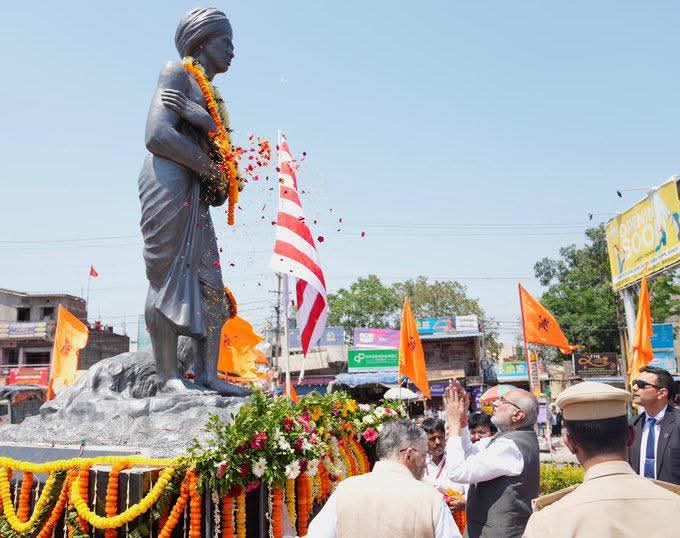
On the birth anniversary of Bhagwan Birsa Munda, merely garlanding his statue or organising commemorative events is not enough. His ideas must find expression in public policy and social practice. His struggle was never about setting one community against another. It was a fight for human dignity and rights against exploitation, injustice and oppression.
At a time when India aspires to achieve higher economic growth and emerge as a global power, Birsa's Ulgulan poses a fundamental question: development for whom, and at whose cost? Are the voices of people whose land, forests and water sources are being used for development projects genuinely being heard? Have Gram Sabhas been given meaningful authority? Are displaced families receiving a dignified life and sustainable livelihood opportunities?
Ulihatu is more than the name of a village. It represents a historical consciousness that transformed a young man born into an ordinary family into a symbol of self-respect for millions. Similarly, Ulgulan is not merely an event in history; it is a continuing message to remain vigilant against injustice. The creation of Jharkhand was a historic step towards fulfilling that vision, but the dream belongs not to Jharkhand alone. It belongs to communities across India struggling to protect their land, forests, culture and livelihoods.
The day tribal families in every part of the country can live without the fear of being dispossessed of their ancestral land, the voices of Gram Sabhas are respected and the benefits of natural resources are shared fairly with local communities will mark genuine progress towards fulfilling Birsa Munda's vision of Ulgulan.
That would be the most meaningful tribute to Dharti Aaba.






[[comment.comment_text]]