Compulsory National Service: Towards a More Prepared and Responsible India

 an hour ago
Every generation redefines its obligations towards the nation in keeping with the demands of its time. For one generation, national duty meant fighting for independence; for another, it meant building a newly established republic. Today, India stands at a juncture where traditional military challenges are being compounded by emerging threats such as terrorism, cyber warfare, drones, artificial intelligence and information warfare, all of which are transforming the very meaning of national security.
In this context, an important question naturally arises: Should India introduce compulsory military service for its youth?
The question may appear straightforward, but the answer is far more complex.
One of the most compelling arguments in favour of compulsory military service is that, in a vast and strategically important country like India, an understanding of national security should not remain confined to soldiers deployed along its borders. It is equally important to cultivate discipline, crisis-response capabilities and a sense of collective national responsibility among citizens.
Military training can instil discipline, leadership, teamwork and the ability to function under difficult circumstances. But is it necessary to turn every young person into a soldier to achieve these objectives?
National Security: Preparedness Beyond the Borders
Modern warfare is no longer simply a contest involving the number of soldiers and weapons. A cyberattack on a country’s electricity infrastructure, an assault on critical digital networks, the targeting of strategic installations through drones, or the collapse of administrative systems during a natural disaster can all pose serious threats to national security.
In such circumstances, a nation needs not merely more soldiers but trained citizens who can contribute effectively whenever the need arises.
A well-structured national service system could train young people in first aid, disaster management, civil defence, cyber awareness, emergency assistance and community service. The objective should not be to turn every citizen into a soldier, but to ensure that every citizen can make a meaningful contribution when the nation needs them.
More uniforms do not necessarily translate into greater security.
India’s armed forces are professional, highly trained and technologically capable institutions. Modern military establishments do not merely require large numbers of personnel; they require specialised expertise.
Engineers, pilots, cyber specialists, intelligence officers, technicians, medical professionals and trained personnel capable of operating advanced weapons systems play an increasingly important role in modern warfare. In this context, training millions of young people for a limited period would not necessarily translate into a corresponding enhancement of military capabilities. Such an initiative would require substantial financial resources, training institutions, infrastructure and qualified instructors.
The question, therefore, should not be how many more people can be made to wear a uniform. The real question is how India can develop its national capabilities to meet the challenges of an evolving security environment.
The Time of Young People: A National Resource and an Individual Future
The age of 18 or 20 is a formative period in a young person’s life. One or two years at this stage can significantly influence an individual’s future. Opportunities for higher education, employment, professional training and career development often emerge during this crucial phase.
If military service is made compulsory without providing a broad range of alternatives, its consequences may not be equally distributed across social and economic groups. For economically weaker families, even a brief interruption in education or employment opportunities can have long-term consequences. A policy intended to promote equality and national unity could, if inadequately designed, inadvertently create another source of inequality.
Agnipath Has Opened the Door to a New Debate
The Agnipath scheme has introduced the idea that military service need not necessarily be a lifelong career. Even a short period of military service can provide valuable experience, discipline, training and a sense of national responsibility.
However, it also raises a larger question: if the objective is to develop discipline, preparedness and civic responsibility among young people, should these experiences be confined exclusively to military service?
India should perhaps consider a broader national service model in which military service is only one of several options.
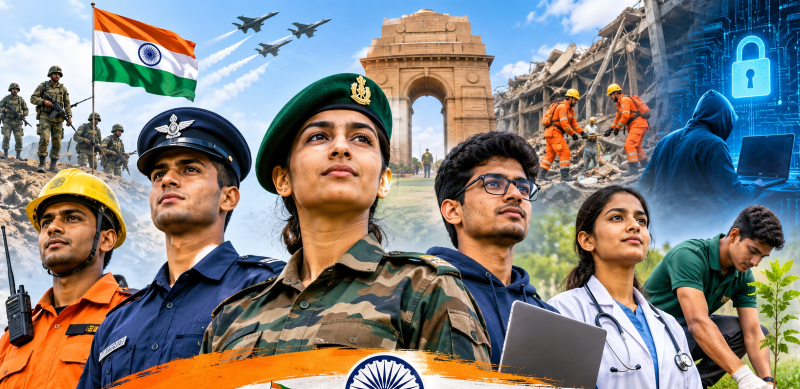
Young people could contribute in different fields according to their abilities, interests and the needs of the nation, including:
The armed forces and territorial support services
Disaster management and civil defence
Cybersecurity and technical services
Healthcare and emergency assistance
Environmental conservation
Services related to critical infrastructure
Community development and public service
A soldier deployed at the border and a cybersecurity specialist protecting a critical digital network may perform entirely different functions, but both ultimately serve the same national interest.
Balancing Individual Freedom with Civic Responsibility
Nevertheless, the question of national service cannot be viewed solely through the prism of nationalism or discipline. India is a constitutional democracy in which individual liberty holds a special significance.
The state can expect citizens to contribute, particularly during national emergencies. However, no broad obligation should be imposed without due consideration of individual freedoms and personal circumstances.
If India considers introducing any form of national service in the future, it must be supported by a clear legal framework, transparent exemption provisions, reasonable duration, alternative civilian service options and adequate safeguards against arbitrary administrative decisions.
National service should not become a test of patriotism. A citizen who does not wear a uniform is not any less patriotic. A teacher serves the nation, as does a doctor, a disaster-relief worker, a scientist, a farmer and a public servant.
The strength of India’s democracy lies precisely in this diversity of contributions.
India’s Real Strength: Service-Minded and Responsible Citizens
Perhaps the real challenge before India is not the absence of compulsory military service, but whether we have succeeded in developing a strong culture of public service and national responsibility.
India has millions of young people, endowed with energy, talent and potential. What is needed is an institutional framework that does not confine this potential merely to individual advancement but also enables young people to contribute to the larger national interest whenever required.
The armed forces must remain adequately trained, technologically equipped and professionally oriented. At the same time, trained volunteer or reserve groups can be developed within civilian institutions to provide immediate assistance during natural disasters, public health emergencies, cyber crises and other national challenges.
National service should be developed not as an obstacle to education or employment, but as an opportunity for acquiring skills, gaining experience and strengthening civic consciousness.
Conclusion: A Culture of Service, Not Militarisation
The question before India is not merely whether compulsory military service should be introduced. The more fundamental question is what kind of national service framework India needs in the twenty-first century.
India may not need millions of young people who wear a uniform for a limited period and then return to their individual pursuits. What it needs are citizens prepared to step forward in times of crisis, professionals who understand that national security extends far beyond geographical borders, and young people who recognise their responsibilities alongside their rights.
A strong nation is not measured solely by the size of its armed forces. Its true strength is also reflected in the readiness with which its citizens stand up for the country when circumstances demand it.
India may not need compulsory military service. But it certainly needs a strong national culture of service.
Ultimately, the objective should not be to create a nation of soldiers, but a nation of citizens who are prepared to serve whenever the need arises.
The question is not how far India can militarise its youth. The real question is how effectively it can inspire them to contribute to a national purpose larger than themselves.
(The interviewer, an NGO leader, is the Special Representative of TEW.)






[[comment.comment_text]]