From Daycare to Algebra: A Comparative Study of the American and Indian Education Systems

 1 month, 4 weeks ago
“A Grandparent’s Perspective on Inclusivity, Holistic Assessment, and the Contrast Between US and Indian Learning Models”
As a grandparent, I have been blessed with the unique opportunity to witness the educational journeys of two of my grandchildren across two completely different continents. Between 2013 and 2026, I spent nearly every year staying with my son’s family in the United States, closely observing my grandson’s growth from a one-year-old toddler to a seventh grader. Concurrently, back home in India, I watched my granddaughter progress through her entire schooling timeline—from Lower Kindergarten (LKG) all the way to her Secondary School Leaving Certificate (SSLC) this very year—at a prominent, highly disciplined private academy in Karnataka.
This parallel decade of observation provided me with a profound, front-row seat to a comparative study of the American public/private school framework and the traditional Indian schooling system. While both systems ultimately aim to produce successful adults, they diverge fundamentally in their philosophies of early childhood development, classroom environment, assessment structures, and the ultimate impact they leave on family and human relationships.
Phase 1: Infancy, Early Socialization, and the Kindergarten Threshold
The contrast between the two systems is visible from the very first year of a child's life. In 2013, at just one year old, my grandson in the United States began attending a licensed daycare for about seven hours a day so that both of his parents could go to work. Coming from an Indian background, where infants are almost universally looked after by mothers, grandparents, or extended family members at home, this felt like a sharp cultural and emotional shock.
However, I quickly observed how American infrastructure uses technology to bridge this emotional gap. The daycare facility was equipped with secure, live CCTV cameras. This allowed his mother to log in from her workplace, stay emotionally connected, and monitor his well-being in real-time. This dynamic fosters early independence in the child, though it strips away the immediate multi-generational warmth traditional to Indian households.
By contrast, my granddaughter’s educational journey in India skipped institutional daycare entirely, remaining wrapped in family care until she reached the age-appropriate threshold for Lower Kindergarten (LKG). The local schooling system does not typically cater to infants; instead, it expects the family unit to provide the emotional and foundational grounding before formal schooling begins. When she did enter LKG, the focus shifted rapidly toward structure. While the American toddler was still navigating unstructured play, the Indian private academy immediately initiated a disciplined routine, introducing the uniform, set school timings, and the concept of a collective classroom identity from day one.
Phase 2: Developing Motor Skills vs. Early Academic Discipline (Age 3 to 5)
By his third year, my grandson entered an American preschool. What struck me most was the absolute absence of academic pressure. The curriculum did not demand that he memorize the alphabet or write sentences. Instead, the focus was entirely on foundational motor skills, tactile coordination, and creative expression. I watched him spend hours learning how to hold pencils correctly through freehand drawing, paint with his fingers, and safely use plastic scissors to cut complex shapes out of colored paper. The American philosophy dictates that physical and neurological readiness must precede academic expectations.
In stark contrast, my granddaughter’s experience in Upper Kindergarten (UKG) in Karnataka was highly structured and academically ambitious. From the age of four, she was already being trained in formal writing, phonics, and basic arithmetic. The Indian system operates on the belief that early academic drilling builds a strong cognitive foundation. While my grandson was mastering the physical mechanics of cutting paper, my granddaughter was mastering the cognitive mechanics of copying letters from a blackboard, memorizing rhymes, and solving basic number sequences. This early divergence highlights a core difference: the US system prioritizes physical coordination and individual creativity, while the Indian system prioritizes mental discipline and early literacy.
Phase 3: The Classroom Environment—Teacher-Student Ratios and Inclusivity
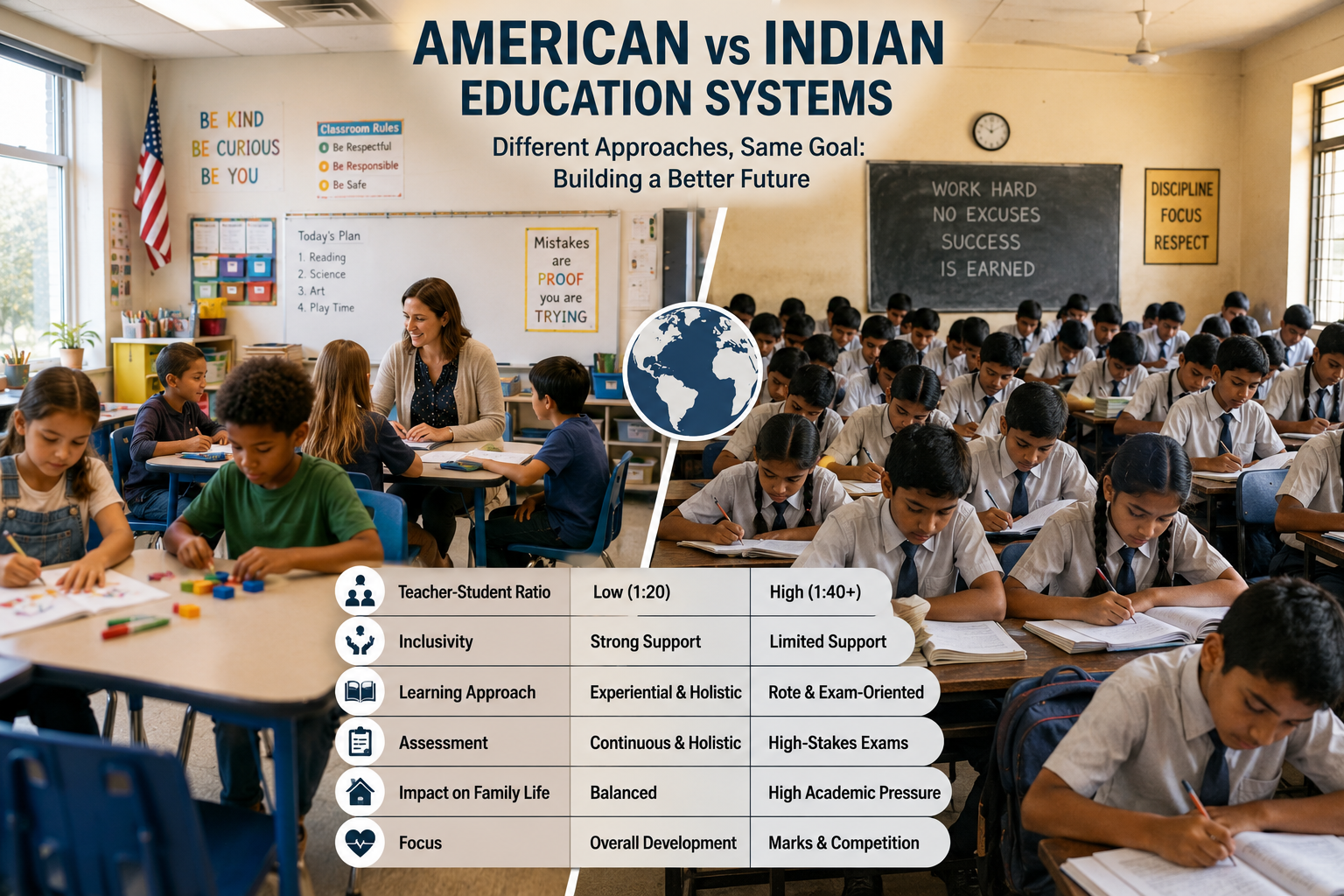
Upon turning six, my grandson entered the first standard (First Grade) at a local public municipal school, where he studied until the fourth standard. During these formative elementary years, I observed two remarkable features of the American classroom environment that stand in sharp contrast to the Indian reality:
• Low Teacher-Student Ratio:
The American public school maintained a strict, legally mandated ratio of 1 teacher to every 20 children. This low ratio meant that the educator could observe the distinct behavioral and academic nuances of every single child, providing personalized attention without burning out.
• Inclusive Education: More profoundly, I observed that children with developmental and mental challenges, such as autism, were not segregated into special schools. Instead, they sat in the exact same classroom alongside my grandson. These special-needs children were provided with dedicated, trained special-care educators who sat with them to assist with their specific needs, while the main teacher conducted the class.
This inclusive model had a beautiful side effect on human relationships. It taught my grandson and his peers deep empathy, patience, and acceptance of human differences from a very tender age. They did not view autism as a stigma; they viewed it merely as another way of being.
Meanwhile, back in India, my granddaughter’s classroom environment reflected the high-density reality of the domestic education system. Class sizes routinely crossed 40 to 50 students per teacher. Managing such a large group requires an authoritative teaching style, where silence and obedience are prioritized over individual dialogue.
Furthermore, the concept of mainstream inclusivity for neurodivergent children is largely absent in traditional institutions. Children with severe learning disabilities or autism are often directed to specialized institutions, separating them from mainstream society. While this allows the teacher to maintain a rapid academic pace for the rest of the class, it deprives neurotypical children of the daily opportunity to practice real-world empathy and integrate with differently-abled peers.
Phase 4: Assessment Philosophies—Holistic Progress vs. High-Stakes Exams
The divergence in how a child’s mind is evaluated represents perhaps the widest chasm between the two nations. Up until the fourth grade in the United States, my grandson faced absolutely no independent, stressful academic assessments, rankings, or formal report cards with marks. The school fiercely protected the children from the psychological burden of failure.
When he transitioned to a private school in the fifth standard, formal evaluations finally began—but they looked nothing like traditional examinations. Instead of a single high-stakes written test, each subject teacher assessed his development holistically over several months. They graded his ability to communicate ideas clearly, his organizational skills, his interpersonal relationships with other classmates, his critical thinking capacity, and his independent decision-making skills.
Furthermore, this private school enforced a 'Zero Homework' policy. After school hours, his time belonged to his childhood. The curriculum focused on reading independence; he was encouraged to borrow books from the library and write short, personal reflections on them. Learning was deeply experiential, characterized by frequent outdoor visits to zoos, aquariums, botanical gardens, and public parks. The world was his classroom.
My granddaughter’s reality during her journey toward her SSLC was the polar opposite. From the elementary standards onward, her academic life was defined by a rigorous cycle of unit tests, terminal examinations, and annual finals. In the Indian context, a student's worth and intelligence are heavily tied to numerical percentages and class ranks.
Her evenings were rarely free. The heavy burden of daily homework required hours of sitting at a desk after an already exhausting school day, leaving little time for unorganized outdoor play. Reading was strictly bound to the prescribed textbooks and syllabi; reading outside the curriculum was often viewed as a distraction from exam preparation. Experiential learning visits were rare, treated as annual picnics rather than core educational tools. The focus was relentlessly quantitative, training her to memorize vast amounts of data to reproduce perfectly on an exam sheet.
Phase 5: The Middle School Pivot—Academic Tracking vs. The SSLC Crucible
By the time my grandson reached the seventh grade, the American system pivoted from experiential play to serious, data-driven academic tracking. For the first time, he underwent standardized, independent assessments specifically for English Language Arts (ELA) and Algebra 1.
Based on these results, the school utilized a system of four performance compartments or proficiency bands: Below Basic, Basic, Proficient, and Advanced. My grandson was categorized based on his specific aptitude, allowing the school to place him in an accelerated track for algebra while ensuring that students in other compartments received tailored, slower-paced support. This system recognizes that children develop at different speeds in different subjects.
This very year, my granddaughter reached the grand finale of her school life: the Secondary School Leaving Certificate (SSLC) board examinations. In India, the SSLC is not just an assessment; it is a high-stakes societal crucible. There are no customized proficiency bands or separate tracks for different learning speeds. Every single student, regardless of their individual cognitive strengths or weaknesses, must sit for the exact same standardized board exams across math, science, languages, and social studies.
The pressure surrounding this milestone has been monumental, transforming the entire household. The focus is entirely on securing high percentages to guarantee admission into premium pre-university colleges. It is an all-or-nothing system that rewards high-end endurance, memory, and academic discipline under pressure.
Conclusion: A Lasting Impact on Family, Society, and Human Relationships
Having stepped back to analyze this decade-long comparative study, I see clearly how these two educational philosophies carve vastly different human paths.
The American system, with its low teacher-student ratios, early focus on motor skills, lack of homework, and mainstream integration of special-needs children, excels at building a well-rounded, emotionally secure, and empathetic individual. It delays academic stress to preserve childhood, fostering a love for independent thinking and reading. However, its focus on individual autonomy can sometimes weaken extended family dependencies, as the system teaches the child to rely primarily on themselves and institutional structures.
The Indian system, as exemplified by my granddaughter’s disciplined journey in Karnataka, produces individuals with unparalleled academic resilience, exceptional mathematical and analytical foundations, and an extraordinary capacity for hard work under intense pressure. The rigor of preparing for the SSLC builds a deep sense of psychological endurance.
Furthermore, because the school system does not provide an all-encompassing emotional safety net, the Indian family unit remains tightly knit. Parents, grandparents, and children must band together to survive the academic pressure, reinforcing deep, lifelong inter-generational family relationships. Yet, this comes at the heavy cost of immense mental stress, a lack of creative freedom, and a systemic neglect of holistic skills like emotional communication and social inclusivity.
As a grandparent who loves both grandchildren equally, I believe the ideal path forward lies in a harmonious marriage of both worlds. The Indian education system must learn to lower its classroom sizes, de-stigmatize and integrate special-needs children, and shift its evaluation metrics from rote memorization to holistic, qualitative assessment. By taking a leaf out of the American book and reducing the unnecessary burden of early childhood homework and high-stakes testing, Indian schools can protect the mental well-being of our youth. Only then can we raise a future generation that possesses both the formidable intellectual discipline of India and the empathetic, innovative, and freethinking spirit of America.
(The author, a former Deputy Conservator of Forests in Karnataka, is a well-recognised commentator on environment, education, and governance issues.)




[[comment.comment_text]]