Israel’s Election: No Clear Mandate, No Easy Way Out

 2 weeks, 6 days ago
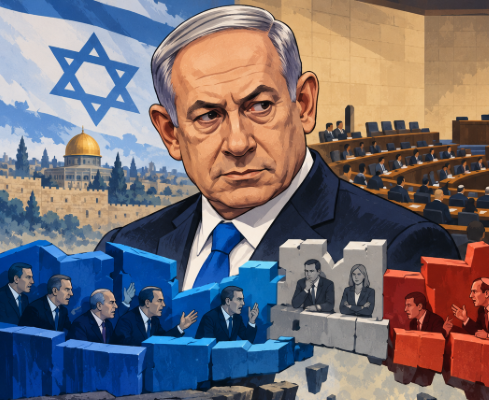
Israel’s latest parliamentary election has delivered a familiar but consequential verdict: a fractured electorate, competing political ambitions and no clear path to a stable government. Prime Minister Benjamin Netanyahu’s Likud emerged as the largest party, outperforming several pre-election projections, but failed to secure the decisive mandate he sought. His principal rival, Gadi Eisenkot, has likewise been denied an unambiguous victory. The outcome underscores a central reality of Israeli politics: electoral strength does not automatically translate into governing authority. With 61 seats required for a majority in the 120-member Knesset, the country once again faces the difficult arithmetic of coalition-building.
The most significant development, however, may be the historic mobilisation of voters supporting Arab parties. Their increased parliamentary representation has strengthened their potential influence over the formation of the next government. For the anti-Netanyahu opposition, cooperation with the Joint List and Raam could provide a viable route to a majority. Yet such an arrangement would involve considerable political risks. Eisenkot has emphasised Israel’s Jewish character and the need to defeat Hamas, positions that could complicate cooperation with Arab political formations. Excluding Arab parties from the cabinet while relying on their parliamentary support for a minority government is another possibility, but such an arrangement could prove fragile. The election has therefore highlighted both the growing electoral significance of Arab citizens and the persistent political barriers to their participation in national governance.
A unity government bringing together Likud, Eisenkot’s Yashar, the Bennett-Lapid alliance Together, and Avigdor Liberman’s Yisrael Beiteinu could offer an alternative. Preliminary results suggest that such a combination could command 66 seats, comfortably above the majority threshold. Yet numerical strength does not guarantee political durability. Eisenkot campaigned on the need to remove Netanyahu from office, while Netanyahu has little incentive to surrender power to a rival who has questioned his fitness to lead. Their differences extend beyond personalities to questions of national security, political accountability and the distribution of authority. A unity government could prevent another election, but without a minimum shared programme, it might merely postpone the next crisis.
Political defections offer a third route. Individual lawmakers or smaller parties could switch sides, allowing either camp to assemble a governing majority. Netanyahu might seek to attract members of the opposition, while Eisenkot could explore cooperation with ultra-Orthodox parties that have traditionally supported the Likud leader. Such manoeuvres are not unfamiliar in Israel’s parliamentary system, but they carry the danger of placing political survival above policy coherence. Disputes over military-service exemptions for ultra-Orthodox men, national security and the future direction of the country would remain formidable obstacles. Israel’s experience of repeated elections between 2019 and 2022 demonstrated how quickly fragile alliances can collapse. A government assembled through tactical defections rather than a credible common agenda could leave the country trapped in another cycle of instability.
The larger lesson is that Israel needs more than a prime minister capable of assembling 61 votes; it needs a government able to govern effectively amid deep social and political divisions. Neither Netanyahu nor Eisenkot has secured the decisive mandate that would allow him to dictate terms. The coming negotiations must therefore test the willingness of political leaders to compromise without abandoning essential principles. Arab representation, the relationship between religion and state, military obligations and the conduct of the war against Hamas will all shape the coalition’s prospects. If party leaders treat the election merely as a contest for office, another trip to the polls may become inevitable. If they recognise the electorate’s divided verdict as a demand for accommodation and accountability, the present impasse could offer an opportunity to build a more durable political settlement. Israel’s immediate challenge is not simply to choose a prime minister, but to find a workable basis for governing.




[[comment.comment_text]]