Contesting the Past: The Shift in India’s History Textbooks

 3 weeks ago
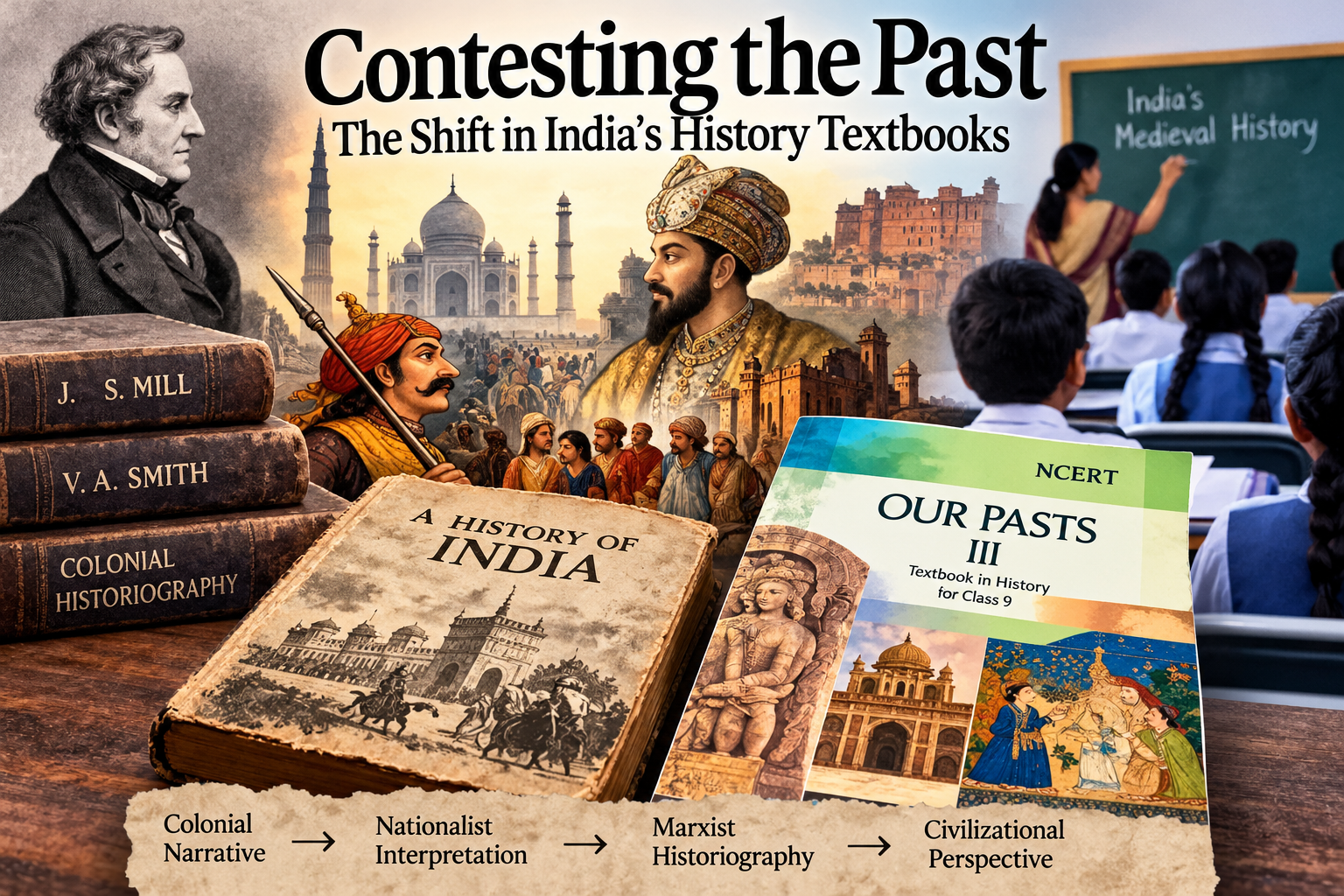
The recent updates to NCERT’s Class 9 history textbook mark a profound shift in how India frames its medieval past. By recasting medieval history around local kings resisting “foreign invaders” rather than highlighting the composite culture and alliances formed under Mughal rule, the new curriculum reflects an evolving ideological lens. This change highlights a fundamental truth: history writing in India has rarely been a neutral recording of facts, but rather an ongoing battle over national identity, political legitimacy, and collective memory.
The roots of this contested history lie in the British colonial period, when imperial historians sought to justify foreign rule. Colonial scholars like James Mill and V.A. Smith periodized Indian history into Hindu, Muslim, and British eras, portraying Indians as intrinsically divided by religion and medieval Muslim rule as inherently autocratic or barbaric. By casting Hindus and Muslims as perpetual adversaries, colonial historiography laid the foundation for the "Divide and Rule" policy, deliberately obscuring shared cultural traditions to present British control as an essential, modernizing force.
In response, leaders and scholars of the Indian freedom movement constructed a nationalist counter-narrative designed to unify a diverse nation. Historians like Tara Chand, alongside political figures like Jawaharlal Nehru and Lala Lajpat Rai, emphasized the emergence of a Ganga-Jamuni tehzeeb—a syncretic, composite culture forged through centuries of co-existence. While acknowledging medieval conflicts, nationalist history framed Muslim rulers who settled in India as native sovereigns rather than foreign colonizers, positioning Hindus and Muslims as co-travellers in the creation of modern India.
The post-independence era saw this narrative further refined through Marxist and Left-leaning historiography, which gained institutional prominence from the 1970s onward. Marxist historians focused on economic structures and social class rather than religious dogma, framing medieval royal policies through the lens of pragmatic statecraft. However, while scholars applied a rigorous, critical gaze to ancient Hindu traditions and social hierarchies, critics argued that a similar critical scrutiny was rarely applied to medieval Islamic institutions, fostering accusations of ideological bias and political patronage.
The current revision of school textbooks represents the latest phase in this long-standing historiographical tug-of-war. Driven by the rise of Hindutva political thought, the contemporary focus shifts toward civilizational continuity and resistance against external conquest. As educational curricula adapt to mirror shifting political power, the debate over NCERT textbooks serves as a reminder that the interpretation of the past remains one of the most powerful tools for shaping a nation's vision of its future.









[[comment.comment_text]]