The Kashmir the Cameras Don’t Show
 2 months, 2 weeks ago
Every year, around the anniversary of the 2019 constitutional changes, a familiar ritual plays out across Jammu and Kashmir. Party offices issue statements. Leaders pose for cameras with folded arms and firm expressions. Old slogans are dusted off — restoration of Article 370, Article 35A, full statehood — and repeated with practiced conviction, as though the passage of another year has only sharpened their urgency.
And every year, the streets tell a different story.
Shops open on schedule. Farmers are in their fields. Government offices function. Students head to school, and young graduates continue the harder, quieter struggle of hunting for jobs in a market that still doesn’t offer enough of them. There is no crowd behind the podiums. The people the parties claim to speak for are, for the most part, simply living their lives — going to work, running errands, worrying about rent, school fees, and the price of vegetables, not constitutional clauses.
That gap between rhetoric and reality is worth sitting with. It is not a small or accidental gap. It has been growing for years, and it says something important about the distance between Kashmir’s political class and the people in whose name it claims to speak.
A Vocabulary That Keeps Changing, Faces That Don’t
Kashmir’s mainstream political class has proven remarkably adaptable — not in policy outcomes, but in language. Self-determination gave way to autonomy. Autonomy gave way to the restoration of special status. Today the dominant demand is statehood. The vocabulary shifts with the political weather; the people making the demands rarely do.
Look closely at the last three decades of Kashmiri electoral politics and a pattern emerges. The same handful of families and factions have occupied the political centre of gravity across multiple constitutional eras — before 1989, through the years of militancy, through the post-2002 period of relative calm, and into the present. Governments have changed hands, coalitions have formed and dissolved, and yet the core cast of characters giving speeches at press conferences has remained strikingly consistent. What has changed is only the demand being voiced at any given moment, calibrated to whatever framing keeps a party relevant to its base and to the national media cycle.
This pattern invites an honest question, not a cynical one: are these shifting positions shaped by what ordinary Kashmiris actually want next, or by what keeps a political career alive through the next election cycle? It is entirely possible — even likely — that genuine grievance and political self-interest are tangled together, that both are real at once. But when the public response to a party’s most passionate calls is a shrug and a return to work, that tangle deserves scrutiny rather than automatic deference.
Democratic politics, in its healthiest form, is supposed to be a feedback loop: leaders read the priorities of the people, translate them into policy demands, and are held accountable at the ballot box for how well they deliver. When that loop breaks down — when parties keep repeating demands that fail to mobilise the very public they claim to represent — something in the relationship between representative and represented has come loose.
In Kashmir, that breakdown is visible not just in voter turnout figures or opinion polls, but in the mundane rhythm of daily life. A press conference can draw a handful of party workers and a cluster of microphones; the market outside carries on as if nothing has been said. That dissonance is not new, but it has become harder to ignore.
Who Actually Paid the Price
Whatever one believes about the constitutional questions — and reasonable people, including Kashmiris themselves, hold genuinely different views on them — it is hard to dispute who bore the human cost of decades of confrontation politics: not the leaders, but the led.
Children lost school years to shutdowns called in their name, sometimes for weeks or months at a stretch. An entire generation of Kashmiri students grew up sitting for board exams after truncated academic calendars, catching up on syllabi compressed into a fraction of the normal teaching time. Ask any parent in the valley about the anxiety of watching a child’s education repeatedly interrupted by strikes and curfews they had no say in calling, and you will hear the same exhaustion, election after election, decade after decade.
The educational disruption was not merely about missed classes. It was about lost momentum. A student who misses two months of school during a critical exam year does not simply “catch up” when schools reopen. Teachers rush through portions, parents hire tutors they can barely afford, and children internalise the idea that their education is expendable in the face of political imperatives. Over time, this erodes not just learning outcomes but aspiration itself.
Shopkeepers and tradespeople watched inventory rot and debts pile up during hartals and shutdowns. A trader who had stocked goods for the wedding season, or a fruit merchant with a truckload of perishable produce, did not have the luxury of waiting out a political statement. Small and medium businesses — the backbone of Kashmir’s urban economy — folded, one after another, not because they lacked demand or skill, but because they could not survive the unpredictability of a closed-shutter economy.
The mathematics of a shutdown are brutal. Rent does not stop accumulating because a bandh has been called. Electricity bills do not pause. Loan EMIs do not wait for the political calendar to clear. A shop that remains shut for ten days in a month must somehow make up for that lost revenue in the remaining twenty — in an economy already operating on thin margins. Over years, this compounding uncertainty drains resilience. Many businesses do not fold in a single dramatic collapse; they simply wither, season after season, until one day the shutters stay down for good.
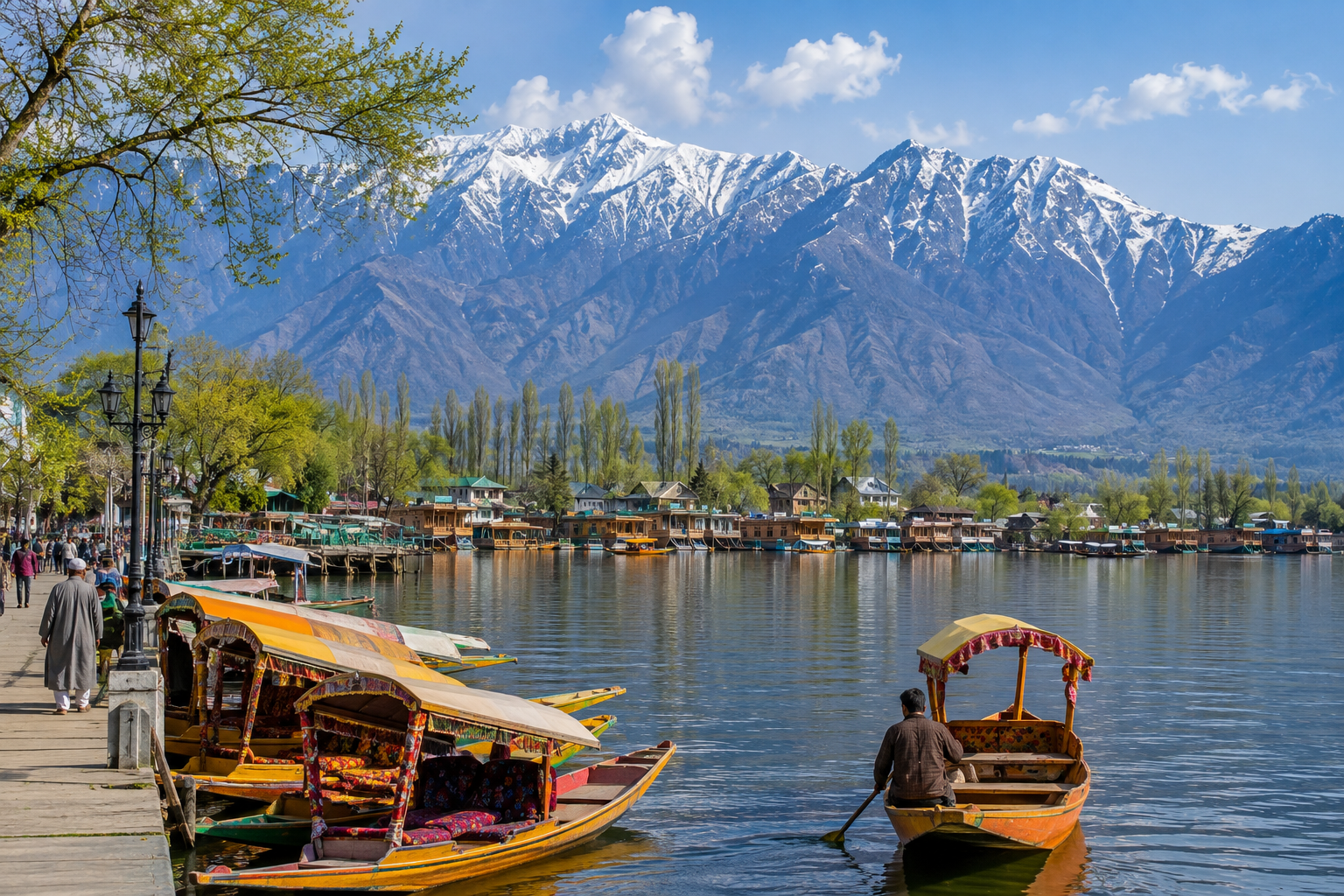
Tourism operators — running an industry that feeds hundreds of thousands of livelihoods, from houseboat owners on Dal Lake to shikara operators, hoteliers, taxi drivers, and handicraft artisans — learned over the years to build their business plans around the assumption of the next disruption, not despite it. Every cycle of unrest sent a shockwave through bookings, cancellations, and lost seasons that took years to recover from. Families who had put their savings into guesthouses or transport vehicles watched those investments sit idle while political leaders issued statements about identity and sovereignty from the comfort of secure, well-guarded residences.
Tourism is not just a sector in Kashmir; it is a lifeline. A bad season does not only affect hotel owners; it ripples through florists, caterers, ponywalas in Gulmarg and Pahalgam, souvenir sellers, photographers, and countless informal workers whose income depends on the flow of visitors. When a family has mortgaged land to build a guesthouse, a string of cancelled bookings is not an inconvenience; it is an existential threat.
Investment stayed shy of a region that needed it most. Industrial estates meant to generate employment have historically struggled to attract sustained private capital, in no small part because instability — real or anticipated — raises the risk premium on any investment in the valley. An unemployment crisis among a well-educated generation was left to simmer, year after year, while the political conversation stayed fixed on constitutional status rather than classrooms, factories, vocational training centres, and job fairs.
Young Kashmiris with engineering degrees, MBBS qualifications, or MBA certificates found themselves in a paradox: too qualified for low-skill work, yet with no ecosystem to absorb their skills locally. The result has been a slow, steady outflow of talent — nurses to Delhi, engineers to Bangalore, teachers to Chandigarh — and a valley that increasingly depends on government jobs as the only stable employment option. That is not a healthy economy; it is a waiting room.
Meanwhile, many of the leaders who called for sacrifice in the name of Kashmiri identity moved with relative ease between houses, protections, and positions — repositioning for the next phase of the same argument, rarely bearing the costs they asked others to bear.
The Silent Majority That Chooses to Build, Not Protest
There is a quiet form of protest in Kashmir today that rarely makes headlines: the protest of ordinary people who simply refuse to let political theatre dictate the rhythm of their lives.
Walk through Lal Chowk, through the markets of Anantnag or Baramulla, through the orchards of Sopore and Shopian during apple season, and what you find is not indifference to Kashmir’s future but a different theory of how to secure it. Farmers tending saffron fields in Pampore or apple orchards across South Kashmir are not thinking primarily about Article 370; they are thinking about irrigation, cold storage facilities, fair prices at the mandi, and access to markets outside the valley. Young entrepreneurs setting up small IT firms, e-commerce ventures, or food-processing units in Srinagar’s business hubs are not waiting for a constitutional resolution before building their futures — they are building anyway, often against considerable odds.
This shift is not apathy. It is a recalibration of priorities born from lived experience. A generation that grew up amid repeated shutdowns, curfews, and disrupted school years has developed its own hard-won wisdom: that dignity and progress are not always won through confrontation, and that a stable job, a functioning market, and a predictable school calendar do more for a family’s wellbeing than another round of slogans that have been chanted, in one form or another, for thirty years without producing the promised outcome.
Consider the apple farmer in Sopore who wakes before dawn to check weather forecasts, not political statements. His concern is not the wording of a constitutional article but whether the cold chain will hold, whether the highway will be open, whether the commission agent at the mandi will offer a fair rate. Or the young woman in Srinagar who has completed a B.Tech and now runs a small digital marketing firm from a rented office near Residency Road. Her focus is on client acquisition, cash flow, and hiring the next intern — not on whether a particular party wins the next assembly election.
These are not isolated stories. They are part of a broader, quieter reorientation in the valley. It is visible in the number of new cafes and co-working spaces in Srinagar, in the growing cohort of Kashmiri content creators and freelancers working for clients in Mumbai and Gurugram, in the families who have quietly shifted their savings from land to education and small business ventures. None of this is dramatic. None of it fits neatly into a protest narrative. But it is real, and it is consequential.
None of this means Kashmiris have stopped caring about their political future, their rights, or their dignity — that would be an unfair caricature. It means many have stopped believing that repeating the same demands, year after year, without a credible plan for translating them into tangible change, is the path to a better life for their children.
What “Development” Actually Looks Like on the Ground
What seems to matter more, on an ordinary Tuesday in Srinagar or Baramulla or Anantnag, is whether the market is open, whether the road to the next town is paved and maintained through the winter, whether a daughter can finish her degree without losing a semester to unrest, whether a small business can get a loan without navigating a maze of bureaucracy, whether tourists will come this season and fill the houseboats and hotels that families have poured their savings into, and whether a young engineer or nurse can find work in the valley rather than migrating out for it.
These are unglamorous, unslogan-able concerns. They don’t fill front pages or trend on social media the way a fiery speech about restoration of special status does. But they fill lives. They determine whether a family eats well this month, whether a child stays in school, whether a young couple can afford to start a household in the town where they grew up rather than moving to Delhi or Bangalore in search of opportunity.
Kashmir’s economy has genuine, well-documented needs: better connectivity and highway infrastructure to reduce the valley’s seasonal isolation, expanded cold-chain and food-processing capacity to let farmers capture more value from their orchards and saffron fields, greater private investment in manufacturing and services to create jobs beyond government employment and tourism, expanded vocational and higher-education opportunities that keep pace with a young, well-educated population, and sustained peace and predictability — the single ingredient that underlies almost everything else on this list, because no investor, tourist, or entrepreneur commits capital to a place they cannot predict.
The infrastructure deficit is not abstract. It is the difference between an apple reaching a Delhi market in good condition or arriving bruised and discounted. It is the difference between a student in Kupwara being able to commute to a college in Srinagar without losing half the day to a treacherous road, and one who drops out because the journey is too costly and unreliable. It is the difference between a small manufacturer who can reliably ship goods to other states and one who remains confined to a local market too small to sustain growth.
Tourism, too, needs more than slogans. It needs predictable security, clean public spaces, reliable transport, and a narrative that goes beyond “conflict zone.” Every time a viral video shows a peaceful shikara ride on Dal Lake or a family enjoying snow in Gulmarg, it does more for bookings than a dozen political statements. But such images thrive only in an environment where disruption is the exception, not the expectation.
None of these needs are met by a press statement demanding restoration of a constitutional provision. They are met by roads built, factories opened, loans disbursed, courses taught, and seasons of uninterrupted business allowed to run their course.
The Democratic Question Worth Asking
A political class that keeps demanding sacrifice from a public that keeps declining to make it is not being defied out of apathy. It is being quietly told something. Democratic representation is supposed to run in one direction — from the people’s priorities to their leaders’ platforms — not the reverse, where leaders decide the priorities and expect the people to fall in line behind them.
This is not to say Kashmir’s mainstream parties are irrelevant or that the constitutional questions they raise carry no weight for anyone in the valley. Some Kashmiris do share those concerns deeply, and it would be dishonest to suggest the political grievances animating these parties are manufactured out of nothing. Decades of complicated history, competing claims, and unresolved questions about representation and identity are real, and they matter to real people. But representing a real grievance faithfully is different from using it as a permanent, unchanging campaign platform regardless of what the public is actually prioritising at any given moment.
There is also a generational dimension here. Older Kashmiris who lived through the most intense years of militancy may still view politics through the prism of identity and constitutional status. Younger Kashmiris, who came of age in a more connected, digital, and economically anxious era, often view politics through the prism of jobs, education, and mobility. This does not mean the younger generation is less Kashmiri or less concerned about rights; it means their hierarchy of priorities has shifted in response to lived reality.
If Kashmir’s mainstream parties want to close the distance between the podium and the pavement, the way to do it may not be a sharper slogan or a more strongly worded press release. It may be an honest inventory, conducted openly and without spin: how many of the last decade’s promises translated into a school built, a job created, a business financed, a highway completed, a hospital equipped — and how many translated only into another press conference, another anniversary statement, another photograph of leaders standing together on a road that the public, this year again, largely chose not to walk down with them.
A Generation Choosing a Different Path Forward
Perhaps the most telling image of Kashmir today is not the one captured at a party press conference, but the one that goes largely undocumented: a shopkeeper raising his shutters at the usual hour, a student cycling to tuition classes, a fruit vendor arranging his cart, a young woman heading to her shift at a call centre or a bank branch, a contractor supervising a road crew, a nurse starting her rounds at a hospital. These are not dramatic images. They will not lead a news bulletin. But together, repeated across tens of thousands of households every single day, they represent the real referendum Kashmiris are conducting — not through a ballot on constitutional status, but through the accumulated weight of their daily choices about how to spend their time, their energy, and their hope.
That referendum, quietly repeated year after year, delivers a consistent verdict: the people of Kashmir want to be part of a developing, connected, opportunity-filled future. They want their children educated without interruption. They want their businesses to run without fear of the next shutdown. They want the same chance at prosperity that young people in Pune, Bangalore, or Gurugram take for granted. Political slogans, however sincerely felt by those who chant them, cannot substitute for that future. Only sustained, honest, accountable governance can build it — and Kashmir’s political class, mainstream and otherwise, would do well to notice which script the people are actually following.
The cameras will continue to focus on press conferences, anniversary statements, and familiar faces repeating familiar lines. But the more important story is unfolding in the quiet accumulation of ordinary days: a semester completed without disruption, a harvest sold at a fair price, a loan repaid on time, a small business that survives long enough to hire its first employee. These are the building blocks of a different Kashmir — one that is being constructed not by speeches, but by choices.

[[comment.comment_text]]