Safeguarding the Democratic Baseline

 an hour ago
The integrity of any democratic election rests fundamentally upon the accuracy of its electoral roll. In India, the Special Intensive Revision (SIR) represents a comprehensive administrative exercise designed to uphold the principle of “one person, one vote.”
Unlike regular summary revisions, which rely primarily on claims and objections to update existing records, an SIR involves proactive verification and the identification of absentee, shifted, deceased and duplicate (ASDD) entries. As demographic shifts, urbanisation and migration accelerate, electoral registers require systematic updating to reflect changing realities.
However, translating this objective into practice in the digital age has exposed a structural conflict between technological rigidity and the complexities of human life. The challenge is to ensure accurate electoral rolls without creating unnecessary barriers to citizens’ constitutional right to vote.
Technical Infrastructure: Centralisation of ERONET and ECINet
In pursuit of data accuracy, the Election Commission of India (ECI) has increasingly relied on integrated digital platforms, including ERONET and ECINet. These systems are intended to facilitate coordination, improve data management and identify possible duplicate registrations across state boundaries.
Automated mechanisms for detecting Demographic Similar Entries (DSE) and Photo Similar Entries (PSE) can help identify records requiring further scrutiny. However, centralisation also presents administrative risks when software-generated alerts begin to influence or constrain decisions that must legally remain with authorised election officials.
By transforming software from a passive repository into an active matching and flagging mechanism, the system risks reducing the discretion of local authorities and Electoral Registration Officers (EROs). Technological uniformity can improve efficiency, but it can also standardise errors on a national scale if its outputs are not subject to adequate human scrutiny.
The Controversy over the 2002 Baseline Mapping
The current revision process has raised concerns about the use of the 2002 electoral roll as a historical reference point. The rationale is that earlier intensive revisions provide a baseline against which existing records can be verified.
Voters appearing in both databases may be classified as “self-mapped”, while younger voters may be linked to their parents through a process commonly described as “progeny mapping”.
Although intended to establish continuity, this approach can create difficulties for citizens whose documentary histories are incomplete. Migrant workers, displaced families, orphans and individuals raised in institutional care may lack the records necessary to establish historical family or geographical links.
A verification system that assumes every citizen has a readily traceable lineage tied to a particular location two decades earlier risks creating disproportionate burdens for vulnerable groups.
The absence of historical ancestral records should not, by itself, be treated as proof of ineligibility. Verification procedures must remain consistent with constitutional guarantees, statutory requirements and the principle of universal adult suffrage. Article 21 protects life and personal liberty, while Article 326 establishes the constitutional framework for elections based on adult suffrage, subject to the qualifications prescribed by law.
Administrative Defects: Misapplication of Statutory Forms
Electoral forms serve distinct statutory purposes and must be used accordingly. Concerns have arisen that software-driven workflows may blur the distinction between new enrolment, deletion, correction and the shifting of existing registrations.
For example, if an existing voter with a valid Electors Photo Identity Card (EPIC) is not matched because of a technical discrepancy, requiring that person to submit Form 6 as a new applicant may create unnecessary procedural difficulties. It could also lead to the loss of historical records or demands for additional documentation.
Similarly, the appropriate mechanisms for correcting entries or shifting registrations may be overlooked if automated workflows do not adequately distinguish between different categories of cases.
Concerns have also been raised about automated deletion flags and the pre-population of objection records or official signatures without adequate human review. Such practices, if established, would raise serious questions about procedural accountability.
Technology should assist statutory decision-making, not displace it. Every proposed deletion or alteration must follow the applicable legal procedure, provide the required opportunity for scrutiny and remain attributable to the authorised official.
Why Deceased Voters Remain on Electoral Rolls
Despite extensive revision exercises, electoral rolls may continue to contain the names of deceased persons. This is not necessarily evidence of inadequate fieldwork; it can also reflect weaknesses in coordination between government databases.
Birth and death registration is administered through state and local institutions, including municipal bodies, gram panchayats and public health authorities. Where these records are not exchanged efficiently with electoral databases, updates may be delayed.
The system may also depend on family members submitting Form 7 to report a death. Such reporting can be delayed because of limited awareness, administrative difficulties or the absence of an immediate incentive.
Booth Level Officers (BLOs) conducting physical verification may encounter locked homes, incomplete information or conflicting accounts from neighbours.
Historical mapping can compound these problems if an old electoral entry is treated as sufficient evidence of current eligibility without an effective check against updated records.
A more reliable approach would combine regular field verification with secure, timely data exchange between civil registration authorities and the ECI, subject to appropriate safeguards for privacy, accuracy and due process.
Civil Society Concerns and Allegations of Demographic Profiling
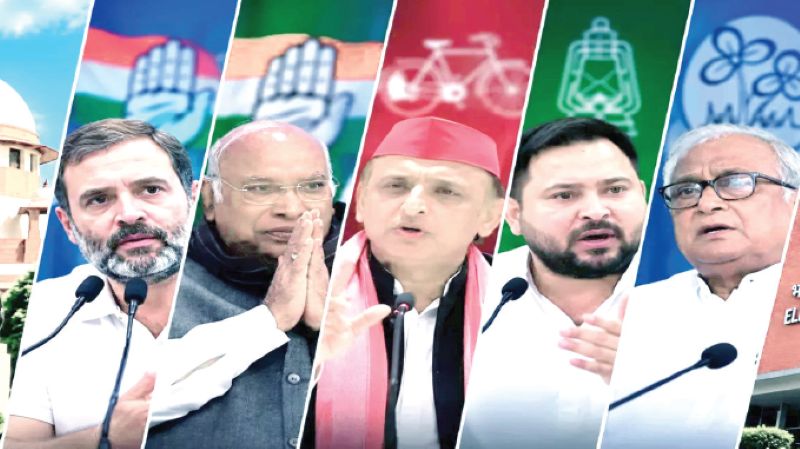
The centralisation of electoral data has prompted concerns among civil society organisations, legal scholars and political parties about the possibility of demographic profiling.
Although electoral rolls do not ordinarily contain dedicated columns identifying a voter’s caste or religion, names, addresses and geographical patterns can potentially be analysed to infer sensitive demographic characteristics.
Onomastic algorithms, which examine names and linguistic patterns, may be used to estimate probable religious or caste affiliations. When combined with information about polling booths, localities and household addresses, such analysis could potentially produce detailed demographic profiles.
Critics have raised the concern that, if such capabilities were used without adequate safeguards, verification procedures might be applied inconsistently across communities or polling areas. Minor spelling variations and gaps in historical records could then be treated as reasons for additional scrutiny.
These concerns require careful examination. The existence of a centralised database does not, by itself, establish that discriminatory profiling has occurred. However, the potential for misuse makes independent technical audits, transparent verification criteria and effective grievance-redress mechanisms essential.
The ECI should ensure that algorithmic systems do not introduce discriminatory outcomes, whether through deliberate design, biased data or unintended technical errors.
Institutional Dissent and Constitutional Accountability
Concerns over the SIR extend beyond civil society and political parties to questions about institutional decision-making within the electoral administration.Reported differences among Election Commissioners over administrative and technological matters raise broader questions about internal deliberation, transparency and the independence of constitutional institutions. Such disagreements should not automatically be dismissed as personal or political disputes; their substantive issues deserve examination.
The constitutional framework under Article 324 vests the superintendence, direction and control of elections in the Election Commission of India. The authority and responsibilities of the Commission must operate within the Constitution and applicable electoral laws. When software configurations influence or constrain the decisions of state election machinery and local Electoral Registration Officers, the distinction between technical assistance and statutory authority becomes critical.
Judicial scrutiny of electoral procedures reinforces the principle that administrative convenience cannot override statutory requirements. Any allegation that software has displaced legally mandated human decision-making must therefore be assessed against the relevant rules, judicial orders and documented administrative practices.A transparent internal mechanism for resolving technical and legal disagreements would strengthen institutional accountability and public confidence.
The Way Forward: A Framework for Electoral Reform
Safeguarding electoral integrity requires a balanced framework that combines technological efficiency with human judgement, statutory compliance and ground-level verification.
Institutionalise a Human-in-the-Loop Architecture
Software should serve as a decision-support tool rather than an autonomous decision-maker.
Automated systems may identify possible duplicate registrations, demographic similarities or inconsistencies across state databases. However, these alerts should trigger verification rather than automatic deletion.
The final decision to include, correct or delete a voter’s name must be taken by an authorised official in accordance with applicable law, after the required verification and procedural safeguards.
Introduce Technical Support at the Constituency Level
The gap between complex digital systems and field-level electoral administration must be addressed. Each Assembly constituency could be provided with a technically qualified data adviser responsible for examining database flags, identifying likely algorithmic errors and preparing targeted verification lists.
BLOs could then use these lists to conduct physical verification and establish the actual circumstances of individual cases. This arrangement would help ensure that technology supports field officials instead of overwhelming them with unfiltered alerts and potentially erroneous records.
Enforce Statutory Form Segregation and Improve Database Integration
The ECI should ensure that digital workflows strictly reflect the legally prescribed purposes of electoral forms.
Form 6: Should be used for new enrolment in accordance with the applicable eligibility and procedural requirements, rather than automatically treating an existing voter whose record cannot be matched as a first-time applicant.
Form 7: Should be processed in accordance with the prescribed procedure for claims and objections, including requests for deletion, with appropriate verification and safeguards.
Form 8: Should be used for the corrections, shifting of residence and other purposes specified under the applicable electoral rules.
The Commission should also strengthen secure data exchange with municipal and panchayat death-registration systems. Timely integration could improve the identification of deceased voters and reduce dependence on delayed individual reporting.
Such integration must incorporate safeguards against mistaken identity, outdated records and wrongful deletion. Data matching should initiate verification, not substitute for it.
Restore Institutional Consensus and Technical-Legal Accountability
The Election Commission should establish a permanent technical-legal review mechanism to examine proposed changes to electoral software and their implications for statutory procedures.
The mechanism could include technical specialists, electoral-law experts and representatives of the relevant administrative authorities.
Its mandate should include reviewing algorithmic changes, documenting known limitations, assessing the risk of wrongful exclusion and ensuring that software updates comply with the applicable legal framework.
Transparent internal deliberation and clear responsibility for technical decisions would help protect the Commission’s institutional credibility.
Prioritise Ground Reality over Statistical Assumptions
Electoral integrity cannot be established solely through statistical analysis or automated database comparisons. Equally, an algorithmic discrepancy should not automatically be interpreted as evidence of fraud or institutional bias.
The ultimate test is whether the electoral roll accurately reflects the eligible electorate on the ground.
Political parties, civil society organisations and election authorities should therefore combine data-based scrutiny with documented field verification, transparent procedures and accessible grievance redress.
India’s electoral system must remain capable of correcting errors without making citizens bear disproportionate burdens for administrative or technological failures. Every eligible citizen whose name has been wrongfully excluded should have a meaningful opportunity to seek correction and restoration in accordance with the law.
The objective of electoral revision must be to improve accuracy while protecting the franchise. A credible electoral roll is not merely a clean database; it is a legally sound, verifiable and inclusive record of the electorate.
Editorial note: The claims concerning automated deletion flags, pre-loaded signatures, internal dissent and judicial findings should be supported by documentary evidence, official records or relevant court orders before publication. The statutory purposes of Forms 6, 7 and 8, as well as references to constitutional provisions, should be checked against the rules and instructions applicable to the particular SIR under discussion.
(Author, a former Deputy Chief Conservator of Forests in Karnataka, is a known expert on forestry, wildlife, and governance issues.)






[[comment.comment_text]]