Constitution is the soul of the country

 2 years, 10 months ago
Niraj Krishna
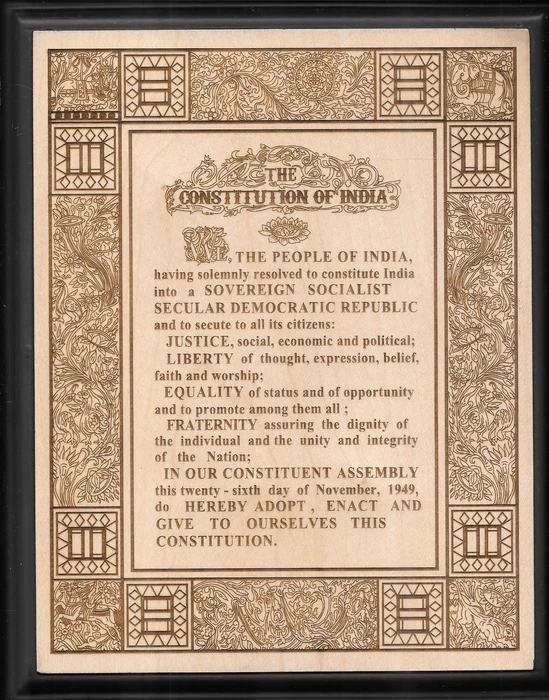
To effectively run any country, it is crucial for it to have a strong constitution. A constitution, in the sense of a citizen, defines the rights and responsibilities of an individual residing in the country. This is the reason every country in the world has its own constitution so that people can follow it and carry out every task within the boundaries of the law.
Whether a country is democratic or not, or whether it operates under a monarchy, it still has its own set of rules and laws based on which the country functions. Moreover, the relevance of some democratic countries in the world is based on the fact that their constitution guides them in the best direction to run the country efficiently. There are many countries that set a remarkable example for the world. If we look at it from this perspective, we should all take pride in the fact that our constitution is the most magnificent constitution in the world.
It is a matter of great concern that there is widespread ignorance about the constitution in India. Most people do not even know what our constitution says, what the rights of citizens are, and what other rights exist. If we conduct a survey, not talking about the general public but among the 790 Members of Parliament, and ask them if they have read the constitution, it would be surprising to find that perhaps none of them would claim to have read the entire constitution after asking this question.
On November 26, 1949, when India adopted its constitution and ratified it in 1950, Dr. B.R. Ambedkar, who played the most crucial role in framing the constitution, remarked in the Constituent Assembly, "No matter how good a constitution is, if the people implementing it are bad, it will prove to be bad. If the constitution is bad, but the people implementing it are good, then it will prove to be good."
Twenty-six years after its enactment on January 26, 1950, Prime Minister Indira Gandhi imposed a state of emergency on the country in the name of internal security. Stripping away all civil rights and creating the first serious crisis of constitutional values and ethics, she did this. In response to this crisis, the 42nd Constitutional Amendment was introduced in Parliament, replacing the phrase 'Sovereign Democratic Republic' with 'Sovereign Socialist Secular Democratic Republic.'
Since then, the constitution has undergone more than a hundred amendments at various times. However, the essence of its preamble remains unchanged. It is the world's largest written constitution, drafted by the Constituent Assembly under the permanent chairmanship of Dr. Rajendra Prasad over a prolonged process of two years, eleven months, and eighteen days. The challenges faced and the delicate balancing act performed during the partition and in the evolving circumstances of the nascent independent nation can be understood not only through the intense debates in the Constituent Assembly but also through the accolades and criticisms expressed on various platforms about its condition and direction.
"In any case, Rajendra Prasad wished that the Constitution should be officially presented in Hindi, just like it was in English. However, this was not possible, and later, the official Constitution, written in English, was translated into various Indian languages, including Hindi. Dr. Rajendra Prasad stated in his concluding speech in the Constituent Assembly, 'Ultimately, like a machine, the Constitution is lifeless. The circulation of life in it is controlled and operated by individuals. India needs individuals who are honest and prioritize the welfare of the country.'
Similarly, Dr. Ambedkar, who was the Chairman of the Drafting Committee, also rejected the idea of considering the Constitution 'his own' or 'unique from the three worlds' on November 25, 1949, before the enactment of the Constitution, due to its regular, selfless, and accepted nature. In his first interview as the Law Minister, he had said that if the Constitution remains in the hands of good people, it will prosper, but if it falls into the hands of bad people, it will disappoint to the extent that it will be 'of no use to anyone.'
He warned that 'the implementation of the Constitution does not solely depend on the form of the Constitution. The Constitution can only provide for the organs of the state such as the legislature, executive, and judiciary. The functioning of these organs depends on the people and the political parties created by them for the fulfillment of their ambitions and political objectives.'
"Then, as he questioned himself, 'In today's date, when our societal mindset is democratic and the state system is democratic, who can predict the behavior of the people of India and political parties in the future?'
Political parties holding opposing ideologies can collaborate with our traditional adversaries of castes and religions to avoid creating a rift. For this, he suggested that all Indians should place their country above their religious beliefs, rather than placing their religious beliefs above the country. At the same time, a warning was issued that "if political parties prioritize their beliefs over the nation, our independence will once again be in jeopardy and might be lost forever. We all must be prepared to respond to this possible event with unwavering determination. We should pledge to defend the last drop of our freedom's blood.
According to him, with the implementation of the constitution, we had entered a new era of conflicts, and the biggest contradiction was that it was being applied in a country where the goal of achieving political equality among citizens was in progress, but economic and social equality was not visible to a great extent.
He handed over the newly crafted constitution to the Prime Minister and the President, urging them to make efforts to bring economic and social equality among citizens as soon as possible. This is because the looming threat of this contradiction persisting for a long time hinted at the failure of democracy in the country. Under this, the system of "one person, one vote" was to be extended to every possible equality, so that there would be no hint of deviation from the lofty values of the constitution, such as freedom, equality, justice, and fraternity."
They wanted to keep the basic industries under government control and private capital within the constraints of equality so that there would be no detrimental concentration of economic resources, which could make certain groups of citizens continuously powerful while rendering others consistently powerless.
On November 25, 1949, while addressing the Constituent Assembly for the last time, Dr. B.R. Ambedkar delivered a memorable speech in favor of democracy. His speech remains as relevant today as it was 74 years ago. He suggested three things to keep Indian democracy intact.
"If we want to keep democracy not only in form but also in substance, what do we need to do? In my opinion, the first essential thing is that we should follow the paths suggested by the Constitution to achieve our socio-economic objectives. This means that we should abandon the bloody paths of revolution. It also means that we should abandon the paths of non-cooperation, civil disobedience, and satyagraha. When there is no constitutional way left to achieve socio-economic objectives, the use of non-constitutional methods can be justified. But when the constitutional paths are open, there is no reason for unconstitutional methods. There are no other ways besides the 'grammar of anarchy,' and the sooner we abandon them, the better it will be for us.
Dr. Ambedkar, while formulating the constitution, hoped that within a few years, the rule of the constitution would prevail in the country, and those residing on the margins of society would be integrated into the mainstream as a priority. A social, economic, and political democracy would be established. However, Ambedkar's hopes were shattered; the aspirations he had for the marginalized communities remain distant, and the oppression of the Dalits has become commonplace.
***********






[[comment.comment_text]]