BAFT-HAWA: When Bengal Wove the Air

 2 weeks, 6 days ago
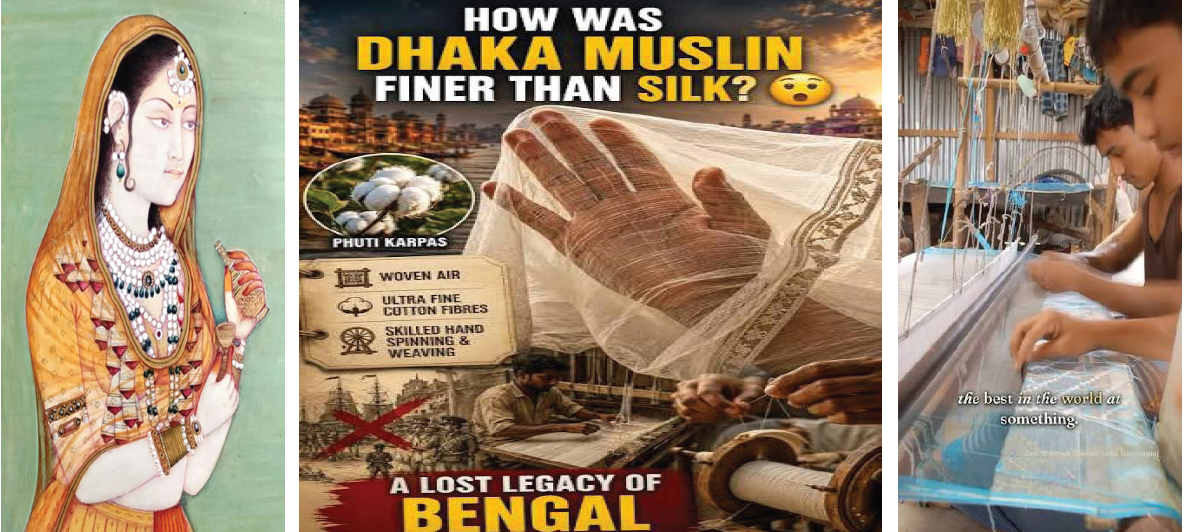
There are moments in economic history when an object outgrows the commodity it was meant to be. Bengal’s muslin was one of them. It clothed emperors, moved through Asian and European markets, and forced observers into metaphor. The finest varieties acquired names that barely concede they were cloth at all: baft-hawa or woven air; ab-i-rawan or running water; Shabnam or dew.
Behind the poetry was technology. Behind the technology was knowledge. That distinction matters, because the story is too often told as romance or grievance: an impossibly delicate fabric, a golden Bengal, colonial ruin, disappearance. The real history is less convenient, and more useful.
Muslin shows that sophisticated knowledge need not live in laboratories or manuals. It used to reside in a particular kind of cotton grown along riverbanks, in a humid morning, in the practiced hands at a household spindle, and in the rhythms of a loom. What Bengal eventually lost was not only a celebrated industry. It lost a legacy; part of a specialised knowledge system.
Before the European Companies
European companies did not invent this trade. By the seventeenth and eighteenth centuries they entered an already dense textile economy. Dhaka and its hinterland, Sonargaon, Kapasia and the riverine tracts along the Meghna and Brahmaputra which held a distinctive place for superfine cottons.
The surviving numbers are commercial, not poetic. In 1747, exports of Dhaka cotton goods, chiefly fine muslin, including cloth reserved for the emperor and the nawab, were valued at about Rs 28.5 lakh. By the end of the eighteenth century, the figure had already fallen to a little over Rs 14 lakh. The cloth had not suddenly become ordinary. The system that priced extraordinary skill was changing.
John Taylor, Commercial Resident at Dhaka, documented district manufacture in 1800 to 1801. Half a century later, A Descriptive and Historical Account of the Cotton Manufacture of Dacca in Bengal (1851), associated with Dr James Taylor, described the sequence from fibre to finish. Together these records expose how misleading the simple image of a loom can be.
Muslin was not one machine and one profession. Cotton selection, cleaning, spinning, warping, weaving, washing and finishing were separate competences. The cloth was the visible end of an invisible chain.
The amalgamation of Hand and Soul
The easiest figure to omit is the spinner. Fine spinning was substantially women’s work, undertaken in households under atmospheric conditions that kept extremely fine fibre workable. Historical accounts recorded the economics of that patience. The finest spinners could produce only about one-eighth of a tola in a month roughly 1.5 grams of yarn, or about 0.05 gram a day.
In 1846, Dr James Taylor recorded a measured skein - a length of yarn wound into a loose coil, that ran upwards of 250 miles to a pound of cotton. In the traditional English cotton-count system, a measure of yarn fineness, this corresponded to more than 520 count. The documented achievement is extraordinary enough.
A weaver of rare ability still required rare yarn. Women within these production communities were not peripheral suppliers to a male craft whose intelligence lay elsewhere. Their fingers were measuring instruments: learning how fibre behaved, how much tension it would take, and when the air would forgive a mistake.
Modern economics files this under labour. The file is too thin. It was embodied knowledge and embodied knowledge has a peculiar vulnerability. Unless another pair of hands learns it, it can disappear without leaving a manual.
By 1925, Jogesh Chandra Sinha reported that the generation of women who had spun yarn for the finest fabrics had already passed away. A letter from a woman spinner of Santipur, printed in Samachar Darpan in 1828 and later discussed by Sushil Chaudhury, offers one rare moment when that labour speaks in its own voice. The cloth entered inventories and museums. The names of those fingers rarely did.
Historic Dhaka muslin also resists the modern habit of separating manufacture from landscape. The finest cloth was associated with the locally adapted cotton known as phuti karpas, grown in particular riverine localities of eastern Bengal. Fibre was prepared with remarkably simple tools, a bamboo bow, even the dried jawbone of a boal fish for the finest cleaning because the staple was short, silky and unforgiving.
Saiful Islam estimates that, after the arduous sequence of preparation, spinning and weaving, a kilogram of cotton might yield only about eight grams of the finest muslin. “Woven air” therefore contains a material truth. Humidity mattered. Water mattered. Cotton mattered. Skill mattered. The product was an interaction, not an assembly line. Industrial policy asks how production can be scaled. Traditional knowledge poses a prior question: what conditions make excellence possible at all?
When the Ecosystem Stopped Paying
Under Mughal patronage and long-distance trade, Dhaka became synonymous with muslin of exceptional quality. After the East India Company became a territorial power in Bengal, the political economy changed. It is important not to flatten this history into a single villain. Company procurement, coercive practices of agents, declining courtly demand, European commercial policy and, eventually, the vastly greater productivity of mechanised Lancashire all belong in the story. The 1851 Dacca account dates the industry’s decline from around 1793, shortly after mule-spun yarn came into general use in England. The decline was neither instantaneous nor uniform.
The more useful question is therefore not only who destroyed muslin? It is: what happens when the economic ecosystem supporting an exceptionally specialised skill ceases to make that skill viable? Indian craft policy still lives inside that question.
The story that British authorities systematically cut off Bengal weavers’ thumbs has immense emotional power. In the form commonly repeated, it lacks adequate evidence.
The historical trail leads instead to William Bolts’s Considerations on India Affairs (1772). Bolts wrote that silk winders, subjected to oppressive conditions, had in some instances cut off their own thumbs to escape forced winding. Later retellings transferred the violence onto British hands and muslin weavers. Sinha, writing in 1925, found no specific corroboration for the popular version.
We should not need it. Documented economic history is sufficient. Colonial power altered Bengal’s commercial environment; British industrialisation transformed the economics of cloth; highly labour-intensive mastery became increasingly difficult to sustain.
A civilisation does not have to cripple an artisan’s fingers to lose his knowledge. It need only build an economy in which those fingers can no longer earn a living. We like to imagine technological progress as the replacement of an inferior method by a superior one. Craft history complicates that sentence.
Industrial textiles achieved productivity, consistency and affordability that hand production could not match, making cloth cheaper and more widely accessible. But efficiency and knowledge are not synonyms. A mill may produce kilometres of excellent fabric without reproducing the sensory intelligence by which another fabric was once made.
When an old technology disappears, two questions must therefore be separated: did we lose an inefficient means of production? And did we also lose knowledge worth keeping?
Museums preserve textiles. Archives preserve commercial records. Nineteenth-century accounts preserve process. None is a living practitioner. Tactile judgement cannot simply be scanned or catalogued. The true archive of a craft is the chain of transmission. Break it for one generation and reconstruction becomes archaeology.
That is the test facing today’s muslin revival. Private and public initiatives in Bangladesh have attempted to recover phuti karpas, retrain hands and produce exceptionally high-count yarn and cloth. Such efforts matter. But they do not settle the harder question. If a reconstructed loom uses an old name, has the knowledge system returned or only its memory? If a beautiful cloth cannot persuade a young person that the skill is worth inheriting, the tradition is not secure.
What We Choose to Call Knowledge
This is why baft-hawa should travel beyond textile history. India speaks confidently of innovation, skills, sustainability and the knowledge economy. Yet craft policy can remain surprisingly narrow about what counts as knowledge. What is a woman capable of spinning extraordinary yarn by hand? Unskilled labour? Heritage worker? Technologist?
The word decides the policy. Treat crafts primarily as welfare, and intervention gathers around subsidy and survival. Treat them as specialised knowledge, and the questions change: material research, apprenticeship, honest labelling and markets capable of paying for time and mastery rather than nostalgia.
Bengal once turned cotton, moisture and accumulated human experience into something so fine that language reached for air, water and dew. The cloth was extraordinary. The greater inheritance was the intelligence that made it. Its future depends on whether we learn to value that knowledge before the last hand carrying it disappears.
(The author, a double Masters in Business Administration and Political Science, is an accomplished Professor. She is a recognised commentator on education, socio-cultural diversities, and empowerment issues.)








[[comment.comment_text]]