West Asia on the Edge: Escalating Tensions and the Global Fallout

 2 months, 2 weeks ago
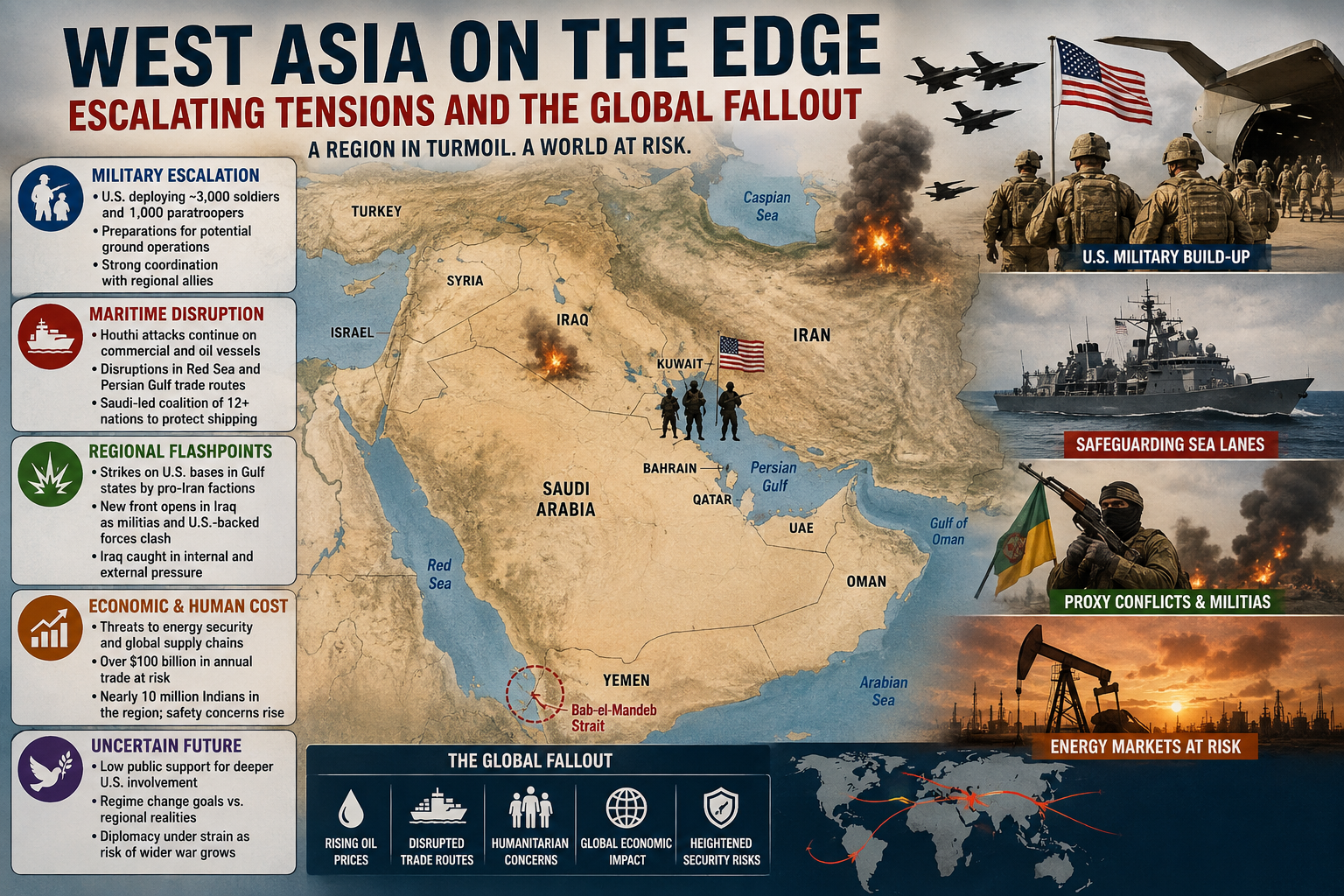
The Persian Gulf region finds itself teetering on the edge of a wider conflict, with developments pointing toward an escalating theater of military confrontation. Recent policy moves and troop deployments indicate that the ongoing friction in West Asia is no longer contained within localized borders. As regional powers, international alliances, and paramilitary forces clash, the stability of key maritime corridors and international energy markets hangs in the balance.
A central element of this deepening crisis is the expanded military presence of the United States. Washington has announced the deployment of approximately 3,000 soldiers alongside 1,000 specialized paratroopers to the region. This movement signals serious preparations for potential ground-level operations, sparking concerns over direct intervention inside Iranian territory. While international participation in a ground effort remains uncertain, coordination among regional allies like Israel remains strong, particularly regarding ground intelligence where local agencies hold critical operational insights.
Concurrently, maritime trade through crucial choke points such as the Bab-el-Mandeb Strait remains severely disrupted. Continuous Houthi attacks on commercial and oil vessels have stalled supply flows through the Red Sea and the Persian Gulf. In response, Saudi Arabia has spearheaded a multi-nation naval coalition comprising over a dozen countries to safeguard shipping lanes. However, many member states possess modest naval capacity, leaving the coalition heavily reliant on the operational backing of the U.S. Navy.
The military footprint across the Gulf states highlights both strategic assets and vulnerabilities. Key host nations such as Bahrain, Kuwait, and Qatar maintain substantial naval or air infrastructure supporting U.S. Central Command assets, including the U.S. Fifth Fleet. Yet, frequent strikes by pro-Iranian factions against these installations have reportedly caused significant operational friction and infrastructure damage, complicating defense measures across the peninsula.
Tensions have further expanded with the opening of new operational fronts in Iraq. Recent joint air strikes targeting pro-Iranian Shia militia positions within Iraqi territory have drawn fierce reactions from paramilitary groups. These groups, formed and battle-hardened during the fight against ISIS, possess substantial weaponry and organizational structure. The military exchanges threaten to pull Iraq back into active regional hostilities just as internal security conditions were beginning to stabilize.
At the same time, the central government in Baghdad finds itself navigating a delicate balancing act. Confronted with pressure from Washington, Iraqi authorities have issued notices to local militias demanding the surrender of unauthorized heavy weaponry. Furthermore, state agencies have carried out raids on officials aligned with regional proxy networks under the umbrella of anti-corruption initiatives, creating intense internal political friction within Iraq.
Strategic discussions among Western and allied analysts also point to potential maneuvers along ethnic borderlands. Particular attention has focused on the Kurdish regions spanning Iran and northern Iraq.
Proposals involving operational presence in these areas aim to create pressure points against Tehran, though such strategies carry high risks of severe local destabilization and unpredictable civilian fallout.
From Tehran’s perspective, the official stance remains defiant. Iranian military leaders have expressed readiness for multi-front engagements, asserting that ground forces are prepared to defend national borders. Despite facing internal economic pressures and external isolation, the security apparatus maintains a firm posture, setting the stage for prolonged friction should ground operations materialize.
The expanding crisis poses severe economic and human risks for third-party nations, particularly in South Asia. India, for instance, maintains deep ties with the region, where nearly ten million Indian expatriates reside and work. Any further expansion of hostilities threatens the safety of this workforce, with return migration already beginning from commercial hubs like the United Arab Emirates as businesses adjust to regional instability.
Energy security and bilateral commerce are equally at risk. Strategic trade relations between West Asia and emerging Asian economies involve over $100 billion in annual exchanges, alongside major commitments for long-term infrastructure investment.
Prolonged maritime blockades or strikes on oil installations threaten to disrupt crude exports, pushing up international energy prices and placing additional strain on global supply chains.
Within the United States, military escalation in West Asia faces considerable domestic head winds. Public support for military interventions remains low, while economic concerns regarding inflation, trade tariffs, and energy costs dominate domestic policy discussions. Political shifts around upcoming elections further complicate the long-term execution of complex foreign policy objectives in the Middle East.
Ultimately, the core tension rests on the overarching policy objective of regime change versus the reality of regional defense capabilities. While diplomatic paths remain strained, the combination of military deployments, proxy conflicts, and economic instability ensures that West Asia remains in a fragile state. The coming months will determine whether regional diplomacy can restore stability or if the region faces a period of sustained disruption.
(The author is a well-recognised commentator on politics and society in West Asia.)









[[comment.comment_text]]