US Drops ‘Indo’ from Pacific Command: What It Means for India’s Strategic Future

 3 months, 1 week ago
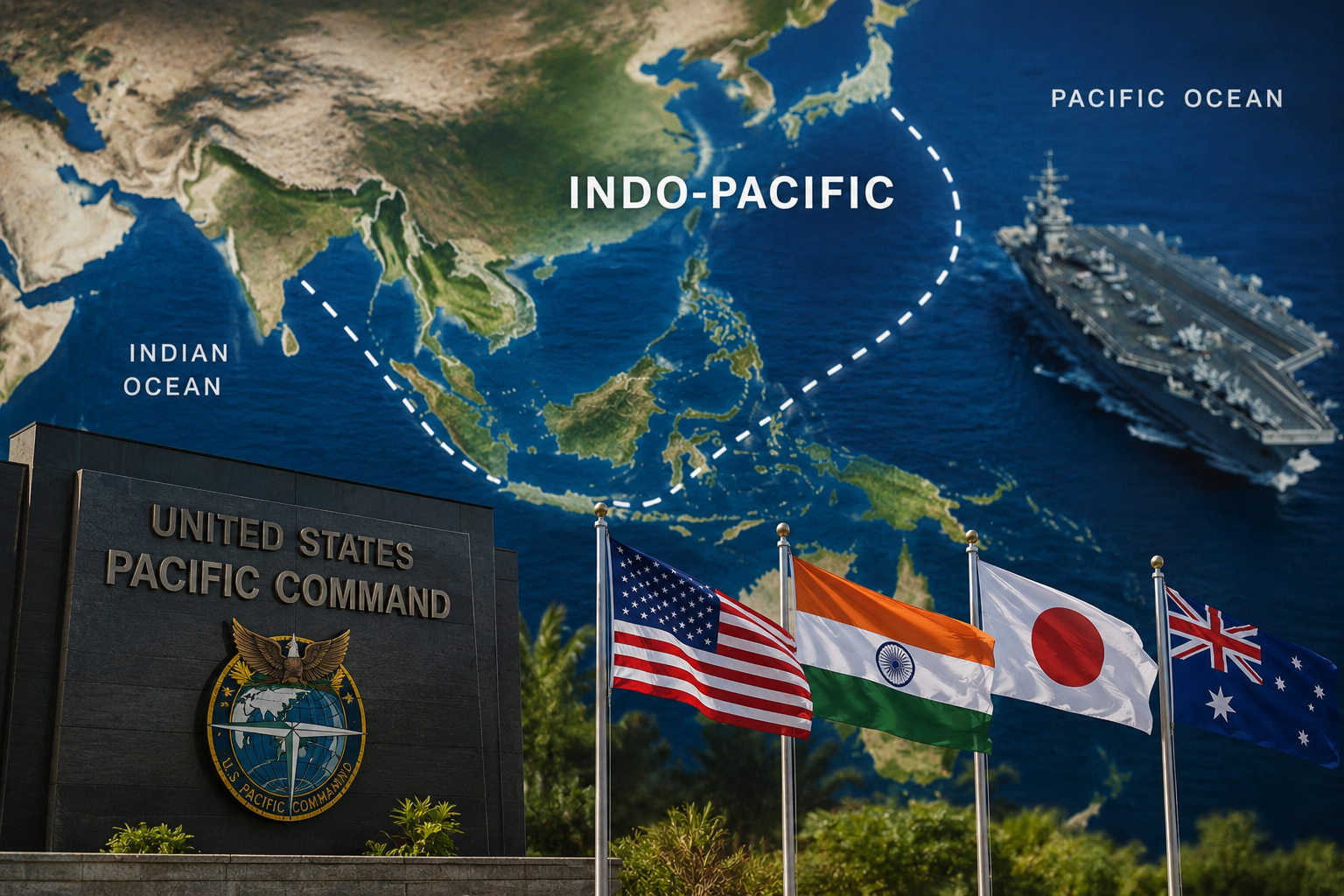
When the United States quietly dropped the word "Indo" from its military command and restored the name U.S. Pacific Command, many dismissed it as a bureaucratic adjustment. Yet in international politics, names are rarely accidental. They often signal changing priorities before official doctrines fully articulate them. For India, the decision is more than a semantic revision—it raises uncomfortable questions about whether Washington's strategic focus is shifting away from the broader Indo-Pacific vision that elevated New Delhi's geopolitical importance over the past decade.
The Indo-Pacific was never merely a geographical expression. It represented a strategic idea that linked the Indian and Pacific Oceans into a single theatre of economics, security and diplomacy. Ironically, the concept itself emerged from Indian strategic thinking before it became a cornerstone of American foreign policy. It gained international recognition when Japan embraced it politically and later became central to the United States' strategy to balance China's growing influence. The renaming of the Pacific Command as the Indo-Pacific Command in 2018 symbolized Washington's recognition that India's location, democratic credentials and growing economic power made it indispensable to maintaining a favourable balance of power in Asia.
India's rise within this framework was not accidental. Situated at the crossroads of the Indian Ocean, New Delhi occupies one of the world's most strategic maritime locations. A significant share of global trade and energy supplies passes through sea lanes that India is uniquely positioned to influence. Combined with its expanding economy, large military and independent foreign policy, India appeared to be the only Asian power capable of balancing China over the long term without being a formal American ally.
This convergence of interests gave birth to deeper cooperation through the Quad, comprising India, the United States, Japan and Australia. What began as a consultative grouping gradually evolved into a platform for collaboration in maritime security, emerging technologies, supply chains, cybersecurity, critical minerals and disaster response. The partnership succeeded largely because it accommodated both sides' priorities. Washington viewed it as part of its broader strategy to deter China, while India saw it as a mechanism to strengthen its capabilities without compromising its long-standing policy of strategic autonomy.
That delicate balance now appears to be under fresh examination. Recent American strategic documents have increasingly concentrated on defending the Western Pacific, particularly the so-called First Island Chain stretching from Japan through Taiwan to the Philippines. Within this narrower military framework, India's geographical advantage carries less immediate operational significance than it did under the broader Indo-Pacific construct. The restoration of the Pacific Command's original name appears to reflect this evolving strategic focus rather than a deterioration in India-U.S. relations.
The distinction is important. India has not become less important to Washington; rather, the nature of its importance is changing. If American military planning is increasingly centred on potential contingencies involving Taiwan and the Western Pacific, treaty allies capable of immediate military integration naturally receive greater emphasis. India, which has consistently rejected alliance politics and maintained an independent foreign policy, inevitably occupies a different strategic category.
This evolution also exposes the strengths and limitations of India's doctrine of strategic autonomy. For decades, New Delhi has sought to maximise cooperation with multiple powers while avoiding exclusive alignments. That approach has enabled India to deepen defence cooperation with the United States, maintain longstanding ties with Russia, strengthen economic engagement with Europe and simultaneously participate in platforms such as BRICS and the Shanghai Cooperation Organisation. Few major powers have managed such diplomatic flexibility.
However, strategic autonomy is not cost-free. As geopolitical rivalry intensifies, major powers increasingly expect clearer commitments from their partners. Differences over India's continued purchase of Russian energy, trade disputes and varying positions on global conflicts demonstrate that Washington's willingness to accommodate Indian balancing has practical limits. If the Indo-Pacific framework gradually contracts into a more narrowly Pacific-focused security architecture, New Delhi could lose some of the leverage it previously enjoyed in negotiations over defence technology, investment and strategic cooperation.
At the same time, much of India's future influence depends not on American strategy but on its own choices. Despite projecting itself as the leading maritime power in the Indian Ocean, India's naval modernisation has struggled to keep pace with expanding strategic ambitions. Land-based security challenges involving China and Pakistan continue to consume the largest share of defence expenditure, leaving comparatively limited resources for naval expansion. Yet the maritime domain is increasingly becoming the decisive arena of twenty-first century geopolitics. China's rapidly expanding naval presence across the Indo-Pacific demonstrates that sea power, logistics and maritime connectivity will shape future economic and strategic competition as much as territorial disputes.
Perhaps the most significant development, however, lies not in the east but in India's growing engagement towards the west. Initiatives such as the India-Middle East-Europe Economic Corridor (IMEC), the I2U2 grouping and expanding connectivity partnerships with Europe indicate that New Delhi is gradually constructing a broader geopolitical framework in which it occupies a structurally central position. Unlike the Indo-Pacific concept, which depended heavily on American strategic priorities, the emerging Indo-Mediterranean vision places India at the heart of trade, logistics, digital connectivity and energy corridors linking Asia, West Asia and Europe.
Although projects such as IMEC remain in their early stages and face geopolitical uncertainties arising from instability in West Asia, they represent a strategic opportunity that is fundamentally different from the Indo-Pacific. In America's Pacific-centred strategy, India is an important partner. In the Indo-Mediterranean framework, India becomes an indispensable connector. That distinction may prove increasingly important as global supply chains diversify and countries search for alternatives to existing trade routes dominated by China.
The renaming of an American military command, therefore, should neither be exaggerated nor ignored. It is unlikely to reverse the substantial progress made in India-U.S. defence cooperation over the past decade. The Quad remains active, technology partnerships continue to expand and intelligence cooperation has deepened considerably. Yet symbols often reveal strategic priorities before policies become fully visible. The disappearance of "Indo" from America's military vocabulary reflects an evolving assessment of where Washington believes the central theatre of competition now lies.
For India, the appropriate response is not to seek reassurance from American terminology but to continue strengthening its own strategic foundations. Investments in naval capability, indigenous defence production, advanced technologies, resilient supply chains and regional connectivity will ultimately determine India's global influence far more than any external designation. Great powers are not defined by their place in another country's strategy document; they are defined by their capacity to shape the strategic geography around them.
The real challenge before New Delhi is therefore not whether it remains central to the Indo-Pacific, but whether it can build a geopolitical architecture in which its centrality is permanent rather than borrowed. If India succeeds in transforming its maritime geography, economic corridors and diplomatic partnerships into lasting strategic assets, the changing nomenclature in Washington will matter little. History has repeatedly shown that nations secure their place in the international order not through recognition by others, but by creating realities that others must eventually recognise.









[[comment.comment_text]]