Gen Z’s Awakening: A Generation Demanding Its Future

 1 month, 1 week ago
For years, many believed that India would remain untouched by the wave of youth-led political movements sweeping South Asia. That assumption has now been challenged.
Over the past few years, young people in Sri Lanka, Bangladesh, and Nepal have emerged as powerful agents of change. In 2022, Sri Lankan youth filled the streets of Colombo during a historic protest movement. In 2024, Bangladesh witnessed a similar surge of youth mobilisation. In 2025, Nepal’s streets echoed with the voices of young people demanding accountability and change. In each case, governments faced unprecedented pressure, and political transitions followed.
While these developments unfolded across India’s neighbourhood, many Indian political observers argued that a similar Gen Z movement was unlikely to emerge here. Recent events have proved otherwise.
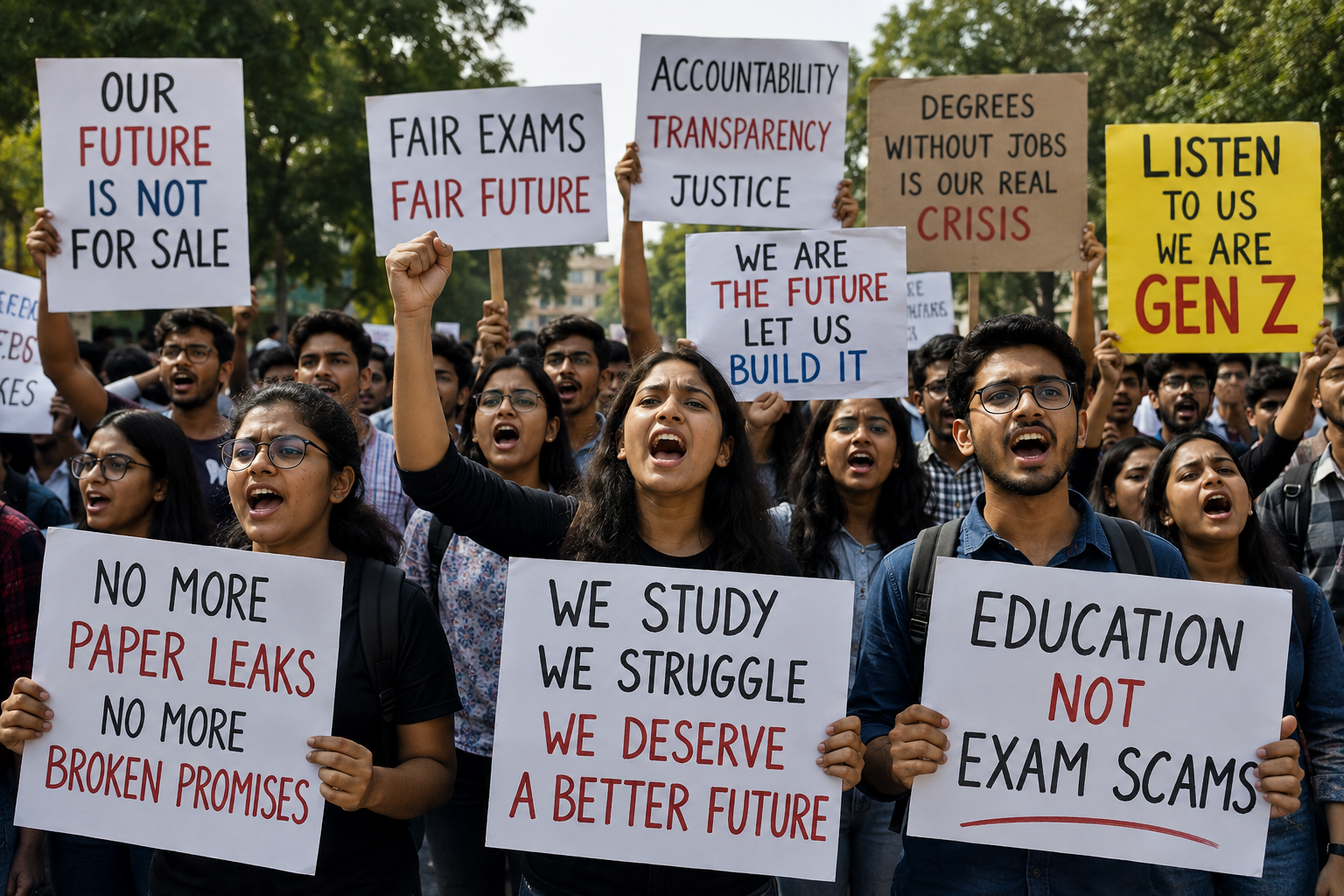
From New Delhi’s Jantar Mantar to cities across the country, young Indians took to the streets to protest irregularities in the NEET examination process and repeated paper leaks. What began as a grievance over an examination system soon became a broader expression of frustration among a generation that feels increasingly excluded from opportunities. The scale of public anger forced the government to confront serious questions about accountability and institutional credibility.
A Generation with Skills but Few Opportunities
Generation Z, generally defined as those born between 1997 and 2012, is now one of the most influential demographic groups in the world. By 2025, it accounts for nearly 30 percent of the global workforce. In India, this generation comprises approximately 370 million people – around one-fourth of the country’s population.
This is not a generation lacking education, ambition, or technological ability. The young people demanding change are students, graduates, professionals, and digital citizens. They are future doctors, scientists, engineers, lawyers, entrepreneurs, journalists, and innovators – the very people expected to contribute to India’s growth story.
Yet many find themselves facing a painful contradiction: they have qualifications but not employment; skills but not opportunities; ambition but no clear pathway to success.
The repeated failures in competitive examinations, including allegations of paper leaks and irregularities, have intensified this frustration. For millions of young people, these examinations are not merely tests; they represent their primary route to economic security and social mobility. When that route appears compromised, anger is inevitable.
The Employment Crisis Behind the Anger
The dissatisfaction among young Indians is rooted in a deeper economic reality. India’s education system has expanded significantly, but its connection with employment remains weak.
A large number of young people between the ages of 15 and 29 are neither studying, employed, nor receiving any form of training. Among those seeking jobs, unemployment remains particularly high among graduates and postgraduates. This creates a disturbing paradox: education, which is expected to improve life opportunities, is increasingly failing to guarantee employment.
For Gen Z, the problem is not simply the absence of jobs. It is the absence of a reliable future. Young people are asking a fundamental question: if years of education, sacrifice, and financial investment do not lead to meaningful opportunities, then what exactly is the promise of the system?
The Failure of Policy Design
One reason for this growing frustration is the gap between policy announcements and outcomes. Good governance requires evidence-based policymaking – decisions based on data, research, and measurable results rather than assumptions. However, many programmes designed to address youth unemployment have struggled to deliver meaningful results.
Skill development initiatives, for example, have received substantial government investment. Yet training alone cannot solve the employment crisis unless it is connected to actual market demand, quality jobs, and long-term career opportunities.
A system that produces millions of degree holders without creating pathways for employment risks creating disappointment on a massive scale. When young people invest their time, money, and hope in education but receive uncertainty in return, dissatisfaction naturally grows.
The Psychology of a Restless Generation
The frustration of Gen Z is not only economic; it is also psychological. This generation has grown up surrounded by conversations about equality, justice, development, and opportunity. They have heard repeated promises about progress and inclusion. At the same time, they see a gap between these ideals and everyday reality.
Psychologists describe such a conflict between beliefs and experiences as cognitive dissonance. When young people repeatedly encounter a mismatch between what they are told and what they experience, it creates disappointment and emotional strain.
Gen Z is also more connected and informed than previous generations. Social media has given young people platforms to organise, question authority, and demand accountability. Their protests are not simply expressions of frustration; they are also expressions of a generation that expects institutions to respond.
The Flynn Effect, a concept associated with psychologist James Flynn, suggests that intelligence scores have generally increased across generations over time. Whether measured through technology use, information access, or problem-solving ability, today’s youth display a different relationship with knowledge and communication compared with earlier generations.
India’s Gen Z is using these tools to articulate its concerns more effectively. Its anger is not limited to one examination or one policy failure. It reflects deeper anxieties about education, employment, fairness, and the future.
Listening to Gen Z
The rise of Gen Z activism should not be viewed merely as a law-and-order challenge. It is a signal that demands serious attention from policymakers.
India’s young population is one of its greatest strengths. But a demographic advantage becomes meaningful only when young people have genuine opportunities to contribute. A generation full of talent, creativity and ambition cannot be allowed to remain trapped between degrees and unemployment.
The challenge before policymakers is clear: build an education and employment ecosystem that aligns skills with opportunities and aspirations with possibilities. This requires more than piecemeal measures or short-term interventions. A concerted effort to overhaul the system holistically is the need of the hour; an ad hoc approach will simply not work.
The energy of Gen Z should not be spent only in protests against a failing system. It must be channelled into building a stronger, more innovative and more inclusive India. For that to happen, policymakers must listen to what this generation is saying—and, more importantly, address the structural problems that lie behind its frustration.
As the great Urdu poet Faiz Ahmed Faiz wrote:
‘Jo dariya jhoom ke uithe hain, tinkon se na taale jaaenge.’ (The rivers that have risen in rage cannot be turned back with mere straws.) The message is clear: rising aspirations cannot be contained through temporary fixes. They require meaningful reform, sustained opportunity and a willingness to listen.
Author is Assistant Professor @ (Economics) B.R.A. Bihar University, Muzaffarpur.







[[comment.comment_text]]