Concrete Palaces Built on Foundations of Books

 2 weeks, 6 days ago
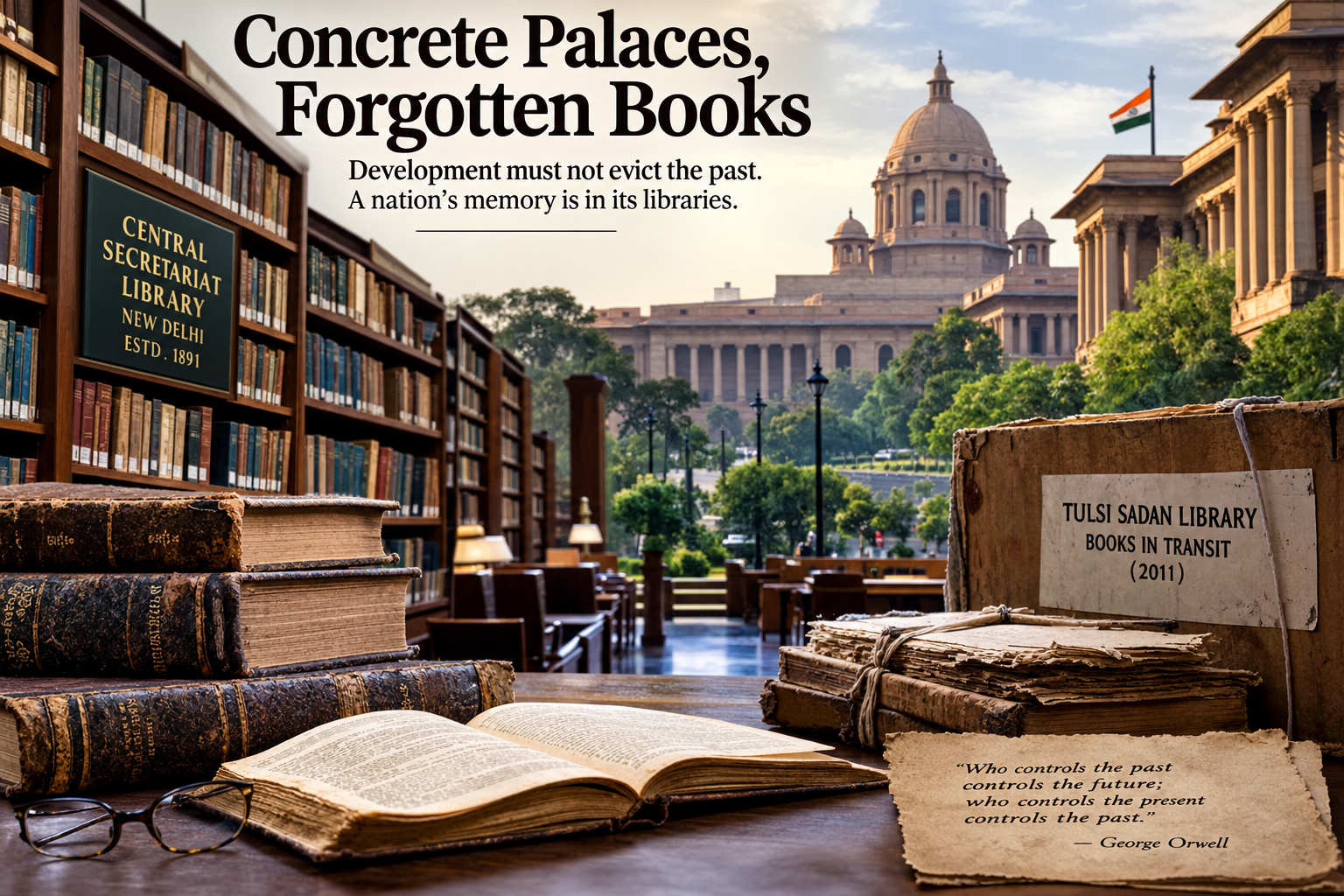
"Who controls the past controls the future; who controls the present controls the past." @George Orwell, 1984.
History is more than just the passage of time; it is the collective memory that allows us to understand the present and chart the course of the future. Controlling history entails not just controlling the understanding of the past but also asserting authority over the consciousness of the future. A society that reads its own history through documents and literature can challenge power; nevertheless, when memory fails, history becomes whatever someone else decides to write for it. That was Orwell's most
This is why the issue at the Central Secretariat Library in Delhi involves more than just a building or the relocation of hundreds of thousands of books. The question is, in the name of progress, what are we constructing, and what are we losing in terms of price? Established in 1891, the library now houses about 850,000 books and records, including government publications, rare books, reports, and an invaluable record of Indian administrative history. These are more than just papers; they are the country's documented and preserved past.
The uncertainty over enough space and amenities for the library has prompted an uncomfortable question: does our vision of progress allow for concrete while requesting space for memory remain difficult? The government has recently suggested that room will be supplied under the new plan; nonetheless, the issue is more than just space. It is about the collection's security, preservation, and digitisation, as well as readers' continued access. The experience at the Tulsi Sadan Library is even more concerning. Since its transfer in 2011, its collection of more than 200,000 volumes has remained packed in crates, out of reach of readers.
Is this what our libraries' future should look like: buildings altering while books remain in cartons? Build new structures, but do not leave books homeless. There is room for more roads. There is room for new offices. There is room for new concrete constructions. But why has asking for room for millions of papers become so difficult? This question is much larger than the preservation of a particular structure. A building can fall without bringing history with it; history falls when a civilisation loses the desire to preserve its own past.
Moving books to another building may be a simple administrative solution, but does it resolve the issues? Will the same preservation, research facilities, public access, and institutional dignity endure? Most importantly, will the books be kept safe or read? Because there is little difference between a book locked inside a cupboard and one kept out of the reader's reach.
Here, Nehru's words instantly come to mind: "Changing the direction of a portrait does not change the course of history." Moving a picture from one side of a wall to another does not change history; however, when original records and sources of history are removed from public access, subsequent generations may have fewer opportunities to investigate that history for themselves.
This is when the topic of a library transforms into one about the relationship between power and memory. Democracy is more than just the right to vote; it also includes the opportunity to question power: "Where is the document for what you are saying?" A library is the quietest yet most potent setting for that question. There is no noise, simply evidence; no slogans, just documents. Books are not the enemy of any government. They are the memory testers for any government, as well as the safest place for a citizen's ability to question.
According to Francis Bacon, "Knowledge itself is power." Knowledge provides citizens with more than just information; it empowers them to question, dispute, and demand evidence from those in positions of authority. As a result, seeing library neglect as purely administrative is a grave error. When determining how much space books require, we compute the cost per square metre, but we rarely consider the cost of losing a rare document. What is the cost of placing a book out of a reader's reach? And who bears the consequences when a generation loses touch with its past? If memory degrades, so does comprehension of the present—and a convenient narrative might become history.
Concrete needs room, but memory does not? The demolition of a building does not kill history; history begins to deteriorate when less space is made available for its archives, books outlive readers, and society begins to deem its past obsolete. In this case, the topic of a library becomes one of democracy. Democracy is more than just elections and Parliament; it also includes memory, information, reasoning, and the ability to question. A library is a place where the current challenges, the past and power claims can be evaluated against documentation.
A person with limited knowledge and a shaky memory may readily accept any convenient tale; a reader of books questions why, when, who said it, where is the evidence, and what the opposing side is. A book is not anti-power; rather, it trains citizens to question. The Pareto Principle's 80/20 metaphor also reminds us that transformative influence is frequently generated by a small number of causes or individuals—and in the domain of knowledge, those who ask questions are precisely the people who shift society's intellectual direction.
Those who preserve civilisational memory are not necessarily the majority; only a few people protect old papers, find forgotten texts, and confront dominant narratives with evidence in hand. They disagree with the majority's convenience and wonder, "Is the story really so simple?" Society preserves and keeps history alive through these exceptional acts of curiosity, courage, and institutional effort.
The greatest tragedy in history is not only the burning of books; it is when they become so irrelevant that no one feels compelled to save, read, or seek them. Knowledge does not always require fire to be destroyed; sometimes neglect is sufficient.
The legacy of Nalanda Mahavihara reinforces this warning. During the transition from the twelfth to the thirteenth centuries, its great storehouse of knowledge was severely damaged by military attacks and destruction. Popular memory recalls it as an occasion in which libraries were set ablaze, although historians see its destruction as a more sophisticated and lengthy process. However, the most important lesson is unmistakable: the destruction of a centre of knowledge is more than just the ruin of buildings; it is the end of intergenerational debate.
Today, the same risk can appear in a much quieter form. There is no need to burn books; instead, deny them space, close collections, isolate them from readers, and continue to postpone their preservation. Knowledge may survive but become unavailable with time.
What disappears first is not the book, but the relationship between a society, its memory, its issues, and its future generations.
A statement from Ray Bradbury's 1979 Coda to Fahrenheit 451 seems even more haunting: "There is more than one way to burn a book." The quietest fire that burns books may be neglect—because its smoke is invisible, but its ashes remain in the memory of generations.
When a library's shelves decline today, the implications are not immediately obvious—no election is lost, and no government collapses. However, a society's intellectual potential gradually declines. When the following generation is unable to read its own history through papers and books, the story produced by others begins to take on new significance. This is the true threat.
Build new roads, buildings, and institutions; but do not celebrate progress by diminishing space for literature. Concrete may make us look modern, but books make us appear civilized.
Borges envisioned heaven as a library. Are we replacing that heaven with another concrete palace? The question is not whether a new structure should be built, but how much history can be preserved within it.
The government must not only choose where over nine hundred thousand books and records will be placed; it must also secure their preservation, researcher access, the conservation of unique collections, and the survival of their world of knowledge for future generations.
A nation's power should be evaluated not only by the height of its structures, but also by how well it has safeguarded its memory. Concrete ages with time, yet books, even when old, remain fresh. And when there is room for new buildings but not for books, the issue becomes one of priorities rather than development.
Today, the Central Secretariat Library is more than just a rehabilitation project; it is also about preserving memories. Development is vital, but will it come at the expense of our knowledge heritage? Why shouldn't the first condition of progress be to safeguard books and papers before moving on to brick and stone? After all, buildings create the future, while books create its consciousness.
Even as they age, books retain their newness. As a result, when a country has room for new buildings but not for books, the dilemma is not only one of libraries, but of national memory. When memory fails, history is no longer read; it is written. Orwell's admonition rings true here: whoever maintains the past influences what the future hears about it.
(The author, a Doctorate in Laws, is a senior lawyer and civil society activist.)






[[comment.comment_text]]