The Steel Grass Revolution

 1 month, 2 weeks ago
India is quietly undergoing a structural renaissance.
For centuries, bamboo was integral to the Indian architectural landscape—from vernacular housing and bridges to everyday structural elements. Yet, as industrialization accelerated, modern India relegated bamboo to temporary construction and "poor man’s timber," choosing instead to equate concrete, steel, aluminium, and imported hardwoods with progress.
That paradigm is now obsolete.
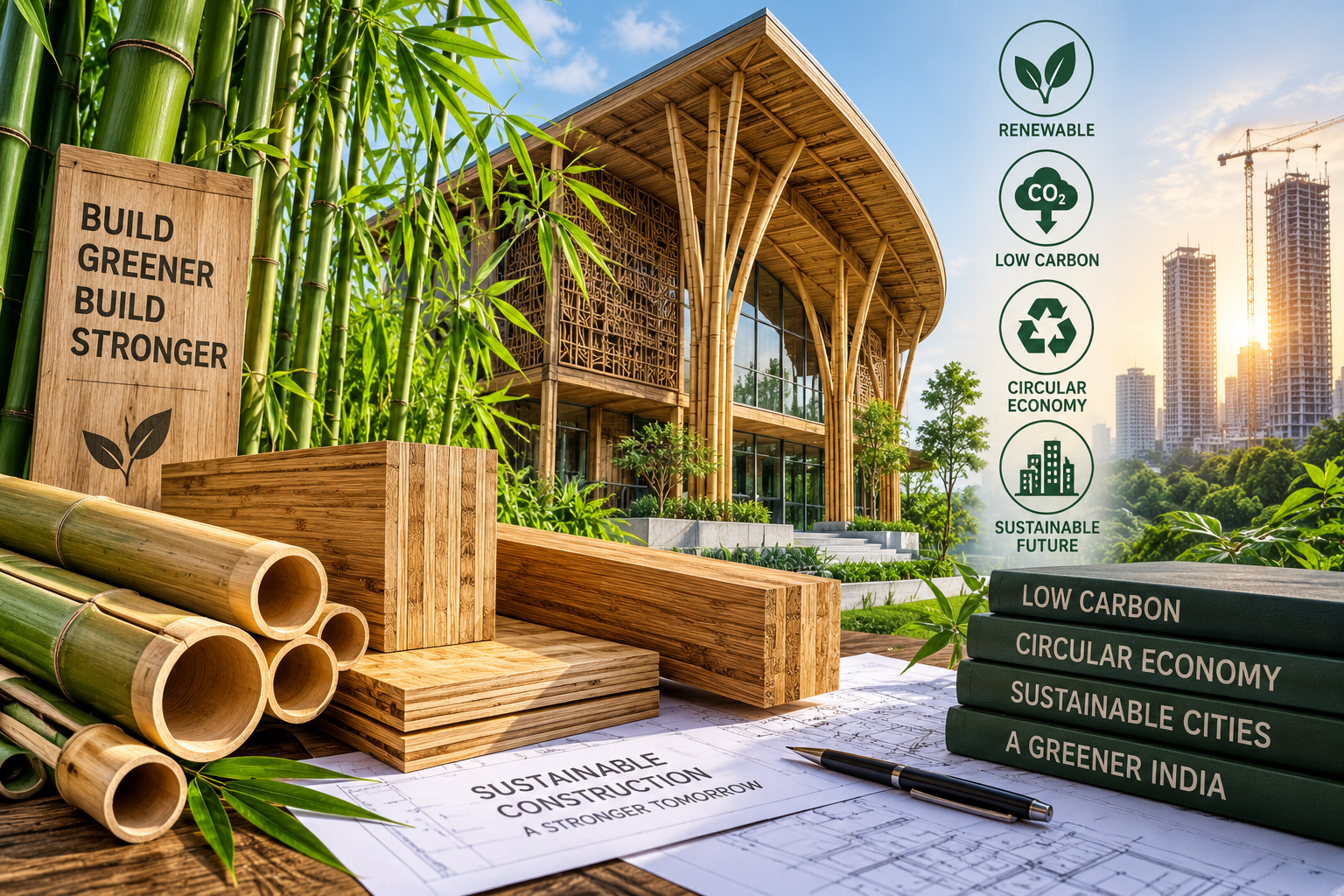
Driven by advanced material science and urgent decarbonization goals, bamboo is stepping out of the craft workshop and into the engineering laboratory. When properly harvested, chemically preserved, and factory-engineered, bamboo becomes a high-performance material capable of replacing carbon-intensive, non-renewable, and forest-depleting alternatives across structural, interior, and envelope applications.
For architects, structural engineers, and sustainable developers, bamboo represents more than just a green gesture—it is a commercially viable, high-strength structural asset for the 21st-century circular bioeconomy.
The Decarbonization Metrics: Bamboo vs. Conventional Materials
To make an objective case to green building evaluators and carbon-auditing frameworks (such as LEED and IGBC), bamboo’s sustainability claims must be grounded in precise empirical data.
Unlike timber, which takes 30 to 50 years to mature, clumping bamboo species reach full structural density in 3 to 5 years. Harvesting bamboo does not kill the plant; the underground rhizome system remains intact, continuously shooting new culms without requiring replanting or topsoil disruption.
When evaluated through Life Cycle Assessments (LCA)—from cradle to gate—the carbon footprint and embodied energy of engineered bamboo present a compelling comparative advantage:
Material | Embodied Energy (MJ/kg) | Embodied Carbon (kg CO2/kg) | Structural / Performance Notes |
Engineered Bamboo (Laminated / Scrimber) | 10 – 12 | -0.5 to -1.3 (Net Negative including biogenic storage) | High tensile strength; renewable raw material cycle of 3–5 years. |
Structural Timber (Hardwood) | 8 – 15 | -0.4 to 0.5 | High performance, but requires 30–80 years to reach harvest maturity. |
Structural Steel | 25 – 35 | 1.8 – 2.2 | Highly energy-intensive extraction and smelting process. |
Primary Aluminium | 150 – 200 | 8.0 – 12.0 | Extremely high embodied energy; best reserved for high-performance skins/frames. |
Reinforced Concrete (M30/M40) | 1.2 – 1.8(Per kg) | 0.15 – 0.25 (Per kg) | Heavy mass weight; major driver of global process-related emissions. |
Data derived from aggregated Life Cycle Assessment (LCA) studies and green building material inventories.
Key Carbon Sequestration and Substitution Metrics:
o Rapid Biomass & Carbon Capture: A well-managed bamboo plantation sequesters between 15 to 30 tonnes of CO_2 per hectare per year, outperforming many fast-growing hardwood species by up to 30–40%.
o Biogenic Carbon Storage: A single cubic metre of engineered bamboo (such as strand-woven or scrimberboard) locks away approximately 1.0 to 1.4 tonnes of atmospheric CO_2 in long-term built structures.
o Embodied Energy Reduction: Substituting primary aluminium decorative louvres or wall panelling with engineered bamboo panels reduces the embodied energy of that architectural component by over 80%.
From Raw Culm to High-Performance Engineered Material
While raw bamboo poles have distinct natural limitations in uniformity and geometry, modern processing eliminates these variability barriers. Strip-processing, strand-weaving, and thermo-density pressing transform raw fibers into standardized building components:
o Structural & Exterior Elements: Glued Laminated Bamboo (Glubam), Bamboo Scrimber beams, columns, trusses, and exterior cladding.
o Architectural Fit-Outs: Bamboo plywood, acoustic ceiling baffles, high-density flooring, door shutters, composite frames, and wall panelling.
International standards have matured alongside these manufacturing advances. ISO 7567:2024 now governs glued laminated bamboo members for structural use, while ISO 23478:2022 sets rigorous test methods for mechanical properties. In India, IS 15912:2018 provides the structural design framework for bamboo housing, supported by extensive technical guidelines from the Institute of Wood Science and Technology (IWST), Bengaluru, and the Bamboo Research Group at IIT Delhi.
Proof of Concept: Modern Infrastructure and Built Legacy
Bamboo is no longer an experimental material restricted to low-cost or temporary structures. It is already shaping mega-scale public infrastructure:
o Kempe Gowda International Airport (Terminal 2, Bengaluru): T2 stands as a monumental proof of concept for green building integration. Featuring extensive engineered bamboo ceilings, screen lattices, and interior pavilions, the project successfully earned LEED Platinum pre-certification and IGBC Platinum certification—demonstrating how bio-based materials can elevate world-class infrastructure without sacrificing luxury or structural compliance.
o Gauhati Airport with Bamboo theme
o New Parliament building entire interior and flooring is from Indian Bamboo engineered wood.
o Urban Transit Infrastructure: The Bangalore Metro Rail Corporation Ltd. (BMRCL) is pioneering bamboo-themed interior designs and architectural features at the Kalena Agrahara (Pink Line) station, alongside theme integration at the Cantonment station.
o Institutional & Public Structures: The three-decade-old bamboo structural buildings at the Forest Research Institute (FRI) campus in Dehradun and IWST Bengaluru, the two-storey Suparba building at Jadavpur University, and the Great Hornbill Gate at Arunachal Pradesh’s Donyi Polo Airport demonstrate long-term durability and structural resilience under varied climatic conditions.
Time-Tested Global Bamboo Landmark Buildings & Their Carbon Savings
These global architectural benchmarks demonstrate bamboo's long-term durability and measurable carbon footprint reduction:
Madrid-Barajas International Airport Terminal 4 (Spain)
Completion Year: 2005
Architects: Richard Rogers Partnership & Estudio Lamela
Scale & Application: Over 200,000 m² of undulating engineered bamboo slat ceilings.
Durability & Performance: Operating continuously for over two decades in a high-occupancy international transit hub without structural degradation or warping.
Carbon Impact: Replacing conventional primary aluminium or steel ceiling panels across T4's massive surface area eliminated an estimated 15,000 to 20,000 tonnes of embodied CO_2 emissions during construction, while permanently sequestering hundreds of tonnes of biogenic carbon in the building envelope.
2. The Arc at the Green School (Bali, Indonesia)
Completion Year: 2021
Architects / Structural Engineers: IBUKU & Atelier One
Scale & Application: A 14-metre-tall, 19-metre-span self-supporting gymnasium roof built using intersecting bamboo arches and double-curved gridshells.
Durability & Performance: Built to withstand tropical humidity and seismic activity using borax-treated Dendrocalamus asper (Petung bamboo).
Carbon Impact: The structural designers calculated that the project achieved a carbon-negative footprint for its structural envelope. The locally harvested raw bamboo sequestered more atmospheric carbon during its rapid 3-to-5-year growth cycle than was emitted across harvesting, local transport, site preparation, and assembly combined.
Ninghai Bamboo Tower (Zhejiang, China)
Completion Year: 2015
Architects / Engineers: Nanjing Forestry University / INBAR
Scale & Application: A multi-storey, 20-metre-tall structural tower constructed using Glued Laminated Bamboo (Glubam).
Durability & Performance: Proves the long-term load-bearing capability, wind resistance, and joint stability of engineered bamboo columns and beams under real-world structural loads.
Carbon Impact: Life Cycle Assessment (LCA) comparison indicates that substituting standard reinforced concrete and structural steel frame systems with engineered Glubam reduced the building's structural embodied carbon footprint by over 60%.
Vedana Restaurant (Ninh Binh, Vietnam)
Completion Year: 2020
Architect: VTN Architects (Vo Trong Nghia)
Scale & Application: A 16-metre-tall, 1,000 m² open-air circular dome crafted from 36 modular bamboo frames using traditional pin and rope joinery.
Durability & Performance: Engineered to endure Northern Vietnam's monsoon climate, heavy rainfall, and hurricane-force winds without structural steel reinforcements.
Carbon Impact: By utilizing locally grown raw bamboo and natural thatch roofing, the structural framework avoided the high-carbon manufacturing footprint of equivalent steel trusses or concrete domes, saving an estimated 120+ tonnes of structural emissions.
Engineering Solutions for Traditional Concerns
For specifiers, material selection hinges on long-term durability, fire rating, and structural predictability.
a. Biological Durability & Termite Resistance: Raw bamboo contains starches that attract borers and fungi. Factory-level vacuum-pressure impregnation using eco-friendly borax-boric acid solutions, followed by controlled kiln drying, removes these starches and fixes preservatives into the fiber matrix—rendering engineered bamboo as resistant to biological decay as treated class-I timber.
b. Fire Safety & Compliance: Like structural timber, engineered bamboo burns at a predictable charring rate, retaining internal load-bearing capacity longer than un-protected steel under elevated temperatures. Furthermore, during manufacturing, flame-retardant additives can be integrated into the resin matrix to achieve Class A fire ratings required by commercial building codes.
c. Adhesive Chemistry & Low Indoor Emissions: The environmental credibility of engineered bamboo relies on responsible processing. To minimize Scope 3 emissions and preserve indoor air quality, specifiers should insist on bamboo boards manufactured with low-formaldehyde or No-Added-Formaldehyde (NAF) resin systems (such as MDI or bio-based adhesives), powered by renewable energy during pressing.
The Macroeconomic and Circular Advantage for India
Promoting an engineered bamboo ecosystem aligns directly with national decarbonization strategies, rural economic development, and forest preservation:
o Preserving Natural Forests: Substituting timber with fast-growing bamboo relieves extraction pressure on natural forests, allowing them to remain intact as primary carbon sinks and biodiversity hotspots.
o Rural Economic Escalation: Industrializing bamboo transforms it from a low-value agricultural pole into an engineered, high-value industrial asset. Establishing primary treatment centers and processing clusters near plantations connects rural farmers directly with urban construction supply chains.
o Prefabrication and Modular Construction:Engineered bamboo’s high strength-to-weight ratio makes it ideal for off-site prefabrication, reducing construction timelines, transport loads, and site-level waste for modular housing, commercial fit-outs, and hospitality resorts.
The Call to Action for Design and Construction Leaders
The transition to sustainable construction does not require an immediate, absolute replacement of conventional materials. It begins with deliberate, high-impact substitutions:
o Phase 1 (Interiors & Fit-Outs): Replace MDF, particleboard, and synthetic panels with NAF bamboo plywood for cabinetry, doors, wall panelling, and acoustic ceilings.
o Phase 2 (Architectural Features & Flooring): Specify high-density strand-woven bamboo flooring, sun-shading louvres, and decorative exterior screens in place of primary aluminium or imported hardwoods.
o Phase 3 (Structural Integration): Incorporate Glued Laminated Bamboo (Glubam) beams, columns, and spatial trusses in low-rise commercial, hospitality, and civic spaces.
India does not need to choose between rapid urban development and environmental responsibility. By elevating bamboo from a humble traditional grass to a modern, engineered building material, architects, engineers, and builders can actively build the future of sustainable Indian architecture.
Let us move beyond merely planting bamboo—let us design, engineer, and build with it.









[[comment.comment_text]]