Hope Is Not a Delivery System

 an hour ago
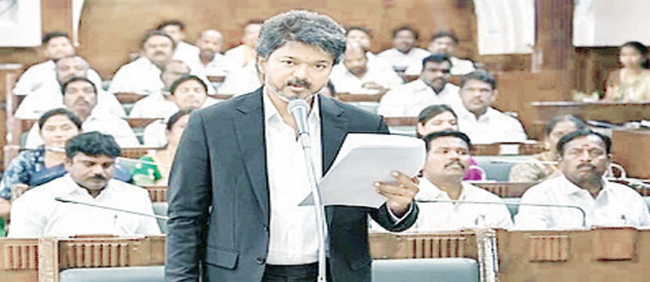
Vijay's government has raised what Tamil Nadu expects of the state. Six months in, it has yet to show it can meet them.
It is whether the clerk looks up, whether a “fee” is quietly demanded, and whether the policeman takes the complaint or the complainant’s patience. Governments are judged here, in these small encounters, far more than in manifesto
Consider what government means to most people in Tamil Nadu. For a daily-wage worker in a district town, it is the electricity counter, the ration queue, the bus fare, and the certificate that should take a day and takes a month. It is whether the clerk looks up, whether a "fee" is quietly demanded, and whether the policeman takes the complaint or the complainant's patience. Governments are judged here, in these small encounters, far more than in manifestos.
That is the standard by which C. Joseph Vijay's government should be judged, and it is a standard he helped set. The 2026 verdict was a vote for a state that treats its citizens as people, not as supplicants. Six months after he took office on 10 May, the honeymoon is over. We think the evidence so far is mixed: ambitious on welfare, uneven on administration, and weakest on the two things TVK promised most loudly, prices and public safety.
A verdict that broke the pattern
The scale of the upset is easy to forget. TVK, a party barely two years old, won 108 of 234 seats in its first Assembly election, with about 35 per cent of the vote. That was ten short of a majority but ahead of both the DMK and the AIADMK, which had alternated in power for more than five decades. Chief Minister M.K. Stalin lost his own seat at Kolathur. This is the first government led by a non-Dravidian party since 1967.
The mandate was, in part, a rejection of dynasty and distance. Voters wanted a politics that was more accessible and more aspirational, and Vijay's years of fan-network organising, his lack of an inherited political family, and his promise of clean governance gave that mood a face. Whatever one thinks of the cinema-to-politics route, the desire it tapped is legitimate and deserves a serious response.
The same verdict made Vijay a coalition leader from the first day. His cabinet includes ministers from the Congress, the VCK and the IUML, and the Congress is back in a state government after nearly six decades. The CPI and CPM gave outside support, and the arrangement has widened to include the MDMK. It has survived a no-confidence motion and won two bypolls, though the margins were modest and show the limits of star power in local contests.
Coalition rule can be a strength, bringing consensus and social breadth to a minority-vote government. It is also a test of maturity, and here the record is uneven. Several orders have been announced, criticised and withdrawn, among them an RTI exemption for the law-and-order department and curbs on student participation in Left-led protests. Partners acting as a check is healthy. A government that has to be corrected so often after it announces things is not thinking them through first.
Welfare with purpose, delivery still unproven
The welfare agenda is the government's best answer to what a humane state looks like. It speaks directly to mobility, education, safety and livelihood. Vijay's first signature provided 200 free units of electricity every two months to households consuming up to 500 units, at a cost of about ₹1,730 crore a year, and it was built into billing systems within weeks. Crop-loan waivers of up to ₹50,000 for marginal farmers, higher procurement incentives for paddy and sugarcane, and 150 days of promised rural work have followed. 717 liquor outlets near schools and places of worship have been closed, and the breakfast scheme has been extended to another 15 lakh students. Laptops for college students, bicycles for Class 11 students and 70,000 concrete houses are in the budget, which the finance minister says carries 125 manifesto promises.
This is bolder than the cautious fiscal habits of the past decade, and we welcome the intent. But much of it remains on paper. Monthly assistance to women heads of households is still ₹1,000, with a rise to ₹2,500 only under consideration. The gold coins for brides and gold rings for newborns are announcements, not yet deliveries. A government that has legislated generously must now show it can count, procure and distribute honestly.
Popularity is not accountability
A leader's popularity is a loan from the public. It becomes accountability only when it is converted into systems that work whether or not the leader is in the room.
There are early signs of discipline. The chief minister is said to be at the Secretariat by nine or ten most mornings, and staff who once drifted in are reportedly arriving on time. The anti-corruption drive has reached former DMK ministers, and a former school education minister has been arrested in a licensing case. Analysts say officials now fear taking bribes. But they also warn that some departments are paralysed by caution, and that pursuing a predecessor's ministers is not proof that the system itself is cleaner. An anti-corruption drive that only ever points at the opposition will be read as politics. It becomes governance only when it changes how an ordinary citizen is treated at the counter.
Industry is a bright spot in the announcements. The government claims investment agreements worth over ₹1 lakh crore and the potential for more than a lakh jobs. But memoranda are intentions, not factories. The test will come in land allotments, power connections and approvals over the next two years.
What the auto driver knows
Ask an auto driver in Chennai what has changed in six months, as we did, and the answer comes quickly. Inflation, he told us, has risen more under this TVK government in six months than during the entire AIADMK tenure.
We cannot verify the final claim, and no honest editorial should pretend to. But the feeling behind it is backed by the official numbers. Tamil Nadu's retail inflation was 7.29 per cent in October, against 6.09 per cent nationally, the highest among states with more than 50 lakh people. In September it was already first among large states at 6.81 per cent, and in January it was only about 3.35 per cent. Rice, the state's staple, shows the squeeze: the average retail price was ₹61.66 a kilogram in September against ₹46.20 for the country. Fine varieties are reported to have risen by up to 35 per cent in a month, and wholesale toor dal in Chennai climbed from about ₹125 to ₹150 a kilogram between September and the festive season.
Three caveats are in order. The surge is national: inflation across India has risen every month since January, from 2.74 per cent to 6.09 per cent, partly because last year's base was unusually low. The monsoon, higher input costs and tight supplies of fine rice varieties are not of any state government's making. And the driver's comparison with the AIADMK years cannot be tested cleanly, because the official consumer price series with a 2024 base only began in January 2026 and the older series used a different basket. As a general recollection that readers can check, national inflation ran in high single digits in the early 2010s, which overlaps the AIADMK years. So "worse than ever" is unproven.
What is not in doubt is that a state which started the year below the national average is now well above it, and that households noticed before the statistics were published. The government's response also deserves scrutiny. Onions went on sale at ₹35 a kilogram through 8,739 ration shops only from 3 September, after the opposition and even TVK's own allies raised the issue in the Assembly. Fine rice at ₹30 a kilogram and stock limits on paddy, rice and key pulses followed the October figures. A subsidised Diwali vegetable kit came in November. Ministers say they track 41 essential commodities daily and weekly. Each measure is sensible. Each also came after the damage had reached the kitchen. Opposition leaders have exaggerated the picture, with Mr Stalin declaring Tamil Nadu "number one" in inflation and Edappadi K. Palaniswami putting the rise in essential items at 20 per cent, a figure that is his own and not an official one. But the underlying complaint is fair. When a driver in Chennai says the money no longer stretches, he is giving this government its first real report card.
Safety, the other promise
TVK sold itself as the answer to the DMK's record on crime, violence against women and drugs, which means every major crime now lands in its account. On Diwali day, more than ten murders were reported across the state. A Coimbatore student was killed after, his family alleges, he reported drug use in his hostel. Prison security has been questioned after jailbreaks, and courts have criticised the use of criminal law in what looked like a personal insult, a warning about how eager the police may be to please.
The Singappen force, launched with about ₹354 crore, and the 65 anti-narcotics units sanctioned at ₹264 crore are serious commitments. But policing researchers note that Singappen's units are small, that it cannot register FIRs on its own, and that visible patrols are not the same as lower crime. The better investment is in investigators, forensics and survivor-sensitive prosecution. Minister Arunraj says crime is lower than in previous years and cannot be eliminated in six months. That may be so, but it is a hard argument to win in the week of a Diwali murder spree.
On the Centre, Vijay has chosen pragmatism, seeking release of ₹3,284 crore in Samagra Shiksha funds, opposing NEET and a three-language formula, and meeting both Narendra Modi and Rahul Gandhi. The dissolution of the Justice Kurian Joseph committee on Union–state relations has handed critics an easy charge, and the government has not explained it well enough.
The last-mile test
Everything above comes down to one question. Does the benefit reach the intended person, on time and without a bribe?
The free-electricity scheme is partly a success: billing was updated quickly, the subsidy sanctioned and about 1.46 crore households brought in. Yet confusion over who qualifies, and complaints of higher bills after a record-demand summer, show what happens when a good scheme is explained badly. A benefit that does not lower a household's bill is a hard message to sell. The laptops, cycles and gold coins face harder tests, because each depends on identifying beneficiaries, buying honestly and distributing without leakage. A laptop that arrives late, a cycle that is substandard, a coin that requires a favour to a local functionary: any of these would do more damage to the idea of a humane government than a hundred speeches could repair.
What we would ask of the government
We think three things would show that Mr Vijay understands this.
First, publish delivery data for every flagship scheme, district by district: applications received, benefits reached, time taken. A government that asks to be trusted should show its work.
Second, build a grievance system with a fixed deadline and a named official, so that the worker in the district town knows exactly whom to hold responsible.
Third, act on prices before the opposition raises the alarm. Daily monitoring of 41 commodities is useful only if it triggers action early. Fine-rice procurement, stock limits and ration-shop sales should be ready before a festival season, not announced after one.
The fiscal question will also come to a head soon. Welfare has been widened faster than the revenue to fund it, and the state cannot indefinitely pay for both a generous safety net and credible investment promises. Choosing which promises matter most, and saying so openly, is better than letting every pledge compete for the same rupee.
Converting hope into public value
There is a danger in judging a six-month-old government too harshly, and a larger one in judging it too generously. Mr Vijay has held a fractious coalition together, launched an unusually ambitious set of schemes and brought a visible discipline to the Secretariat. He has also presided over rollbacks, an unsteady law-and-order picture and a cost-of-living problem that now shows up in the national statistics.
His supporters say no government can fix Tamil Nadu in six months. His opponents answer, with some justification, that a government elected on the promise of change cannot ask for the patience earlier governments were granted. Both are partly right. The fairest test is simple. A year from now, the woman in the district town should find the counter staffed, the bill explained, the benefit in her account and the price of rice back within reach, and the auto driver should no longer say things were easier before. If that happens, the generational moment of 2026 will have mattered. If not, it will be remembered as a very well-produced introduction.
(The author, currently pursuing a Master’s degree in Journalism from Maharaja Sayajirao Univer sity of Baroda, is the founder of blogging site: dumpyourthoughts.wordpress.com)



[[comment.comment_text]]