India’s Demographic Shift

 an hour ago
(Religious Composition, Fertility Rates and the India of 2070)
The Future of World Religions: Population Growth Projections, 2020 2070, a research published on November 18, 2026, by the US-based Pew Research Center, is very important in this regard
Potential changes in India's religious makeup are closely linked to social pluralism, national identity, and future politics in addition to being an issue of demographic statistics. It is considerably more crucial to comprehend the real demographic reasons behind this shift in the midst of mounting concerns and political accusations regarding the shifting demographic balance between Muslims and Hindus. The Future of World Religions: Population Growth Projections, 2020–2070, a research published on November 18, 2026, by the US-based Pew Research Center, is very important in this regard. The study anticipates how the world's religious landscape might change over the next fifty years, taking into account seven major religious groupings in 201 countries and territories. What is changing in India's religious demographic equation and what are the driving causes behind it is the main question.
The Changing Demographic Equation
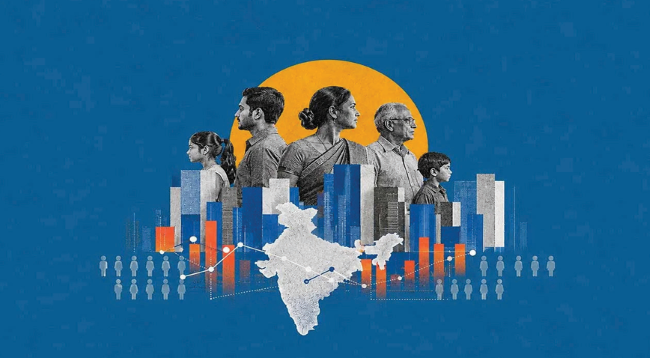
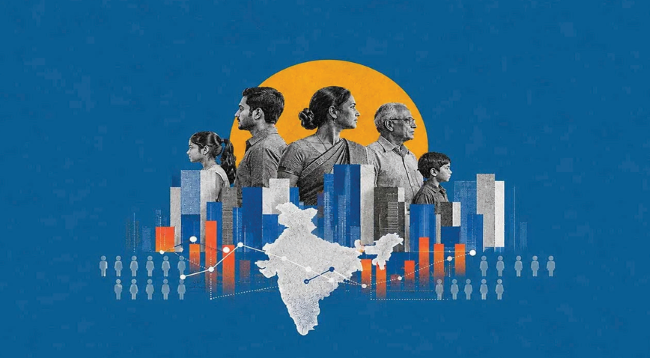
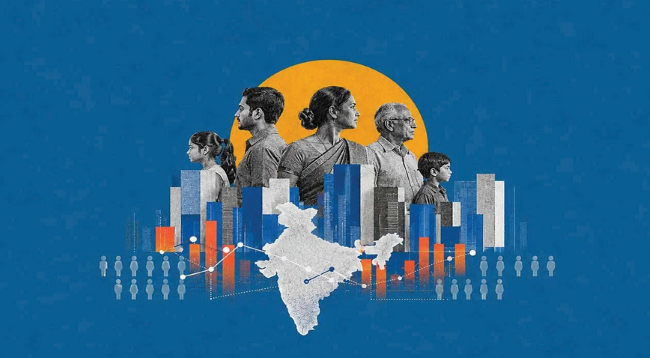
India will continue to be a Hindu-majority nation until 2070, according to Pew Research Center estimates; however, the relative sizes of its religious sects are anticipated to shift. In 2020, Hindus made up 79.4% of India's population; by 2070, that percentage is expected to drop to 75.8%. On the other hand, the percentage of Muslims may increase from 15.2 to 19.6%. While the percentage of Buddhists may slightly decrease from 0.7 to 0.6 per cent and that of other religions from 2.5 to 1.8 cent, Christians are predicted to stay at 2.2 per cent.
These numbers show variations in the growth rates of different communities rather than a fall in the Hindu population. A community's population growth and its proportion of the overall population are two different demographic processes. The Hindu population in India was estimated to be 111 crore (1.11 billion) in 2020 and is expected to grow to 129 crore (1.29 billion) by 2070. This is an approximately 17.6 crore (176 million) rise. However, because other communities are expected to develop at somewhat higher rates, its share of the nation's total population may decrease despite this significant numerical expansion. Therefore, it would be a basic misinterpretation of demographic data to interpret a reduction in percentage share as a true population decline.
The study conducted by the Prime Minister's Economic Advisory Council (EAC-PM) is also worth taking into account in order to comprehend the historical trajectory of this transition. Its conclusions show that the Hindu population proportion of India fell by 6.62 percentage points, from 84.68 percent in 1950 to 78.06 per cent in 2015. On the other hand, a number of minority groups, including Muslims, Christians, Buddhists, and Sikhs, saw an increase in their population shares. The Pew study provides forecasts for a potential future, whereas the EAC-PM study looks at demographic shifts over previous decades. Both need to be comprehended in light of their own analytical and historical settings.
The global viewpoint gives this demographic shift an additional significant dimension. 94.5% of the Hindus worldwide lived in India in 2020. India's Hindu population is expected to increase to 129 crore (1.29 billion) by 2070, but its proportion of the world's Hindu population is expected to drop to 93.6%. The number of Hindus worldwide could rise by about 19.9 crore (199 million) throughout that time, despite the fact that their proportion of the world's population decreases from 15 to 14%. The number of Hindus in Pakistan is also expected to rise, from 50 lakh (5 million) to 1.03 crore (10.3 million). It is anticipated that natural population growth would be the main driver of this expansion.
Fertility and Age: Drivers of Demographic Change
The Pew Research Center claims that age distribution and fertility rates are two important variables that could influence shifts in India's religious makeup. Hindu women's average fertility rate has decreased from 3.3 to roughly 1.9 children per woman during the last thirty years. The fertility rate is expected to be 2.3 for Muslim women and 1.8 for Hindu women in 2025–2030. Although the disparity still exists, it is evident that fertility rates have decreased in both cultures.
Age is the second important element. Muslims in India had a median age of 24 in 2020, while Hindus had a median age of 29. There is more room for population expansion in a comparatively younger population since there are more individuals in their reproductive years. Population momentum is the term used by demographers to characterise this phenomena. It implies that a younger population can continue to produce a comparatively high number of newborns for a while even when fertility rates drop.
This distinction shouldn't be seen as permanent, though. All communities' reproductive trends have been impacted by factors such as education, urbanisation, women's economic engagement, access to healthcare, and family planning. India's overall fertility rate fell to 2.0, below the replacement level of 2.1, according to NFHS-5 (2019–21).
Therefore, no single factor is responsible for India's shifting religious demographic landscape. Fertility rates, age distribution, and broader socioeconomic changes all work together to develop it. Pew's forecasts present a potential future rather than an unchangeable forecast. Education, healthcare, economic growth, and shifting social conditions have the potential to drastically change these population trends over the ensuing decades.
A Smaller Share, Not a Smaller Population
By 2070, the proportion of Hindus in India's population may decrease, according to Pew's forecasts. However, this does not imply a decline in the Hindu population as a whole. Conversely, between 2020 and 2070, the Hindu population is expected to grow by almost 176 million. It is anticipated that the Muslim population would also increase, albeit at a somewhat quicker pace, possibly increasing its proportion of India's total population to about 19.6%.
Absolute population counts and their percentage of the total population are fundamentally different. It is a statistical fallacy to interpret a decrease in one group's demographic share as a decrease in its actual population or to interpret the expansion of one community as the defeat of another. Fertility patterns, age structures, and current socioeconomic situations are reflected in demographic proportions, which are not a contest.
Fertility Decline and Social Change
It would be insufficient to analyse India's reproductive patterns only from the perspective of religious identity. Socioeconomic factors like education, income, urbanisation, women's decision-making authority, healthcare access, and child mortality rates also influence family size.
India's overall fertility rate fell to 2.0, below the replacement threshold of 2.1, according to the National Family Health Survey (NFHS-5, 2019–21). The age at which a woman marries, her choice of motherhood, and the size of her family are all significantly influenced by her level of education. Women are empowered to make better family planning decisions and have more agency when they are economically independent and educated.
Therefore, it would be deceptive to attribute variations in fertility rates within religious communities exclusively to religious views. Demographic outcomes are equally influenced by structural variables, such as the gap between rural and urban areas, economic disparity, and educational discrepancies.
India 2070: Beyond Demographic Predictions
The Pew Research Center report offers statistical forecasts based on current demographic patterns rather than a precise vision of the future. Age structures, international migration, fertility and mortality rates, and religious conversion are all taken into consideration in these forecasts. The 2011 Census and accessible surveys are the main sources used to estimate India's population's religious makeup in 2020. The lack of more recent official census data undoubtedly impacts the accuracy and dependability of these estimates because the 2021 Census could not be completed on time.
Furthermore, over the next fifty years, advancements in healthcare, education, economic expansion, women's empowerment, social conditions, and governmental regulations could drastically change current population trends. Consequently, it would be deceptive to consider the 2070 projections as the final reality. They only suggest the future's potential course in light of the current situation; they do not declare the future.
India in the Global Religious Shift
Significant changes in the world's religious landscape are also indicated by the Pew survey. By 2035, Muslims may surpass Christians, according to its forecasts. Muslims are predicted to make up 35.8% of the global population by 2070, while Christians will make up 29.1%. India may have the second-biggest Muslim population in the world by 2070, after Pakistan, while still having the greatest Hindu population. This is an important result for the country.
It would be inaccurate, nevertheless, to read these forecasts as proof of an increasing representation of all minority communities. While the overall fraction of Buddhists and adherents of other religions may somewhat decrease, the proportion of Christians is predicted to be quite unchanged. Sikhs have been classified with other religions rather than in a different category. Therefore, varied tendencies across many communities rather than a uniform demographic shift characterise India's evolving religious landscape.
Facts Versus Fears
In India, issues pertaining to religion and demographics often transcend social debate and turn into tools of political division. Variations in fertility rates are sometimes cited as proof of approaching religion domination or demographic imbalance. However, it is crucial to separate the political interpretation of demographic statistics. It is neither supported by science or democratic judgement to see the anticipated expansion of one group as a threat to another.
The results of the Pew Research Center must likewise be interpreted in this light. Recognising that fertility has decreased in all major religious communities over the past few decades is just as important as paying attention to variations in fertility rates. Education, the state of the economy, access to healthcare, and women's social standing are some of the elements driving this change. Therefore, addressing fundamental socioeconomic disparities rather than religious concerns is the solution to demographic difficulties.
Human dignity, equality, and religious freedom are all guaranteed by the Indian Constitution. Therefore, education, healthcare, women's empowerment, and voluntary family planning should be the driving forces behind population policy rather than fear of any certain religion. The destiny of a country should be decided by equal rights and opportunities for all of its residents, not by the size of its religious congregations.
India's Prospects:Harmony Over Numbers
The report by the Pew Research Center is a statistical analysis of shifting demographic realities rather than a warning of any religious threat to India's future. According to its predictions, Muslims may make up as much as 19.6% of the population in 2070, although Hindus will still make up the majority in India. Rather than just religious identification, the underlying causes include variations in reproduction rates and the comparatively younger age distribution of the Muslim community. These are forecasts, not an unchangeable image of the future, nevertheless.
The study's true message is that a variety of factors, including education, economic conditions, healthcare, women's social position, and access to family planning, influence population dynamics in addition to religion. It is significantly more crucial to comprehend the underlying social and scientific causes of shifting religious proportions rather than using them as justifications for political division, mistrust, or terror.
The true challenge facing India is not which religion will make up what percentage of the population in 2070, but rather how much poverty, inequality, and illiteracy the nation will have eradicated by then. A country's strength is determined by equality, opportunity, and constitutional trust among its citizens rather than by the numerical balance between its majority and minority communities.
India's diversity is its essence. Strengthening the democratic awareness that transcends religious affiliations and ensures that every citizen has equal rights and dignity is considerably more important than the shifting demographic figures. India's future will ultimately depend on its social cohesion and democratic maturity rather than the religious makeup of its populace.
(Author a doctorate in laws, is a senior lawyer, columnist, and civil society activist.)




[[comment.comment_text]]