Advantage SP or BJP’s Edge? The Real Takeaways from the Council Polls in U.P.

 2 hours ago
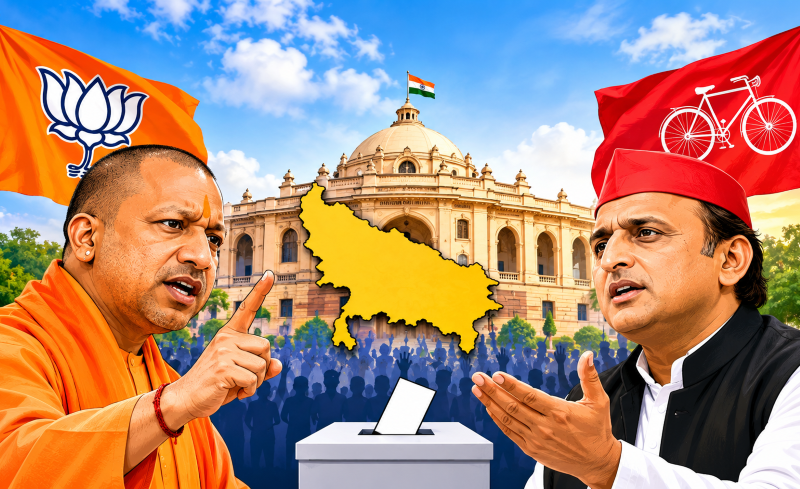
The results of Uttar Pradesh’s Legislative Council polls for five graduates’ and six teachers’ seats, declared on October 29, held few shocks. Both main parties finished roughly where pre-poll chatter had placed them. The BJP managed to keep its overall tally of six seats, while the Samajwadi Party (SP) grew its presence from three seats to five. The SP wrested the Lucknow graduates' seat from the BJP, took the Agra teachers' seat from an independent contender, and held both Varanasi seats within the Prime Minister's own parliamentary constituency. In turn, the BJP captured the Gorakhpur-Faizabad teachers' seat on Chief Minister Yogi Adityanath’s home turf.
One outcome is obvious from these Council polls: Uttar Pradesh politics is rapidly settling into a direct, two-horse race. In ten of the eleven contested seats, the BJP and the SP finished directly in first and second places. In the eleventh constituency of Gorakhpur-Faizabad, an independent candidate pushed the BJP candidate close. Meanwhile, former heavyweights like the Bahujan Samaj Party (BSP) and the Congress did not field any candidates for these elections.
These council results suggest that the Samajwadi Party's performance in 2024 was no mere passing storm. When the SP-led opposition alliance won 43 of the state's 80 Lok Sabha seats, many in the ruling camp wrote it off as a temporary anomaly driven by transient anxiety over the Constitution, tired local candidates, and a listless cadre. Two years on, the SP's political revival looks deeply rooted across the state's electoral map.
However, these Council polls also indicate that neither the BJP nor the SP has established a decisive, overwhelming lead over the other. The political contest between both regional titans remains fiercely balanced, and the fight for total dominance in the state is very much ongoing.
At the same time, analysts should be cautious not to read too much into these specific election outcomes. Only about 14.8 lakh people were eligible to vote, representing around one in a hundred of the state's total voting electorate. Furthermore, these voters represent a distinct demographic: registered graduates and teachers who are largely urban, educated, and salaried. No definitive legislative assembly forecast can be built on such a narrow subset of voters. What the results do highlight is the direction of an alert, opinion-forming slice of the electorate, and that specific group leaned a bit further toward the SP this time.
On the BJP's side, Chief Minister Yogi Adityanath actively campaigned for the party's candidates across all eleven seats, while the SP relied largely on local leaders. Nearly a decade into his tenure, the Chief Minister remains the BJP's most potent and recognizable face in the state. His core pitch centering on strict law and order, direct welfare delivery, and Hindutva remains crisp, and no internal party rival comes close to challenging his leadership standing.
When Yogi Adityanath's personal appeal is combined with the BJP's relentless election machinery, it produces a formidable winning formula. The BJP seldom loses an election due to a lack of operational effort. Few political parties in India match its organizational discipline: structured booth committees, active panna pramukhs, meticulously calibrated local caste balances, and a quick readiness to adjust candidates or messaging whenever ground dynamics shift.
While the SP has earned its moment to celebrate, critical challenges lie ahead for party leader Akhilesh Yadav. The first major hurdle concerns its relationship with the Congress party. The alliance bore fruit in 2024 when Congress converted its ticket share into six parliamentary seats, but current seat-sharing bargaining has turned tense. Congress is demanding well over 150 seats for upcoming assembly polls, whereas the SP is reportedly weighing a limited offer of 60 to 70 seats, leading to public friction and premature posturing by local leaders.
Akhilesh Yadav must carefully decide what role Congress should play in his broader coalition strategy. The party can serve as a valuable partner that helps consolidate Muslim votes, attracts slivers of upper-caste and Dalit voters, and provides national weight to the front. Conversely, it risks becoming an electoral drag if it remains adamant about contesting seats it cannot realistically win, similar to past dynamics in Bihar. Giving up too many viable seats to Congress presents a serious strategic risk for the SP.
The most crucial question facing the SP, however, is whether Akhilesh Yadav can successfully expand his core Pichhda, Dalit, Alpsankhyak (PDA) coalition beyond its traditional boundaries. It remains uncertain whether high-caste communities like Pandits will vote for the party in sufficient numbers, or if SP can allocate enough seats to non-Yadav groups without alienating its core base. Balancing these distinct social groups is essential if the SP wishes to overcome its historical reliance on Yadav-Muslim support.
Meanwhile, Mayawati's BSP remains an unquantified variable in the state's political calculus. Although Mayawati maintains that her party will contest elections independently and has initiated Brahmin outreach alongside organizational reviews across all 75 districts, the party's electoral clout has waned significantly. Having won 206 seats in 2007, the BSP was reduced to just one seat in 2022 with a vote share dropping below 13%. Sitting out the Council polls reflects an ongoing strategy of electoral absence. If she manages to mobilize her Jatav base, it could split the anti-BJP vote and hurt the SP; if she cannot, the direct two-horse race between BJP and SP will only solidify further.
With the next assembly election still months away, much can change in Uttar Pradesh's fast-moving political landscape. A single issue, such as ticket distribution disputes, seat-sharing disagreements, new government welfare rollouts, or a major campaign statement, can quickly reset public sentiment. Furthermore, campaigns surrounding electoral integrity and voter roll updates remain an ongoing political debate, though it is unclear whether such issues will deeply resonate with voters or ultimately benefit the ruling party or the opposition.
In politics as in sports, winning frequently becomes a habit built on structural advantage. Recent international elections—such as Lula da Silva securing a victory in Brazil or Benjamin Netanyahu's Likud retaining its position as the largest party in Israel—demonstrate that established leaders backed by disciplined, well-oiled organizations are difficult to unseat. That organizational strength remains the BJP's primary advantage in Uttar Pradesh. The SP's ongoing challenge is to prove that its recent gains mark the start of a sustained upward trend rather than a temporary peak, and while these Council results offer a supporting case, the ultimate contest is far from decided.
(Author, a senior trilingual journalist, is an editorial adviser to TEW.)





[[comment.comment_text]]