Broken Promises, Lost Futures: Why Gen Z Won’t Forgive Punjab’s Political Class
 2 weeks, 6 days ago
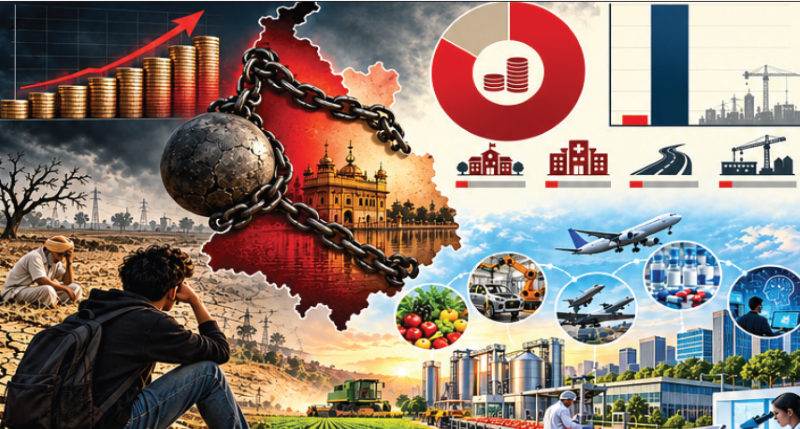
The acute fiscal stress confronting Punjab has mortgaged its economic future. This has destroyed intergenerational equity by saddling future generations with an insurmountable debt burden, eroding the state’s fiscal autonomy. It is the consequence of conscious and disastrous policy choices made by the political class over the past 30 years.
The state has been living beyond its means for well over a couple of decades. Outstanding liabilities are projected to reach Rs 4,47,754 crore by March 2027, roughly 45% of the Gross State Domestic Product (GSDP), a ratio that has stubbornly hovered between 43% and 48% despite nominal growth in GSDP.
The Comptroller and Auditor General (CAG) has flagged off-budget borrowings of Rs 4,092.78 crore raised through public sector undertakings and parastatals as of March 2024, liabilities that do not flow through the consolidated fund but must still be serviced from the budget. Today, that figure stands at Rs 23,654 crore.
Debt servicing alone is estimated at over Rs 42,000 crore in 2026-27, with interest payments consuming 20-25% of the revenue receipts. The share of capital expenditure has collapsed to under 5% of the total spending, at just 3.88% of the total expenditure in 2023-24 and only 4.4% of the total borrowings deployed for asset creation.
The committed expenditure (salaries, pensions and interest) averaged around 78% of the revenue receipts between 2019 and 2024, rising to 80% in 2023-24. A state that commits four-fifths of its recurring income before it has funded a single school, hospital or road has already surrendered the discretion that fiscal policy is supposed to confer. The revenue deficit has widened from Rs 7,311 crore in 2016-17 to Rs 27,007 crore in 2025-26 (revised estimates), and the fiscal deficit for 2026-27 is budgeted at Rs 39,971 crore (4.1% of GSDP).
The political economy that produced this outcome is not a mystery. The credit is due (no pun intended) to governments of different parties that found it electorally advantageous to expand committed expenditure and off-budget liabilities while deferring the adjustment costs to a successor government.
Freebies, particularly power subsidies that absorb around 20% of the revenue receipts (making it the highest subsidy-to-revenue ratio among all states), have become a symbol of a governing model that treats the treasury as a patronage instrument rather than a development instrument. The result is a budget in which over 90% of the projected revenue receipts are consumed by interest, salaries, pensions and power subsidy, leaving barely Rs 11,000 crore for infrastructure and flagship schemes.
The incoming government in March 2027 will inherit a budget in which the first charge on revenue is not its own manifesto but the accumulated claims of its predecessor governments. The State Finance Commission projects that the debt-to-GSDP ratio could rise to 62% by 2030-31 if present trends continue.
The first part of any corrective action requires political will and courage to confront the myopia of short-term electoral gains. Overwhelming and wasteful social welfare expenditure on freebies must be radically restructured. It is not the duty of the state to provide unnecessary handouts or subsidise consumption for all; its fundamental duty is to create social overhead capital and foster efficient community resources that empower citizens to become productive agents of economic growth.
The “aamdani athanni, kharcha rupaiya” phenomenon that a proud Punjabi must now confront is a reality that the state’s political class has long refused to acknowledge. The pursuit of fiscal prudence is a precondition for development.
The second, and more hopeful, part of the corrective action is to break free from the intellectual and economic shackles of the past. Punjab must stop seeing itself as an agricultural state that needs industry and, instead, reinvent itself as an advanced agri-industrial state where its farms feed its factories. This requires a conscious move away from the low-value, water-intensive paddy-wheat cycle and towards high-value horticulture, food processing and agricultural exports.
Economic zones, anchored by specialised industrial nodes, would allow the state to build on existing capabilities. The north zone (Pathankot and Gurdaspur) could specialise in defence and aerospace components, avionics and precision engineering, leveraging its proximity to major military installations. This would be the dual-use, high-tech hub, with horticulture focused on high-value, perishable produce for the air-freight market.
The central-west zone (Amritsar and Tarn Taran) could focus on processed vegetables, fruits, dairy, spices and ready-to-eat foods, leveraging the airport for cargo. It could also expand into textiles, sports goods and light engineering. The central zone (Ludhiana, Jalandhar and Kapurthala) must be encouraged to move up the value chain, from bicycles to e-bikes, motors and exports; from simple machine tools to advanced manufacturing and railway equipment, building on the Rail Coach Factory in Kapurthala.
The south-west zone (Bathinda, Mansa and Ferozepur) can become the agro-processing capital, specialising in agricultural machinery, seed processing, and solar and electrical equipment. The districts of Rupnagar, Shaheed Bhagat Singh Nagar (Nawanshahr) and Hoshiarpur can easily become an extension of the Baddi pharma ecosystem.
Finally, the east zone (Mohali, Patiala and Sangrur) should be a niche hub for AI, software, biotechnology, medical technology and semiconductor design, creating a seamless pipeline from universities to laboratories to start-ups and product companies.
To connect these nodes to the world, a network of airport-oriented export hubs is critical. Amritsar, Mohali, Halwara, Adampur, Bathinda and Pathankot airports must be transformed into dedicated freight terminals that fly high-value, low-weight goods. The roadmap must also include an energy strategy that targets solar, biomass and storage solutions, and a long-term plan to develop 1,400 MW of nuclear capacity by 2040, ensuring reliable and clean power for new industries.
For a skilled workforce, an industry-run skills centre at every node and university research parks at Mohali, Patiala, Ludhiana and Amritsar are non-negotiable. Unlike Gujarat or Maharashtra, which have coastal and industrial advantages, Punjab must carve its own identity, becoming India’s first large-scale, integrated agro-industrial, engineering, digital and high-value horticulture state.
The political challenge is formidable because fiscal prudence imposes concentrated costs on organised interests, while its benefits are diffused and delayed. That is why it cannot be the project of a single party or government.
Unfortunately, the political class in Punjab has failed to look beyond electoral dividends, right from its trifurcation in 1966 and more so after the end of Pakistan-sponsored terrorism in 1995.
Punjab needs a multi-partisan fiscal consensus, a 1991 moment, to commit to a medium-term expenditure framework for reducing the revenue deficit and raising the capital expenditure share from below 5% to at least 10-20% of the total spending within the next five years.
The off-budget borrowings must be consolidated into the budget and disclosed in a single statement. Asset monetisation must be treated as a one-time bridge rather than a recurring financing strategy because pawning government assets to pay salaries is liquidation, not fiscal management.
The debt trajectory can be stabilised if nominal GSDP growth exceeds the effective interest rate and the primary deficit is reduced considerably, but the arithmetic only works if the political class accepts the discipline of a rule that binds successors as well as incumbents. That is a project worthy of Punjab, Punjabis and Punjabiyat. It’s the only one that can surmount the cruel calculus of being labelled as a laggard state, which is defined today by the spectre of narco-terrorism that holds it by the jugular.
.(A senior parliamentarian and former Union Minister, the author served about a decade as president of the National Students’ Union of India and the Youth Con-gress prior to entering the Lok Sabha.)

[[comment.comment_text]]