Erratic monsoon raises questions over the resilience and quality of government construction

 1 month, 1 week ago
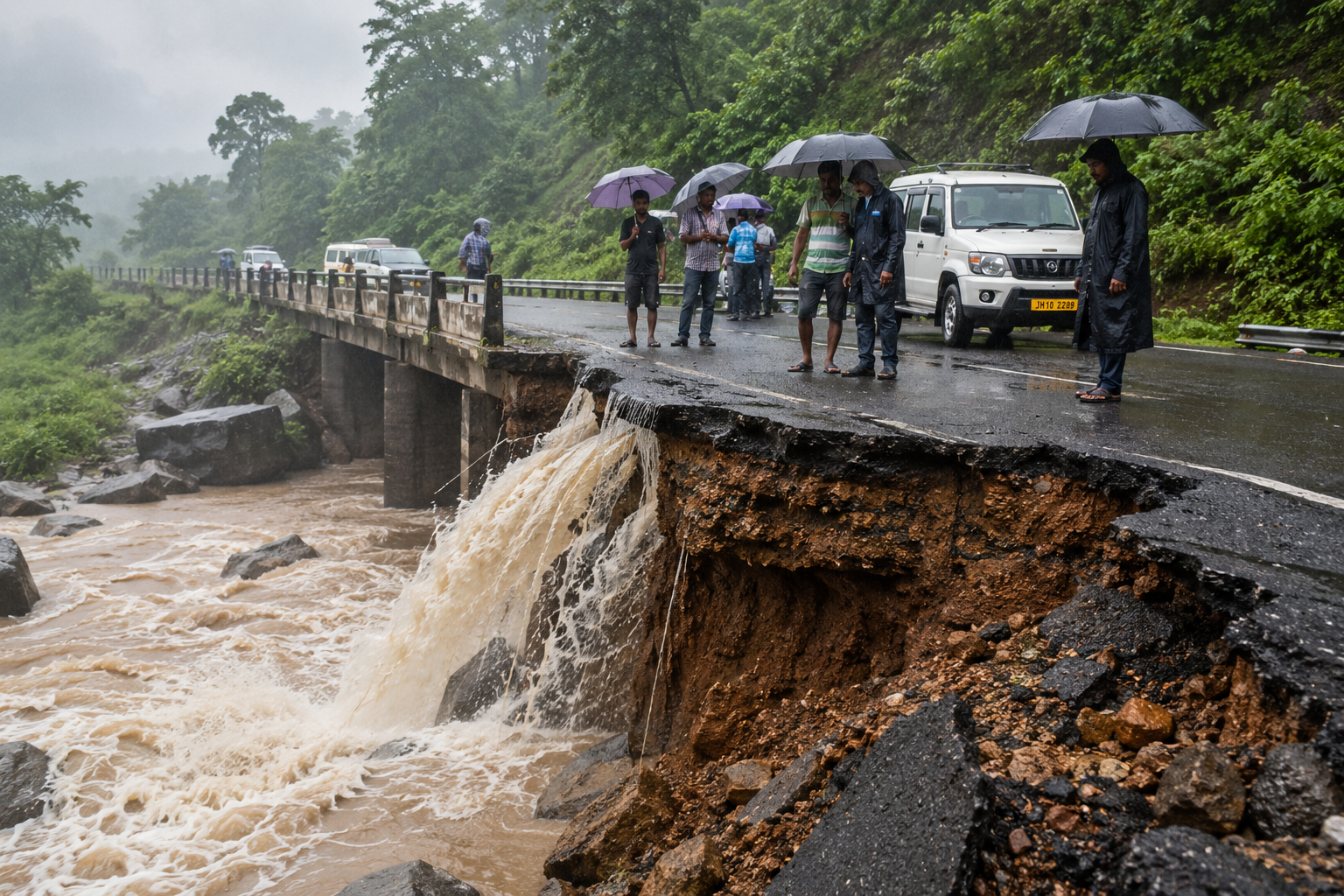
Jharkhand is witnessing an increasingly uneven monsoon pattern this year, with some areas receiving heavy rainfall while others are experiencing comparatively less rain or only intermittent showers. The changing and unpredictable nature of rainfall is no longer merely a concern for agriculture. It is also posing a serious challenge to the state’s roads, bridges, drainage systems, government buildings and other public infrastructure projects.
The emerging question is straightforward but significant: Are Jharkhand’s public infrastructure projects being designed and constructed to withstand changing weather conditions and sudden episodes of intense rainfall?
Every monsoon, reports emerge from different parts of the state about damaged roads, washed-away diversions, waterlogging and damage to structures that are either newly constructed or still under construction. In several places, heavy rainfall has severely affected connectivity and created the need for repeated repairs. These incidents, however, should not be viewed merely as evidence of the force of nature. They also raise questions about whether adequate consideration was given to rainfall intensity, drainage, soil conditions, natural water flow, slope stability and long-term structural resilience at the planning and construction stages.
Natural Disaster or Weak Construction?
Whenever a road, bridge or building is damaged during heavy rainfall, it is easy to attribute the entire incident to a natural disaster. But a proper technical assessment should go beyond that explanation.
Several questions need to be examined in every such case:
Was a proper hydrological study conducted while preparing the Detailed Project Report (DPR)?
Was the soil tested and a comprehensive site survey carried out?, Was adequate drainage provided?, Was the structure built according to prescribed technical standards?, Was the quality of construction material independently tested?, Were engineers conducting regular and meaningful site inspections?, Were payments released on the basis of actual and quality work? The answers to these questions can help establish whether the failure was caused primarily by exceptional natural conditions, deficiencies in design, poor construction, inadequate quality control or weak supervision.
Past CAG Reports Have Also Raised Concerns, Questions concerning the implementation, monitoring and supervision of government construction projects in Jharkhand are not entirely new. Past reports of the Comptroller and Auditor General of India (CAG) have highlighted irregularities in different areas of public works, including issues related to contractual compliance, recovery of dues, engineering supervision, project delays and deficiencies in planning and DPR preparation. Although such audit observations relate to specific projects and periods, they raise a broader institutional question: Have the weaknesses identified in the past been fully addressed, or do gaps in monitoring and accountability continue to exist in some projects? The issue is particularly important because delays and quality deficiencies in public works ultimately have a direct impact on citizens as well as the public exchequer.
Contractor-Engineer Nexus Needs Evidence, Not Assumptions
There is often public discussion about the close relationship between contractors and officials involved in construction projects and whether such relationships can compromise quality. However, allegations of a “nexus” between contractors and engineers should not be treated as established facts without a proper investigation and supporting evidence. At the same time, transparency in the construction system can significantly reduce the scope for irregularities and improve public confidence. Experts and citizens can reasonably demand stronger mechanisms such as third-party quality audits, geo-tagging of projects, digital measurement books, independent technical inspections and public disclosure of project progress. Information regarding administrative approvals and various projects is made available by government departments. The system could become more transparent if details such as project cost, executing agency or contractor, sanctioned completion period, actual progress, quality-test results and action taken in cases of deficiencies were made easily accessible to the public.
Delayed Projects Mean Higher Costs and Lower Public Trust
When a government building, road, bridge or other public project is not completed within the stipulated period, the loss is not limited to financial expenditure.
An incomplete project can:
delay public services → increase costs → increase exposure to weather-related damage → create additional repair requirements → and ultimately weaken public confidence. Past audit observations concerning Jharkhand have also referred to delays in construction projects, departmental delays, contractor-related delays and shortcomings in technical surveys and planning. Therefore, completing projects within the prescribed time should not remain merely an administrative target. It should increasingly become a measurable component of financial and institutional accountability. Construction Planning Must Adapt to a Changing Climate: The nature of rainfall is becoming an increasingly important consideration for infrastructure planning. Intense rainfall within a short period, sudden water flow and highly localized heavy showers can place enormous pressure on conventional infrastructure.
For Jharkhand, the question should no longer be limited to:
“How many kilometres of road have been constructed?”. The more important question is: How much of that road survives after the first major spell of rainfall?” Similarly, in the case of government buildings, it is not enough to ask whether a building has been completed. Its foundation, drainage system, roof, walls and surrounding infrastructure must also be assessed for their ability to withstand intense rainfall and water accumulation. Post-Monsoon Audit Could Provide a Clearer Picture If the government is serious about improving the quality of public infrastructure, major projects could undergo a post-monsoon structural and quality audit every year. Whenever a road, bridge, drain, building or other public structure suffers significant damage despite being constructed according to prescribed standards, the authorities should not limit their response to repair work. A technical investigation should determine: Was the problem caused by design? Was there a construction deficiency?, Did quality control fail? Was there inadequate supervision? Or was the damage genuinely caused by an exceptional natural event? If a contractor is found responsible, action should be taken according to contractual provisions. If departmental negligence is established, accountability should be fixed at the appropriate level. If an extraordinary natural event is determined to be the principal cause, the technical findings should also be made public. Development Must Survive the First Major Rain Jharkhand is rich in natural resources, but development cannot be measured only by the announcement of new schemes, allocation of funds or inauguration of completed projects.
Real development is infrastructure that remains functional after the first heavy rain, the first flood and the first major natural challenge. The weather is changing, rainfall patterns are becoming increasingly unpredictable and infrastructure planning must respond accordingly. The state now needs a construction culture based on better scientific planning, stronger technical supervision, independent quality assessment, transparent project monitoring and clear accountability. Otherwise, every monsoon will bring back the same uncomfortable question: Why did roads, bridges and public buildings built with crores of rupees fail to withstand the rain? The answer cannot always be attributed to the weather. Where technical or administrative shortcomings are responsible, the system must be prepared to identify them, fix them and hold the responsible parties accountable.
THE BIGGER QUESTION: WHAT KIND OF DEVELOPMENT DOES JHARKHAND WANT?
Jharkhand is a state of forests, minerals, rivers and varied terrain. Its infrastructure therefore needs to be designed around its geography—not merely around administrative deadlines. Development cannot be defined only by new schemes, sanctioned funds, tenders or inauguration ceremonies. Development is successful only when the infrastructure continues to serve people after the first major storm.
The changing monsoon is sending a warning that policymakers and engineers cannot afford to ignore. Construction standards must evolve. Drainage planning must improve. Technical supervision must become more rigorous. Independent quality audits must become routine. Project information must be more transparent. And responsibility must be clearly fixed when failures result from avoidable negligence. Otherwise, every monsoon will leave behind the same uncomfortable question: Crores were spent—but why did the road, bridge or building fail when the rain came?” The answer cannot always be “because of nature.” Sometimes, the real story may lie in the way the project was planned, designed, executed, supervised and monitored. And that is precisely where the next chapter of Jharkhand’s infrastructure story must begin.
Email for feedback: emergingworldpoliticaleditor@gmail.com








[[comment.comment_text]]