BAFT HAWA II: Beyond the Revival Narrative: Bengal’s Muslin and the Future of Its Weavers

 an hour ago
Bengal has revived the visibility of muslin. Whether it has secured the livelihoods and knowledge needed to sustain muslin is a harder question. A textile can return to exhibitions and boutiques even as the people who know how to make it find fewer reasons to remain at their looms.
West Bengal’s Project Muslin, implemented through the West Bengal Khadi and Village Industries Board (WBKVIB), is a serious public intervention. Its published account lists 75 spinning-training programmes, 18 weaving-and-design programmes, eight dyeing-and-printing programmes and five pre-loom programmes across districts. Such investment deserves recognition. But training activity is not the same as sustained employment; and institutional infrastructure is not evidence that a hereditary craft has become economically secure.
This is the unresolved issue at the heart of Bengal’s revival narrative: what happens to the artisan after the programme, the demonstration and the sale?
The evidence gap
The Fourth All India Handloom Census (2019–20) recorded 366,656 weavers and 264,791 allied workers in West Bengal. The combined figure of 631,447 establishes the historical scale of the workforce, not its current strength. It cannot tell us how many artisans remain active today, how many have changed occupations or how many practise specialised muslin techniques.
Official records of the West Bengal government list several handloom organizations in and around Dhatrigram engaged in Jamdani and Tangail production. The Dhatrigram Handloom Cluster Development Society is listed with an employment figure of 505. However, this administrative figure does not establish how many artisans are currently engaged in weaving or earning a sustainable livelihood. That entry should not be mistaken for a present-day count of regularly operating looms or adequately paid weavers. Administrative coverage and occupational continuity are different measures.
The missing evidence is specific: current net earnings after material costs; the proportion of trained artisans still producing; active rather than registered looms; regularity of orders; and the number of younger people entering spinning and weaving. Without comparable baseline and follow-up figures, claims of lasting livelihood revival remain unproven. Equally, incomplete data do not justify declaring the entire programme a failure.
Field evidence and the mechanisation question
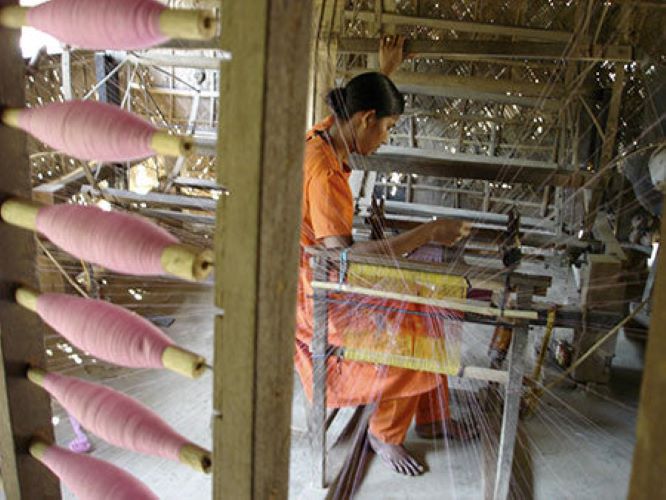
My field research with Amalendu Basak, a cluster trader from Dhatrigram in Purba Bardhaman, brings the question closer to the weaving economy. The account points to uneven activity, including work reported around Habibpur, and to pressures confronting hereditary weaving. These observations are primary field evidence, but they are not a district-wide statistical survey. They warrant investigation rather than extrapolation.
A further distinction is essential. Dhatrigram’s Jamdani and Tangail economy overlaps with the wider ecology of textile skill, yarn supply, trading and household labour; it is not identical to the specialised reconstruction of historic fine muslin. Without additional evidence, distress in one segment cannot prove failure in another. It can, however, reveal structural weaknesses that any revival policy must address.
The testimony of Biren Kumar Basak brings another, nationally recognised voice into this debate. The Phulia-based master weaver received the Padma Shri in 2021 for his contribution to art and handloom craftsmanship. During the Padma award events that November, he presented Prime Minister Narendra Modi with a specially woven Jamdani sari; the Prime Minister publicly acknowledged the gift on 13 November. Recognition at this level establishes Basak’s standing in the craft, but cannot by itself demonstrate the viability of today’s specialist muslin economy.
In a telephone interview with this author on 23 October 2026, Basak described a highly specialised segment of the muslin economy. He spoke of producing 500-count muslin and of elderly practitioners in Murshidabad still possessing exceptional spinning skills. Some pieces, he suggested, can take exceptionally long to complete; the reconstructed transcript records periods extending to two years and saree prices in few lakh range. He also mentioned a raw-material cost of about ₹5,000 per kilogram. The precise materials, production stages, durations and price basis require confirmation against the Bengali audio. These figures are therefore attributed illustrations, not verified industry averages.
Basak described demand among established high-end customers, despite the absence of a Kolkata retail outlet, and expressed concern about inexpensive imitations of handwoven designs. This complicates any claim that demand for fine muslin has disappeared: an exclusive market may survive while the wider weaving workforce faces uncertain orders and earnings. Nor can the price of an exceptional sari be equated with the spinner’s or weaver’s income. Basak also recalled the closure of a spinning mill in Kalyani, an account that warrants independent investigation as part of the larger question of local raw-material and processing capacity.
His account sits alongside, rather than contradicts, the field observations of Amalendu Basak in Dhatrigram. The two speak from different positions within overlapping textile economies: one describes highly specialised production and premium buyers; the other highlights uneven cluster activity and livelihood pressures. Neither interview is a representative survey. Together they sharpen the question that public revival claims often leave unanswered: how much of the final selling price reaches those who spin and weave, how regularly are they paid, and who will learn these skills next?
The reported shift towards rapier looms reflects mounting economic pressures on traditional weaving. Mechanisation offers higher output and lower production costs, making it an understandable commercial choice. Yet greater production efficiency must not be mistaken for the preservation of specialised handweaving skills. The policy challenge is not to resist modernisation, but to ensure that technological progress does not come at the cost of irreplaceable craftsmanship.
The policy question is therefore not whether Bengal should modernise. It is whether modernisation is accompanied by a credible plan to retain the skills and supply of reasonably priced raw material that mechanisation does not reproduce.
The price of remaining a weaver
For a weaving household, heritage is not an abstract category. It must pay for yarn, labour, maintenance and daily living. Cotton and yarn prices, quality specifications, payment delays and intermediaries all affect the return on skilled work. Reports of rising input costs deserve attention, but meaningful comparison requires the same yarn quality, count, market and dates; a general claim about cotton inflation cannot substitute for a cost study.
The livelihood question has an instructive historical benchmark. In an August 2019 report for Village Square, weaver Rajeshwar Guin of East Bardhaman said he earned around ₹8,000 a month, sometimes more when orders increased, and credited cooperative-linked government purchases with providing work. This was one artisan’s reported income in 2019, not a verified current average for Murshidabad or Bengal’s muslin workforce. The report also described high-count weaving as labour-intensive, making the distinction between intermittent earnings and a dependable monthly livelihood especially important.
Alternative purchasing arrangements suggest another approach. A 2020 account of the Tula initiative reported payments of ₹110 per metre for khadi fabric, compared with prevailing rates of ₹15–20 per metre cited by the initiative. These are fabric procurement rates, not individual artisans’ take-home wages, and the model cannot be directly equated with 500-count muslin. It nevertheless illustrates why transparent purchasing terms and the distribution of value along the supply chain deserve closer examination.
A premium price at retail does not establish a premium income at the loom. The decisive calculation is what an artisan retains after costs, relative to the time required and the income available elsewhere. If weaving cannot compete with alternative work, younger family members may rationally decline to learn it. The resulting loss extends beyond one occupation: tacit knowledge of yarn handling, tension, humidity and finishing may disappear with its practitioners.
Claims that weaving families have moved to Assam or other states should be tested through household-level research, with destinations and reasons recorded. They should neither be repeated as verified mass migration nor dismissed simply because official statistics are incomplete.
What counts as revival?
Contemporary muslin products may be commercially attractive without replicating the full historic combination of fibre, hand-spinning and fine handweaving. That is not a criticism of innovation. It is a demand for precision. Revival of a product, reconstruction of a technique and survival of an artisan economy are three distinct achievements.
The state’s published Muslin Tirtha material describes infrastructure, training and production support, including a Murshidabad initiative with charkhas, looms, work sheds and common production facilities. These are useful inputs. Their effectiveness should be tested by independently verified outputs: functioning equipment, regular orders, artisans’ net incomes and transmission of specialist skills.
West Bengal’s Department of Micro, Small and Medium Enterprises and Textiles, together with WBKVIB and relevant handloom bodies, should commission a public cluster-wise assessment. It should distinguish hand-spun from mill-spun yarn, handloom from mechanised production, and muslin-specific outcomes from the wider textile sector. Artisans and traders should participate in framing the questions, while independent researchers verify the findings.
A credible second stage of revival would combine transparent livelihood data with remunerative procurement, dependable material supply, sustained apprenticeships and technical documentation of endangered processes. Success should be measured not by how often muslin appears at a fair, but by whether those who make it can continue to earn a living and teach the craft.
Bengal once wove the air. Its next achievement must be less ceremonial and more demanding: ensuring that the hands carrying that knowledge have a future.
(The author, a double Masters in Business Administration and Political Science, is an accomplished Professor. She is a recognised commentator on education, socio-cultural diversities, and empowerment issues.)









[[comment.comment_text]]