When Conscience Costs a Seat: Aga Syed Ruhullah Mehdi’s resignation and the questions it forces on Kashmir and on India
 an hour ago
Some resignations are paperwork. Others are verdicts.
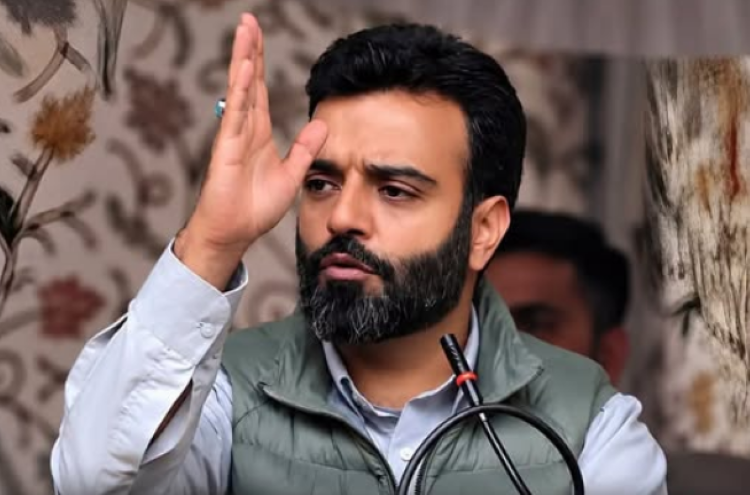
At a public gathering in Budgam, Aga Syed Ruhullah Mehdi did something rare in Indian politics. He walked away from a party he had served for roughly a quarter of a century and, in the same breath, announced that he was giving up the Lok Sabha seat that party had helped him win. He said he would not lend his name to what he sees as the betrayal of a promise made to voters.
Whether one finds his reasoning persuasive or deeply flawed, the act demands attention. It poses a question that reaches far beyond one man and one party: what should an elected representative do when he believes the platform he was elected on has been quietly set aside? This article examines what the resignation means for the National Conference, for Parliament and the voters of Srinagar, for the new platform Ruhullah has hinted at, and for New Delhi. It also takes up the question many Kashmiris are already asking in their homes, shops and university corridors: is this a genuine sacrifice, or the opening move of a new political career?
A Decision Made on a Day of Memory
Ruhullah chose his moment with care. He made the announcement at Behisht-e-Zehra Park in Budgam on the 26th death anniversary of his father, Aga Syed Mehdi, who was killed in an explosion in 2000. By tying a personal memory to a public decision, he made sure no one in the crowd could miss the weight of what he was saying. The break did not come suddenly. By most accounts, his relationship with the leadership began to sour within months of the National Conference’s victory in the 2024 Assembly elections. Some time earlier, he had announced that he would leave both the party and Parliament. NC president Farooq Abdullah publicly challenged him to resign his seat and seek a fresh mandate. Ruhullah, in effect, accepted the dare. His charge is specific. He argues that the party has abandoned its election promise to fight for Article 370 and the special status of Jammu and Kashmir, and that constitutional rights cannot be traded for the narrower demand of statehood. His grievances extend to reservation and the release of prisoners. In a letter addressed to Lok Sabha Speaker Om Birla, he formally tendered his resignation from the seat. To see why the moment resonates, one has to look back to August 2019, when Article 370 was abrogated and the former state was reorganised into two Union Territories. Since then, questions of statehood, constitutional safeguards, jobs, representation and civil liberties have stayed at the centre of public debate. The 2024 elections gave voters their first chance in years to choose an elected government, and many chose it believing it would give those questions a forceful voice.
The Cost to the National Conference
Begin with the arithmetic, because it is the least interesting part of the story. The resignation does not threaten the government’s majority in the Jammu and Kashmir Assembly, and Omar Abdullah’s administration will carry on. In the Lok Sabha, however, once the Speaker formally accepts the resignation, the party will be left with a single member, Mian Altaf Ahmad of Anantnag-Rajouri, which thins its voice in the national forum where Kashmir’s status is ultimately debated.
The deeper damage is moral and political. The NC won in 2024 as the party most closely identified with resistance to the changes of 2019. One of its own prominent leaders now says that identity has been hollowed out. An accusation like that cannot be answered with a seat count. It can only be answered with a record. The BJP’s reaction has been notable for its distance. Speaking in Jammu, senior leader Ram Madhav claimed that Ruhullah held his resignation rally with the blessings and support of “our people” and said the National Conference is “visibly divided today.” Yet he explicitly kept his party out of the fallout, calling it an internal NC matter, and declined to speculate on future political realignments, remarking that “all bridges are crossed when you reach them.” Such comments reveal more about how rivals read the moment than about Ruhullah’s own intentions, and the National Conference will be judged on how it answers the charge of division rather than on who happens to point it out. The party has a serious case to make, and it deserves a fair hearing. Jammu and Kashmir is today a Union Territory whose elected government does not control every lever of administration, security or constitutional change. Leaders who inherit such limits can reasonably argue that restoring statehood is the achievable first step, and that overpromising on matters beyond their power would be its own kind of dishonesty. But limited authority is not a licence for limited transparency. The leadership owes voters a plain account: which promises it still intends to pursue, through which legal and constitutional avenues, on what timeline, and which it regards as out of reach. Reports of unease among older party figures suggest the question is being asked inside the organisation as well as outside it. If the only response to Ruhullah is counter-attack, the party will confirm the very impression he is trying to create. If it offers a candid public reckoning, it may turn a damaging exit into a moment of renewal.
The Parliamentary Question and Srinagar’s Vote
Under Article 101(3)(b) of the Constitution, a member’s seat falls vacant when the Speaker accepts a resignation after being satisfied that it is voluntary and genuine. Until that acceptance, the resignation is not complete in law. Because the term of the present Lok Sabha runs to 2029, a by-election is ordinarily required within six months of the date the vacancy occurs. That requirement flows from Section 151A of the Representation of the People Act, 1951, and it is subject to the statutory exceptions the provision itself contains: it does not apply where the remainder of the member’s term is less than one year, or where the Election Commission, in consultation with the Central Government, certifies that holding the by-election within that period is difficult. Two consequences follow. First, Srinagar will temporarily have no directly elected representative in the Lok Sabha until the vacancy is filled, a real cost carried by voters rather than by politicians. Second, the by-election will become far more than a routine contest. It will be the first direct test of whether Ruhullah’s argument has traction beyond his own supporters, and whether the NC can still command the Valley’s confidence when the question on the ballot is not governance but promise-keeping.
There is a certain symmetry here. Farooq Abdullah dared his critic to go back to the people, and Ruhullah has opened the door to exactly that. Interestingly, he has said he does not wish to return to Parliament himself, and has even suggested that Omar Abdullah should contest a Lok Sabha election and carry the constitutional questions to the national stage while the government concentrates on delivering its manifesto. Whether that was a serious proposal or a rhetorical challenge, it reveals the division of labour he believes the party should have adopted.
Is This a Sacrifice?
In Kashmir, the word sacrifice carries enormous weight. It is spoken at graveside gatherings and handed down in family stories. It is not a word to be used lightly, so it is fair to ask whether giving up a seat in Parliament qualifies. There is a case that it does. Political offices are rarely surrendered; they are defended, extended and inherited. Ruhullah has given up a national platform, the standing that comes with it and the protection of an institutional position, without a guaranteed destination. Many ordinary people, tired of politicians who speak of principle while clinging to every post, will recognise that as a costly choice. The setting reinforces the message: the son of a man killed in the region’s long turmoil, declaring his decision on the anniversary of that death. There is also a sceptical case, and it deserves equal respect. Critics will ask why a man who spent years inside the party chose this moment, and whether a new venture was already in his mind. His own hint at a new party gives them material. A sacrifice that conveniently produces a larger stage looks, to some eyes, like strategy.
A resignation can create a moment. Only sustained public service can create history.
Both readings contain part of the truth, which means the decision alone cannot settle the matter. Symbolism is always borrowed from the future. What will decide it is conduct: whether Ruhullah stays with the issues he has raised when the political winds shift, when opposition becomes lonely and when power returns in a more comfortable form. If he does, the seat he surrendered will be remembered as the first chapter of a principled career. If he does not, it will be remembered as a well-staged exit.
The Platform Still to Be Built
Ruhullah has expressed an intention to establish a new political platform, one in which, in his words, honest and compassionate people will lead, and he has said that Jammu and Kashmir will engage with Delhi on its own terms. He has not yet presented a detailed organisational structure or published a programme. What exists so far is a statement of intent. The opening for such an initiative is genuine. Kashmir has a young, educated population that has watched familiar families and familiar alliances rotate through power, and many feel represented by none of them. A credible new voice could draw them in. But founding a party is easy; building a movement is the hard part. Kashmir does not need another organisation held together by a single personality. It needs a published programme with clear priorities on jobs, education, farming, health and the accountability of public institutions. It needs internal elections and open decision-making, so that the new platform does not reproduce the habits it condemns. It needs women in real positions of authority rather than on the poster, and young professionals shaping policy rather than filling rally grounds. It must also speak across the region’s diversity. Jammu, the Kashmir Valley and the communities of the Chenab and Pir Panjal belts have distinct histories and distinct anxieties. A platform that speaks fluently to only one of them cannot claim to represent Jammu and Kashmir. Finally, the method matters as much as the message. A movement that wins lasting trust will have to remain peaceful, democratic and constitutional, and prove through practice that the politics of dignity does not depend on the politics of grievance.
A Message for New Delhi and for India
For the rest of India, it is tempting to read this episode as a quarrel inside a regional party. It is more than that. Ruhullah did not boycott elections or reject the Constitution. He contested under it, sat in Parliament under it, and has now left Parliament in a manner the Constitution itself provides for. A politician who criticises his own government, quits his party and questions the direction of an elected administration is exercising democratic rights, not declaring hostility to the nation. Mature democracies treat such dissent as information. For New Delhi, the lesson is subtler. Elections have been held and an elected government is in office; these are real achievements that no fair observer should dismiss. Yet the assumption that roads, investment and tourism will by themselves settle questions of political identity is tested whenever a mainstream figure concludes that participation is no longer worth the price. Engagement that listens throughout the electoral cycle, and not only before polling day, is an investment in democratic confidence rather than a concession to any one leader. And for readers in Delhi, Mumbai, Chennai and Kolkata, there is a simple invitation: look past the headline and ask what Kashmiris themselves are saying. A country is at its strongest when citizens in every region feel that their questions are heard in its capital.
What the People of Kashmir Should Ask
The people of Kashmir are not spectators to this story. They are its judges. They should ask the National Conference to publish a clear, honest account of what it has pursued since 2024. They should ask Ruhullah for a programme, not only passion. And they should ask every institution, in Srinagar and in Delhi, how it intends to turn disagreement into dialogue rather than distance. Above all, they should resist the pull of blind loyalty in every direction. Admiration for a leader’s courage is no substitute for scrutiny of his plans. Anger at a party’s compromises is no substitute for asking what alternatives are truly available. A voter who demands evidence from everyone is the strongest guarantee that no leader, old or new, can take public trust for granted.
History Will Judge the Response
Three weeks, three months or three years from now, this day will be remembered according to what follows it. If honest answers, real programmes and attentive engagement follow, it may be recalled as the moment Kashmir’s politics was forced to become more accountable. If not, it will join the long list of dramatic days that changed headlines but not lives. A seat can be surrendered in an afternoon. Trust takes far longer to earn, and it belongs, in the end, to the people who give it.
References
- The Wire, “Why Ruhullah’s resignation is a test of Omar Abdullah and NC’s real strength.” https://thewire.in/politics/why-ruhullahs-resignation-is-a-test-of-omar-abdullah-and-ncs-real-strength
- Constitution of India, Article 101(3)(b), Legislative Department, Government of India. https://legislative.gov.in/constitution-of-india/
- Representation of the People Act, 1951, Section 151A (time limit for filling vacancies). https://courtbook.in/representation-of-the-people-act-1951/section-151A
(Author, a Kashmiri sociologist, is a writer, -researcher, and columnist. His research Interests Include Kashmir Affairs, South Asian Politics, Human Rights, and Public Policy issues. krasool70@gmail.com)

[[comment.comment_text]]