The Saffron Renaissance or a Moral Compromise? The Rise of Suvendu Adhikari

 4 months ago
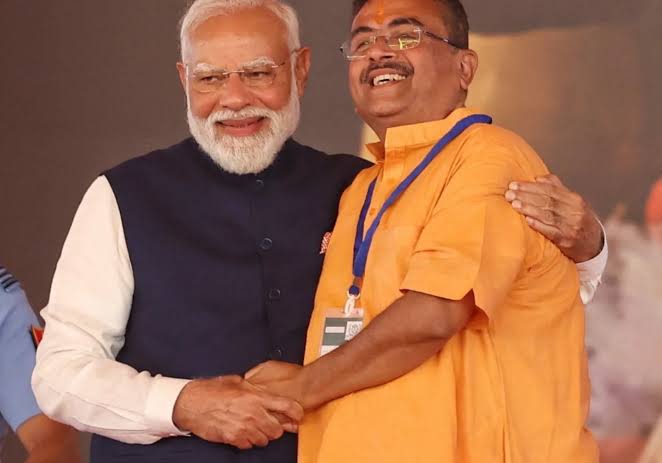
In the storied landscape of Bengal’s politics, where ideologies often clash with the ferocity of Nor’westers, May 9, 2026, will be etched as a watershed moment. As Suvendu Adhikari took the oath of office at Kolkata’s Brigade Parade Ground, he didn’t just become the first Bharatiya Janata Party (BJP) Chief Minister of West Bengal; he completed one of the most audacious political metamorphoses in modern Indian history. Yet, beneath the marigold garlands and the triumphant chants of “Sonar Bangla,” lies a complex narrative of shifting allegiances, conveniently forgotten allegations, and a polarizing rhetoric that has redefined the state’s secular fabric.
The Architect of Change
Adhikari’s journey to the helm of the state is a masterclass in grassroots mobilization. Rising through the ranks of the Congress and later the Trinamool Congress (TMC), he earned his stripes not in the air-conditioned corridors of power, but in the muddy trenches of Nandigram. His leadership of the Bhumi Uchhed Pratirodh Committee in 2007 was the sledgehammer that cracked the 34-year-old Left Front monolith. For over a decade, he was Mamata Banerjee’s most trusted lieutenant, the "son of the soil" who delivered the Medinipur belt on a silver platter.
However, the camaraderie dissolved in 2020, replaced by a bitter rivalry fueled by the rise of Abhishek Banerjee and Adhikari’s own burgeoning ambitions. His defection to the BJP was more than a change of jersey; it was a tactical strike that provided the saffron camp with the "insider" DNA it so desperately lacked.
The "Washing Machine" Phenomenon
The most jarring aspect of Adhikari’s elevation is the silence surrounding his past. It was not long ago that the BJP’s central leadership traversed the state, screening the Narada sting operation tapes where Adhikari was purportedly seen accepting cash. In 2014 and 2016, the BJP’s official social media handles were repositories of these videos, labelling him a face of the "TMC’s cut-money culture."
Today, those videos are digital ghosts, scrubbed from official channels in a move critics have dubbed the "Washing Machine" effect—a process where the stains of corruption are magically laundered the moment a leader joins the BJP. The Saradha chit-fund scam, which saw Adhikari interrogated by the CBI in 2014, has similarly been reframed. What was once "unpardonable corruption" in the BJP’s 2019 manifesto is now described by the new administration as "political victimization." This selective amnesia raises a fundamental question: has the BJP truly "cleaned" Bengal, or has it simply co-opted the very machinery it once vowed to dismantle?
A Shift in Rhetoric: From "Bhoomi Putra" to Polarizer
Beyond the allegations of financial impropriety, Adhikari’s ascent has been marked by a sharp, often divisive, ideological pivot. In his quest to consolidate the Hindu vote, the man who once championed a secular anti-land-acquisition movement has increasingly leaned into communal rhetoric.
His campaign trail was peppered with references to "infiltrators" and "fake voters," often conflating valid citizens with undocumented migrants. Statements suggesting that the demographic change in Bengal was a threat to Hindus—and his controversial warnings about "Muslim Chief Ministers"—have signalled a departure from the inclusive "Ma, Mati, Manush" slogan of his previous life. By framing the 2026 election as a choice between "native Hindus" and "external threats," Adhikari successfully fragmented the minority vote, but at the cost of deepening the state’s communal fault lines.
The Burden of the Crown
As Suvendu Adhikari settles into the Chief Minister’s chair, he inherits a Bengal that is politically polarized and economically expectant. His mandate is substantial—207 seats is a resounding roar of approval—but the shadows of Narada, Saradha, and the "syndicate raj" he once allegedly helmed still linger in the public record, if not in the current political discourse.
Governance is a different beast than agitation. To lead a state as complex as West Bengal, Adhikari must transcend the "strongman" persona and prove that his administration is more than just a rebranded version of the system he overthrew. For the people of Bengal, the hope is for the promised "Sonar Bangla." For the historian, however, the curiosity lies in whether the Chief Minister can ever truly outrun the ghost of the man he was before 2020.
(The author is a former member of the history faculty at St. Xavier’s College, Mumbai. Views are personal.)




[[comment.comment_text]]