Gurugram's Unchecked Growth: A City Drowning in its Own Ambition

 1 year, 3 months ago
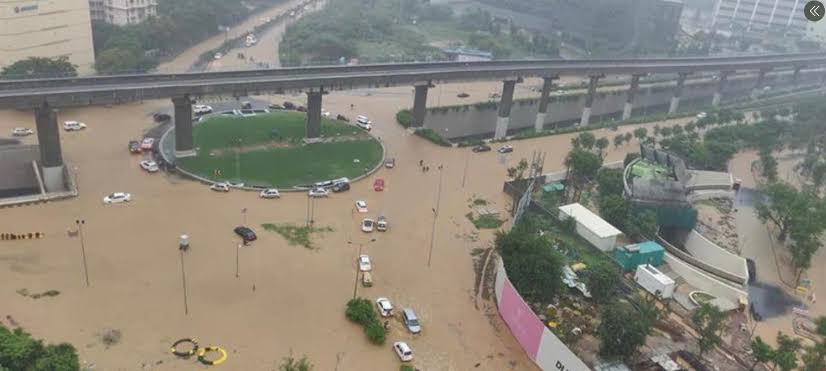
The chaotic urban development of Gurugram, and the absurdity of the city's current state is truly pathetic. This chaos becomes more prominent during the monsoon season.
Despite its moniker as "Millennium City" and its impressive skyline, Gurugram's ground reality is a stark contrast to the gleaming corporate towers, especially during the monsoon season. Flooded roads, crippling traffic jams, and a severe lack of basic infrastructure expose the disconnect between its aspirational image and its struggling functionality.
Gurugram's transformation began in 1991, with India's economic liberalization. It first reflected in the vision of Kushal Pal Singh, through DLF, who masterminded a idea of a modern, upscale urban center.
The Promise of Global Standards
This promise of well-paying multinational jobs and a "new-rich" lifestyle attracted a massive influx of residents, particularly from South Delhi, leading to the rapid proliferation of corporate giants like Nestle, Microsoft, and Google. The city quickly became a magnet for those seeking a "Manhattan-like" existence, seemingly shifting India's economic center of gravity.
However, this rapid growth came at a steep price. This aligns Gurugram's development with Robert Reich's concept of the "secession of the successful," where affluent communities retreat into gated complexes, inadvertently undermining the traditional idea of a shared public city space. This pursuit of private luxury has resulted in a public domain plagued by waterlogging, gridlock, and pollution, creating a "strange mix of vanity and inanity."
A significant part of Gurugram's woes stems from its flawed and delayed urban planning. Despite its challenging terrain, including its proximity to the rocky Aravalli hills and anticipated groundwater issues, "dream merchants" prioritized construction over essential infrastructure. Crucially, Gurugram lacked a municipal corporation until 2008, nearly two decades after its major growth spurt began. A master plan only emerged in 2007, and a metropolitan development authority as late as 2017. This piecemeal approach, often driven more by private developers than a genuine town-planning vision, has led to deeply "mixed-up priorities."
Contrasting with Other Cities
This contrasts Gurugram with more thoughtfully planned cities like Noida, Chandigarh, and New Delhi, where state authorities prioritized foundational infrastructure such as roads, parks, and stadiums.
These cities demonstrate superior urban planning and management, highlighting what Gurugram could have been with proper foresight.
Adding to the complexity, Gurugram's affluent residents, despite bearing the brunt of the infrastructural failures, possess little political leverage. The local political landscape, dominated by rural politicians and land sellers, offers minimal hope for addressing the urban challenges. The article suggests that "angry Instagram posts or tagging politicos on X tweets can hardly help" in a system where high-rise apartments are more like "Noah's Ark" protecting from floods than towers of influence for civic improvement.
Ultimately, the piece concludes with a poignant call for a redefinition of development. It suggests that the vision of a "Viksit Bharat" (Developed India) must extend beyond mere Gross Domestic Product to encompass the quality of life for its citizens.
The Way Forward
There's a hope, however faint, that Gurugram might one day achieve a state where the civic amenities are mirrored by the functionality and livability of the city outside its walls.
A hopeful, yet critical, reflection, suggests that the dream of a "Viksit Bharat" (Developed India) should prioritize the quality of life for citizens over mere Gross Domestic Product. It calls for a "born-again Gurugram" where the facilities inside gated complexes are matched by amenities outside, and where "development is not about Gross Domestic Product but the quality of life of citizens."



[[comment.comment_text]]