From First Ascents to Modern Techniques

 1 month, 4 weeks ago
60 Years On, the Climbers Return
Susunia Hills has been at the centre of West Bengal’s rock-climbing story for six decades. In November, nearly 300 climbers, mountaineers and enthusiasts gathered there to mark the anniversary of the first organised rock-climbing course in Eastern India and to remember the pioneers who made it possible.
The three-day event, “Legacy Unbounded: 60 Years of Rock Climbing in West Bengal,” brought together veterans, young climbers, mountaineering organisations and members of the local community. More than an anniversary, it was an exercise in recovering a sporting history whose pioneers have often remained outside the public spotlight.
The festival was jointly organised by the Indian Mountaineering Foundation (East Zone), the West Bengal Mountaineering and Allied Sports Foundation, the West Bengal Mountaineers’ and Trekkers’ Confederation, and The Pahariya, a platform for mountain enthusiasts.
The Everest Effect
The roots of Bengal’s organised mountaineering movement can be traced to 1953, when Sir Edmund Hillary and Tenzing Norgay conquered Mount Everest. The achievement had a powerful impact on young people across India. In Bengal, it helped turn a longstanding fascination with the Himalayas into a serious interest in exploration and climbing.
Among the earliest organised initiatives was an expedition led by Sri Gopendranath and Debshankar to Mount Pandim (21,953 ft.) in Sikkim, then an unclimbed peak. The expedition did not reach the summit but succeeded in establishing a base camp at the Talung Glacier.
Its significance went beyond the outcome. It demonstrated that Bengal’s climbers were prepared to undertake serious Himalayan expeditions. The expedition received support from the then Chief Minister of West Bengal, Dr Bidhan Chandra Roy, while Tenzing Norgay provided logistical advice.
Roy also recognised that the growing interest in mountaineering required formal training and institutional support. He advised Prime Minister Jawaharlal Nehru to establish a dedicated mountaineering institute. The Himalayan Mountaineering Institute (HMI) was subsequently established in Darjeeling in 1954.
Building a Mountaineering Movement
The next phase of Bengal’s climbing history developed in Kolkata. On 12 March 1960, a group of alpinists established the Himalayan Institute, later renamed the Himalayan Association, at Ashutosh Memorial Hall in Bhawanipur. It was formed under the presidency of Umaprasad Mukhopadhyay.
Later that year, the association organised the first successful civilian expedition to Mount Nandaghunti, at approximately 20,000 feet. Led by Sri Sukumar Roy, the expedition received substantial financial support from Anandabazar Patrika.
These early expeditions created enthusiasm, but the movement needed something more practical: a place where aspiring climbers could learn the fundamentals before attempting the high Himalayas. That search led to Susunia.
Susunia: The Training Ground
In October 1964, the association considered establishing a formal rock-climbing training programme. Its members conducted field surveys before Colonel B. S. Jaiswal, then Principal of HMI Darjeeling, inspected Susunia Hills. His assessment was decisive. The hill’s natural rock formations and accessible terrain made it particularly suitable for rock-climbing instruction.
In January 1965, the Himalayan Association inaugurated Eastern India’s first formal rock-climbing training course at Susunia. There were only 23 trainees, including five women. The programme owed much to the efforts of Dr Manindralal Biswas and his wife, Smt Bhakti Biswas, who worked extensively to organise and establish the course. Their contribution would later earn them a special place in Bengal’s mountaineering history.
The significance of that first course was considerable. Susunia offered Bengal’s aspiring climbers an opportunity to acquire technical skills without having to begin their training in the Himalayas. Rock climbing became a foundation for mountaineering rather than an isolated adventure.
60 Years On, the Climbers Return
Six decades later, the climbers returned to Susunia. The Legacy Unbounded festival brought together veterans who had helped build Bengal’s climbing culture and younger practitioners who now approach the sport with modern equipment, specialised training and more rigorous safety standards.
The national mountaineering community was represented by Sri Vijay Raghavan, Vice-President of the Indian Mountaineering Foundation; Sri Kirthi Payas, Secretary of the IMF; Wing Commander Amit Chowdhury (Retd.), Chairman of International Safety and Security; Smt K. Saraswati, a member of the IMF Governing Council; and Sri Writtik Marne, a young climber from Pune.
The three-day programme combined recognition, historical documentation, technical education and live demonstrations.
Honouring Those Who Came Before
The opening day focused on the veterans. Eleven senior mountaineers—nine men above the age of 65 and two women over 60—were felicitated for their contributions to Himalayan exploration and mountaineering. Many had never received formal recognition from the state or from mountaineering institutions. Their public acknowledgement was therefore an important part of the festival.
The evening also featured the Himalayan Travel and Expedition Writing Competition. Cash prizes were presented to the winners following evaluation by a panel of four senior alpinists.
The competition recognised another important aspect of mountaineering: the need to record and preserve experiences that otherwise risk disappearing with the passing of their authors.
Preserving Bengal’s Climbing History
The second day concentrated on heritage and education. The contribution of Dr Manindralal Biswas and Smt Bhakti Biswas, remembered as the “First Family” of Bengal’s mountain community, was highlighted.
The programme included lectures on climbing safety and the felicitation of more than 50 senior rock climbers. A commemorative volume, Legacy of Rock Climbing, was released, bringing together memories and accounts from the movement’s long history.
A panel discussion later examined the evolution of rock climbing—from the early years of limited equipment and improvised methods to today’s emphasis on technical proficiency, scientific training and safety.
The discussion also underscored a simple fact: modern climbing may look very different from the sport practised in the 1960s, but the fundamentals remain unchanged—discipline, judgement, physical endurance and the ability to manage risk.
The Rock, Revisited
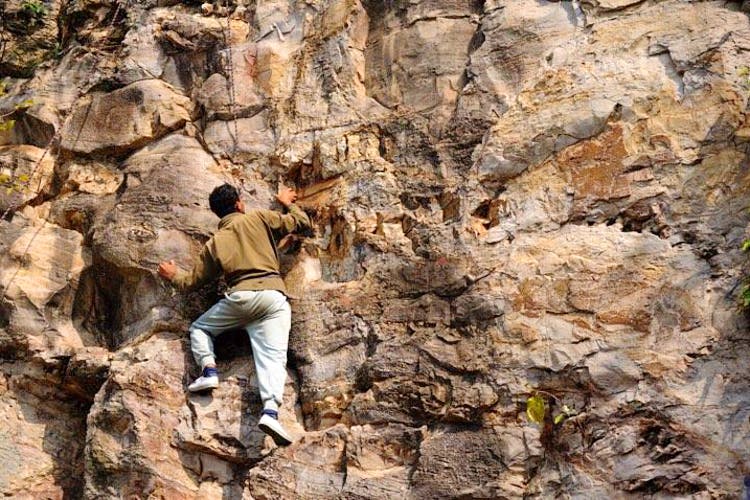
The final day returned the celebration to the terrain that had started it all. Participants climbed Susunia Hill, which rises to 1,442 feet, to watch a live demonstration of contemporary rock-climbing techniques.
Choreographed by David Naskar, the demonstration featured young climbers negotiating the historic rock faces using modern methods and equipment. For the veterans watching from below, the spectacle offered a direct comparison between two generations of climbing.
The equipment has changed. Training has become more systematic. Safety standards have improved. But the basic challenge posed by the rock remains the same.
The programme ended at the foothills with a group photograph and a traditional campfire organised by Sri Ujjwal Roy and his team.
A Tradition That Endures
More than 70 veteran mountaineers and rock climbers were honoured during the festival. Its larger achievement, however, was bringing together generations of Bengal’s climbing community.
The pioneers worked with limited resources and little institutional infrastructure. The younger generation has access to better equipment, formal training and a more developed safety culture. Between the two lies six decades of accumulated knowledge and experience.
Susunia remains the common ground.
What began in January 1965 with 23 trainees has developed into a sustained tradition of rock climbing and mountaineering in West Bengal. Generations of climbers have since used these rocks as a training ground before venturing into the Himalayas and beyond.
The lesson of Legacy Unbounded is therefore straightforward. Sporting traditions do not survive merely because they have a history. They survive because each generation chooses to remember that history—and then adds to it.
At Susunia, six decades after the first formal course, the climbing continues. The techniques have changed. The equipment has evolved. But the ascent goes on.









[[comment.comment_text]]