Women’s Labour in West Bengal’s Craft and Coastal Economies

 1 month, 2 weeks ago
The invisible work behind Bengal’s celebrated crafts and climate-vulnerable livelihoods
The invisible work behind Bengal’s celebrated crafts and climate-vulnerable livelihoods
West Bengal is often introduced to the world through the products it creates and sells: kantha, tant, terracotta, madurkathi, crab, honey and the magnificent Durga idols that come alive under festive lights. Yet behind these celebrated products lies a vast and largely invisible workforce. Much of this work is performed by women, at home, in courtyards, along creek banks, in weaving sheds and beneath makeshift tarpaulin roofs. Their contribution is frequently described as “helping”, “seasonal” or “flexible” rather than recognised as skilled and productive labour.
The fundamental problem is not that women do not work. It is that a significant share of their work remains inadequately recognised, poorly classified, underpaid and insufficiently protected. A home-based embroiderer is not always counted or recorded as a worker. A masland weaver may not know the final price of the mat that leaves her loom. Intermediaries can capture much of the value, while the artisan remains economically vulnerable.
Climate change deepens this vulnerability. After a flood, women spend countless unpaid hours drying grain, collecting water and rebuilding everyday life. This labour is essential to recovery, yet it rarely enters conventional assessments of economic loss or climate damage.
This is the paradox at the heart of Bengal’s rural economy: the economy depends on these women, but the institutions designed to measure, protect and support the economy often fail to see them.
Muktarani of Sabang, and the Grass That Becomes Prestige
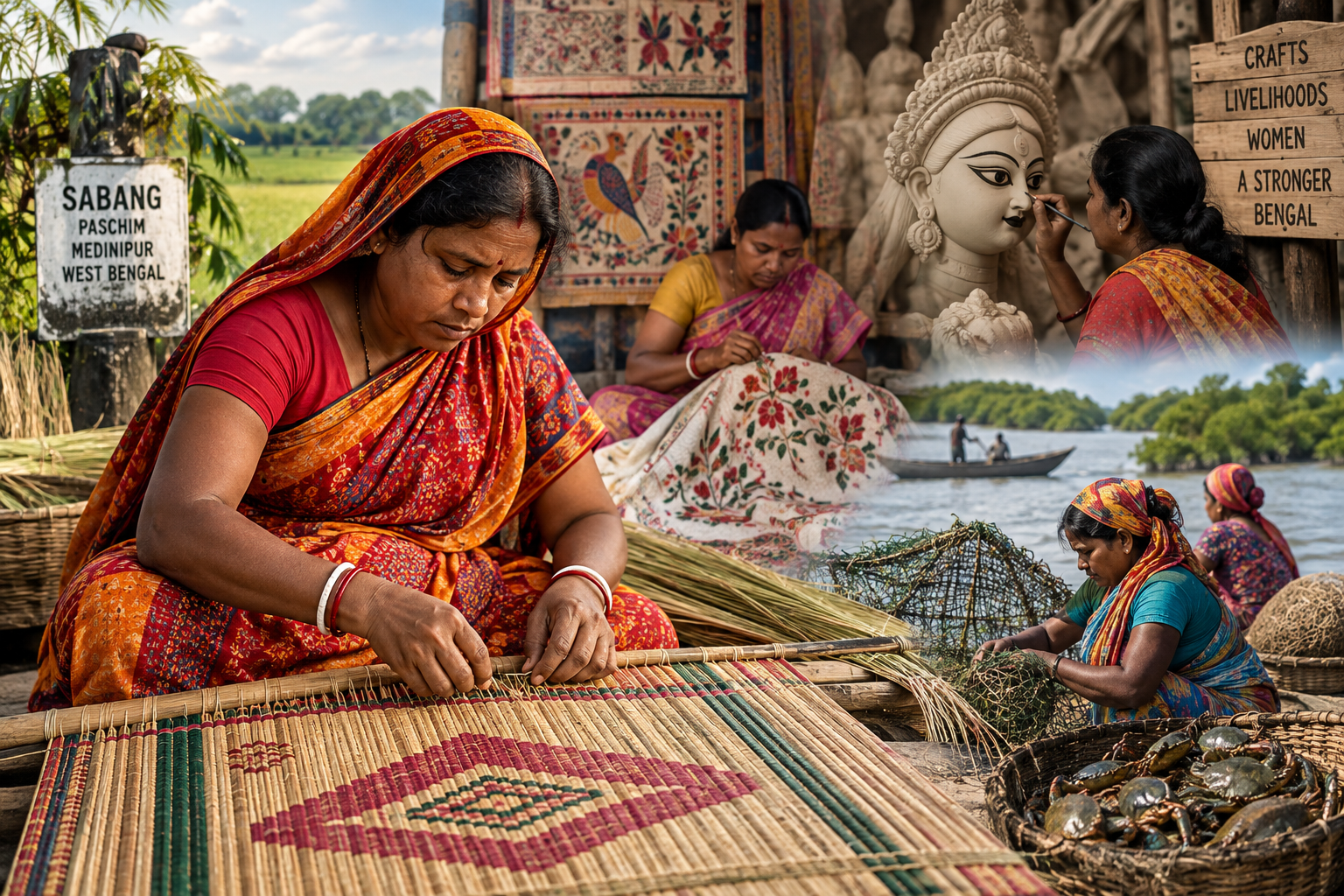
In Sabang, locally also known as Sobong, in Paschim Medinipur, wetland-grown madurkathi is split, dried and woven into mats. The finest variety, masland, is a highly specialised handwoven craft with a long history in Medinipur. Madurkathi received Geographical Indication status in 2018, and official and cultural sources place Sabang among the principal centres of the craft.
Publicly available craft documentation puts the number of madur artisans in the two Medinipur districts at roughly 4,400 to 4,500 in the principal supported clusters, with women forming the overwhelming majority. One West Bengal craft source gives a figure of 93 per cent women; other reporting has put the share at more than 70 per cent. The precise proportion varies by source and by how the artisan population is defined, but the gendered character of the craft is unmistakable.
Muktarani works in that world. Her name is associated with the Medinipur craft cluster. She makes masland from grass grown in wet fields, not from a factory fibre. A simple rectangular frame made from bamboo or wooden poles serves as the loom. It is a remarkable thing to watch: the weaver’s hands move with extraordinary speed and precision as fine geometric designs emerge from the reed and cotton warp.
Masland, or matranchi, can take weeks or even months depending on its fineness and design. In some traditions, two artisans sit face to face and work on the same mat, coordinating their movements and calculations to maintain precision. Men in the cluster may handle cultivation, processing, transport and parts of the marketing chain; the weaving itself is dominated by women.
Muktarani at work on a masland mat (Photo: Sutapa Bhattacharyya)
Muktarani’s skill is not “help”. It is production.
That division of labour is why the craft can look like a success story and still leave the weaver exposed. GI status, exhibitions and export orders have raised the profile of Sabang mats. Historic reporting has documented a dramatic increase in earnings for some skilled artisans. Yet the gains are not necessarily distributed equally across the value chain.
The weaver is often paid for a piece, not for the cultural premium attached to masland. She may also absorb the cost of floor space, electricity, tools, interrupted time and the household responsibilities that run alongside production. The mat may acquire prestige as it moves through the market; the woman who made it may remain at the weakest bargaining point.
Until official data, piece rates and social protection treat this work as work, the mat will travel further than the woman who made it.
The Hidden Cost of “Flexible” Work
Home-based work is often praised for allowing women to earn without leaving the household. The praise misses the condition that makes the arrangement possible: unpaid care work running alongside paid production.
Electricity used for a bulb over a loom is a production cost. Floor space given to drying reeds, storing material or working with clay is a workshop. Time spent stopping production to fetch water, care for children or manage household emergencies is part of the real labour equation. Yet these costs are rarely visible in the price of the finished object.
Toolkits, training and digital-marketing schemes can help. They do not, by themselves, guarantee a fair share of value. The useful question is not simply whether a craft is famous. It is whether the woman producing it can bargain.
The Sundarbans: Where Water Governs Work
In the Sundarbans, tides, salinity, breached embankments and cyclones organise the working day. For women, climate shock rarely means rest. It means more labour: moving stores, finding drinking water, caring for children and older people, repairing homes, and then looking again for cash from whatever work the season still allows.
“Resilience” can be a poor description of this reality. A woman who rebuilds after every flood is not necessarily more secure. She may simply be absorbing a larger share of the delta’s risk.
The distinction matters. If resilience is measured only by whether a household eventually recovers, the unpaid labour that makes recovery possible disappears from the account. A better measure asks who performs that labour, who pays for the losses, and who controls the next source of income.
Women Artisans of Hingalganj, and the Idol That Must Dry in the Rain
Idol-making is one of Bengal’s most visible seasonal craft economies. It needs clay, straw, bamboo, skilled hands, dry air and time. In the Sundarbans, those conditions can be especially difficult to secure during the monsoon months, when production must intensify for the approaching Durga Puja.
This year’s pinch is already visible in Hingalganj, a border block in the north of the delta. Artisans report that river clay once collected nearby now often has to be bought and hauled. Jute twine that cost a little over ₹100 a kilogram has been quoted at about ₹250. Paint, bamboo, straw and transport have all risen. Idol prices have not kept pace.
Storms and sudden rain can undo days of work. Srikanta Santra, an artisan in that cluster, has said households take loans simply to keep production going.
Women artisans in family pratima workshops across the delta are rarely the names on the order book. They may prepare clay, bind straw to the frame, smooth limbs, paint jewellery and decorative details, and keep the household functioning while the seasonal rush peaks.
When rain comes through a tin roof, they cover and move the unfinished figures and the work begins again, if clay slumps. The principal artisan may be recognised when the idol is carried out. The women’s labour that got it to that point usually is not.
A damaged idol is not only a cultural loss. It can mean lost wages, lost material and a loan that still has to be repaid. Paint and finish are the visible final stages. In delta workshops, waiting for clay to dry and protecting it from rain is already part of the labour.
One Labour Regime, Two Landscapes
Muktarani at a Sabang loom and women artisans under a Hingalganj shed appear to inhabit different economies. They do not.
Both work in places conventional labour systems struggle to see: the home, the courtyard, the family workshop and the creek-side shed. Both have limited control over price. Both carry unpaid household labour alongside paid production. Both are exposed to risks that can quickly turn a small income into debt.
Heritage schemes may celebrate masland; festival coverage may celebrate the goddess. Neither automatically registers the woman on the loom or the woman with clay on her hands.
From Heritage Recognition to Labour Justice
Crafts should be protected. GI tags, fairs, self-help groups, training and tool support matter. But they are not a substitute for labour rights.
A workable agenda is specific:
Record home-based women as workers in official statistics and livelihood programmes.
Publish transparent and locally realistic piece-rate benchmarks for masland, kantha, finishing and other home-based craft work.
Extend social-security and occupational-health coverage to informal and home-based artisans, including those exposed to repetitive work, dust, paint, prolonged sitting and saline or flood-affected environments.
Reduce intermediary dependence through producer collectives that can negotiate prices, sell directly and protect artisans’ design ownership and margins.
In the Sundarbans, treat embankments, potable water, raised housing, dry community workspaces and safe storage as livelihood infrastructure—not as a separate “disaster” file.
Build climate-resilient production spaces where seasonal craft work can continue safely during rain, heat and flooding.
Look Past the Object
Kantha can hang in a boutique. Masland can travel to a European fair. A Durga image can hold a whole neighbourhood’s festival. Crab and honey can enter a supply chain. The women who sustain those circuits remain too often underpaid, under-counted and uninsured.
Bengal does not need another hymn to the product. It needs conditions in which Muktarani can weave, and women artisans in the delta can finish an idol, with a known price, a safe workspace and a claim on the value they create.
Move beyond the object. Recognise the work!





[[comment.comment_text]]