Manusmriti: The Truth of the Past and the Demands of the Present

 1 month, 2 weeks ago
The very mention of the Manusmriti immediately sparks a heated debate. Some regard it as an important text of Indian tradition, while others associate several of its provisions with social inequality and discrimination. There may be room for emotion in this debate, but to understand history, we need to step back and look at the past in its proper context.
It would not be appropriate to read the Manusmriti as a rulebook for present-day India. It is an ancient Dharmashastra, reflecting the social structure, values and practices of its own time. Therefore, what is written in it should be understood within the circumstances of that period.
This does not mean that everything considered acceptable in that era must be regarded as right today. What was once a social reality need not become a modern ideal. With time, societies change. Their moral values evolve, laws change, and their understanding of human beings also changes. Modern India’s Constitution is founded on equality, liberty, justice and dignity. Therefore, ideas in the Manusmriti that are considered discriminatory or unequal today can rightly be rejected.
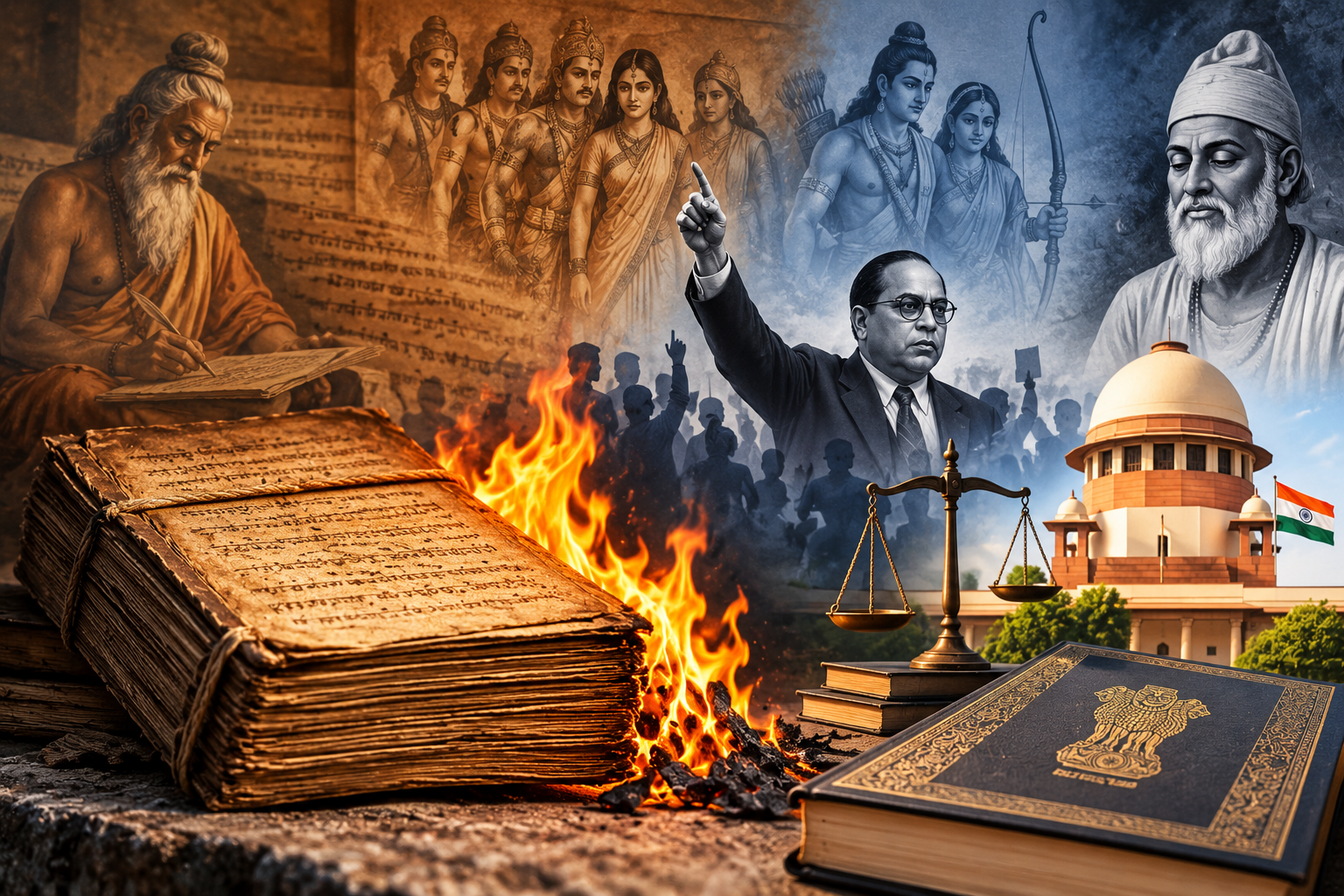
But an important question remains: Can burning a book also erase the truth of the time in which it was written?
Burning the Manusmriti may symbolically reject a social order, but it cannot burn away the social values and historical realities of that period. A book can be destroyed, but history cannot. Instead of erasing ideas recorded in history, it is more important to understand them.
Examples from the Ramayana and Mahabharata
Let us look at examples from ancient Indian epics themselves. In the Mahabharata, Draupadi’s marriage to the five Pandavas is an example of polyandry in Indian literature. Modern Indian law and social norms do not recognise such a form of marriage as an acceptable marital institution. Yet we do not remove this episode from history and literature simply because our social thinking has changed.
Similarly, ancient Indian literature contains several examples of polygamy. In the narrative tradition of the Ramayana, King Dasharatha is described as having several wives. This reflects the royal traditions and social practices of that period.
In contrast, Lord Rama is presented as an ideal of monogamy. He accepted Sita as his only wife, and the ideal of a single-wife marriage was given particular importance in his life. Thus, within the same cultural tradition, we find examples of both polygamy as a royal practice and monogamy as a personal moral ideal.
These examples teach us an important lesson: social traditions are not static. They have evolved with time, place, circumstances and changing social roles. Therefore, directly measuring every practice described in ancient texts against present-day social and legal standards oversimplifies the complexity of history.
Today, the legal and social understanding of marriage is different. But we do not say that references to older forms of marriage in ancient texts are wrong simply because we no longer accept those practices.
The same principle should apply to the Manusmriti.
Changing Social Norms
History contains numerous examples of societies changing practices that were once considered acceptable.
Child marriage was once regarded as a social practice in many parts of India. Today, the law treats it as an offence.
Similarly, sati existed in some regions as a social and religious practice. Social reformers such as Raja Ram Mohan Roy opposed it, and eventually legislation abolished the practice.
This does not mean that sati never existed. Rather, society recognised the practice, challenged it and ultimately abolished it. This itself is an important example of social change.
Untouchability was similarly a part of India’s social history. Article 17 of the Indian Constitution abolished untouchability. We do not accept untouchability today, but we cannot deny its existence in history.
This leads to an important distinction: the historical existence of a practice and its validity in the present are two different things.
Dr Ambedkar’s Example
In the context of criticism of the Manusmriti, the example of Dr B. R. Ambedkar is particularly significant. On 25 December 1927, at Mahad, the burning of the Manusmriti became a symbolic act in his social movement. Its purpose was to protest against social norms that he associated with caste-based inequality and social injustice.
For Ambedkar, social equality did not end with political freedom. The dignity of the individual and the right to equality within society were equally essential.
To treat this event merely as an act of burning a book would therefore be incomplete. It is necessary to understand the social struggle and demand for equality behind it.
At the same time, the event itself should be studied historically—with an understanding of its causes, circumstances and consequences.
Kabir’s Example
Kabir, too, challenged the rigidities of his time. He questioned religious divisions, caste distinctions and external rituals. His message was that a person’s identity should not be determined by caste or outward labels, but by conduct and humanity.
Kabir placed greater emphasis on challenging ideas than on destroying texts.
This is one of the great features of the Indian intellectual tradition: dissent did not always take the form of destruction; it also emerged through the creation of new ideas.
Being Ancient Does Not Make Something Right
One point should be absolutely clear: the age of an idea does not automatically make it correct.
If that were so, societies would never change. Child marriage would never have been abolished. Sati would never have ended. Laws against untouchability would never have been enacted. Women would never have gained greater access to education and property rights. The concepts of democracy and equal citizenship would never have emerged.
Societies progress because they critically examine their inherited ideas.
Therefore, criticism of the Manusmriti is not wrong. What would be wrong is to reject history itself in the name of criticism.
Understanding a Text Does Not Mean Accepting It
Studying a text does not mean accepting it.
We can read Marx, Gandhi, Ambedkar, the Manusmriti and the Mahabharata. But reading does not mean that we must accept every idea contained in them.
Reading is meant to understand; acceptance is a matter of judgment.
That is what independent thinking means.
Therefore, we should avoid two extremes in the debate over the Manusmriti. On the one hand, we should not treat it as a text whose every statement must still apply today. On the other, we should not assume that burning it means the entire history associated with it has disappeared.
Both positions are incomplete.
What Will Govern India Today?
Modern India will not be governed by the Manusmriti or any other ancient social code. India will be governed by the Constitution.
The Constitution places equality, liberty, justice and fraternity at the foundation of modern India. Therefore, if any provision or idea from an ancient text conflicts with constitutional values, the Constitution must prevail in contemporary India.
But respecting the Constitution does not require us to erase history.
We need to know our past so that we can understand where society came from and how it reached where it is today.
There should be a debate on the Manusmriti. It should be open and vigorous. Its provisions can and should be criticised. But that debate must be based on study, history and reason.
Burning the Manusmriti cannot burn away the social realities of the time in which it existed. The society that produced those ideas remains part of history.
Today, we can and must reject ideas that conflict with equality, liberty and human dignity. That is the difference between the past and the present.
Erasing the past is not progress; moving beyond the past is.
A society does not become modern merely by burning a book in protest. It becomes modern when it confronts its inherited ideas, examines them critically and creates new values that place human beings and their dignity at the centre.
Perhaps, therefore, the final word on the Manusmriti should be:
“Burning a book does not burn history; but in the light of reason, we can reject the ideas that no longer conform to our values.”




[[comment.comment_text]]