Bhagwat’s New York Message, India’s Test

 1 month, 1 week ago
From New York, Mohan Bhagwat spoke of oneness, dialogue and diversity. But the real test of that message will not take place in Times Square or Madison Square Garden. It will take place in India, where questions of faith, identity, citizenship and political power continue to shape everyday life.
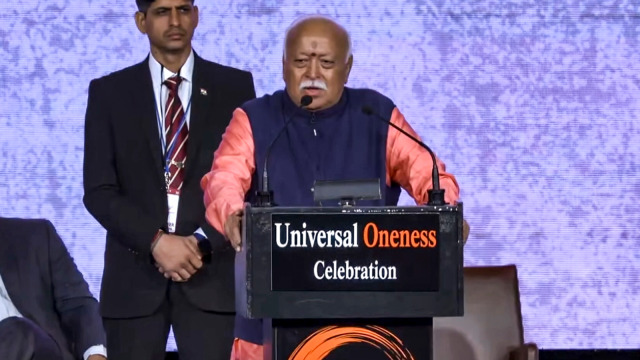
The bright lights of New York briefly turned the spotlight towards an old and continuing Indian debate: what does it mean to be Indian in a country defined by extraordinary diversity? RSS chief Mohan Bhagwat’s appearance in New York, the display of his image and message on digital billboards in Times Square, and his address before thousands at Madison Square Garden have given that debate a new international setting.
It would be easy to describe the event simply as a cultural gathering of the Indian and Hindu diaspora. But that would miss the larger significance. The timing, the venue, the message and the controversy surrounding the event all suggest something bigger: an attempt by the Rashtriya Swayamsevak Sangh, as it enters its centenary phase, to present its worldview to a global audience in a language that places harmony, dialogue, diversity and civilisational identity at the centre.
One factual distinction needs to be made at the outset. Bhagwat’s principal address was not delivered at Times Square but at the ‘Universal Oneness Celebration’ held at Madison Square Garden. Times Square was used for digital displays carrying his image and messages such as “Resolve, Harmony and Dialogue”. The distinction may appear technical, but it has symbolic importance. Times Square represents global visibility; Madison Square Garden provided the platform for an organised public engagement.
Together, the two settings created a powerful image: an Indian ideological and cultural message being projected into one of the world's most visible cities.
The central idea in Bhagwat’s address was “unity in diversity”. Drawing a comparison between American pluralism and India’s tradition of unity in diversity, he argued that diversity is not something that needs to be erased. It is part of India’s social character and, rather than weakening unity, can enrich it.
The idea itself is hardly new. India has long described itself through the coexistence of multiple religions, languages, cultures, customs and traditions. What makes Bhagwat’s formulation significant is the way he connects this familiar idea with the larger ideological framework of the RSS and with what he describes as India’s civilisational responsibility.
Bhagwat presented India not merely as a modern nation-state but as a civilisation with a larger message for the world. Referring to Swami Vivekananda, he argued that nations have a purpose and that India’s role is to demonstrate how unity and diversity can coexist.
This is an important element of the RSS worldview. India, in this interpretation, is more than a geographical territory or a constitutional arrangement. It is a civilisational continuum with a distinctive cultural and ethical contribution to make to humanity.
But that argument also raises a difficult question: how should India’s civilisational identity coexist with its identity as a modern constitutional republic?
The two need not necessarily be in conflict. A civilisation provides a society with historical memory and cultural continuity. A Constitution provides its citizens with rights, institutions and a framework for political life. The challenge is to ensure that one does not undermine the other.
Bhagwat’s explanation of ‘dharma’ also belongs to this broader philosophical framework. He did not present dharma merely as a matter of worship or membership of a particular religious community. Instead, he linked it to ethical conduct, responsibility and the ability to distinguish between right and wrong.
In this interpretation, human beings have a greater responsibility precisely because they possess reason and moral judgment. Individual life therefore cannot be reduced to personal achievement or material consumption. It carries obligations towards society and the wider world.
This part of the speech moves beyond the conventional political debate surrounding the RSS and touches upon a broader moral question: what is the purpose of prosperity if it does not translate into social responsibility?
Bhagwat similarly connected wealth with the idea of giving back. The measure of success, he suggested, should not only be how much one earns but also how much one contributes to others.
There is an obvious resonance here with India’s long tradition of ‘seva’, or service. At a time when societies across the world are struggling with inequality, consumerism and the concentration of wealth, such a message has relevance beyond the religious or cultural context in which it was delivered.
Another important part of Bhagwat’s message was directed towards the Indian diaspora.
He described America as the ‘karmabhoomi’, or land of work, of Indians settled there, while India remains their ‘janmabhoomi’, or land of birth. The message was that those living in America must remain loyal and responsible citizens of the country in which they live. Their emotional and cultural relationship with India can continue, but their civic responsibilities towards their country of residence must come first.
This is particularly relevant because the Indian-American community has changed dramatically over the decades.
Indian-origin Americans are no longer merely a cultural diaspora maintaining links with an ancestral homeland. They are prominent in technology, medicine, education, business, academia and politics. Their influence within American public life has grown considerably.
Bhagwat’s formulation attempts to reconcile two identities rather than placing them in opposition. One can remain culturally connected to India while being fully committed to the civic life of America.
The most politically sensitive part of the broader message, however, concerns the relationship between Hindu identity and Muslims.
Bhagwat reiterated the view that a Hindu who believes that Muslims should not live in India cannot be regarded as a true Hindu. The significance of this statement lies in the effort to distinguish the RSS understanding of Hindu identity from an explicitly anti-Muslim position.
The RSS has consistently argued that Hindutva should be understood as a broader civilisational and cultural identity rather than merely as a religious identity. Bhagwat’s formulation fits squarely within that argument.
But this is also where the gap between an ideological statement and political reality becomes important.
A political philosophy is ultimately judged not only by what its leaders say but by what its ideas produce in society. If unity in diversity is presented as a defining characteristic of India, then the obvious tests are the treatment of minorities, freedom of religion, equality before law, respect for dissent and the ability of different communities to live with mutual confidence.
Bhagwat’s statement offers a conceptual answer to some of these questions. It does not, however, end the wider political debate.
That debate was visible outside the venue as well.
New York Mayor Zohran Mamdani expressed opposition to the event and raised ideological objections concerning the RSS. Civil rights, interfaith and diaspora organisations also protested. Organisers, on the other hand, presented the gathering as an expression of unity, dialogue and interfaith harmony and pointed to broad support among Hindu-American organisations.
The controversy revealed something important about the diaspora itself: Indian-Americans and Hindu-Americans are not a politically or ideologically homogeneous community.
Some see their Indian identity primarily through the prism of Hindu civilisation and cultural nationalism. Others emphasise the Constitution, secularism, equal citizenship and minority rights. Many see no inherent contradiction between cultural heritage and constitutional democracy.
The New York event therefore became more than an India-versus-America argument. It exposed an internal debate within the diaspora about what India represents and how India should be understood abroad.
One conception sees India primarily as an ancient civilisation whose strength lies in its cultural continuity and ability to accommodate diversity.
Another sees the modern Indian republic primarily through the framework of constitutional democracy, equal citizenship and secular institutions.
Both may speak of unity and diversity. But they may not mean exactly the same thing by either word.
This distinction matters.
The political importance of Bhagwat’s New York appearance also needs to be understood in the context of the RSS entering its centenary period. The organisation has played a significant role in India’s social and political life, and its ideological relationship with the BJP has been a subject of sustained public debate.
As a result, when the RSS chief speaks abroad, his words inevitably carry a political significance that extends beyond the immediate gathering.
The vocabulary of the New York address is therefore worth examining.
There was relatively little emphasis on political confrontation. Instead, the dominant words were oneness, harmony, dialogue, diversity, dharma and service.
That may be read as an attempt to present the RSS internationally through a softer cultural and civilisational vocabulary.
For an organisation whose image abroad is often shaped by debates surrounding Hindutva and Indian politics, this is significant.
But international image-building cannot depend on vocabulary alone. It ultimately depends on credibility. And credibility is built through conduct, institutional practice and social outcomes.
That is where the larger test begins.
Bhagwat’s vision also fits into India’s expanding use of civilisational soft power.
India today is increasingly seen as an economic, technological, diplomatic and strategic power. But its international influence is not confined to these areas. Yoga, Ayurveda, Indian philosophy, family structures, traditions of service and the idea of ‘Vasudhaiva Kutumbakam’ have all become part of India’s cultural influence.
Bhagwat’s message seeks to place the RSS within this larger civilisational narrative.
Yet soft power has an unavoidable condition: the domestic reality must support the international message.
A country cannot convincingly teach the world about pluralism if its own citizens lose confidence in their ability to live together. Nor can a message of oneness acquire lasting credibility if sections of society feel that their identity or rights are insecure.
This is why the most important question emerging from Bhagwat’s New York address is not whether the message sounds appealing. It is whether the principles can withstand the complexities of real political life.
What does ‘oneness’ mean in a democracy?
It cannot mean that everyone must become culturally identical. Democracies do not require uniformity. They require equal citizenship.
People can worship differently, speak different languages, eat different food, follow different traditions and hold different political opinions while still belonging equally to the same nation.
If unity means that—shared citizenship despite differences—then unity in diversity is a powerful democratic principle.
But if unity becomes a demand for cultural conformity, diversity begins to lose its meaning.
That distinction will remain at the heart of the debate surrounding the RSS and Hindutva.
Bhagwat has offered an interpretation in which Hindu identity is compatible with the presence of Muslims, diversity is compatible with national unity, and Indian civilisation has a message for the wider world.
His critics, however, will continue to ask whether this interpretation is reflected consistently in social and political practice.
That question cannot be settled by one speech.
Nor can it be dismissed as merely a political disagreement.
It goes to the heart of India’s national identity.
The New York event, therefore, should be seen on three levels.
First, it was an effort to present the RSS as a cultural and civilisational organisation whose message is rooted in unity, diversity and service.
Second, it was an important engagement with an increasingly influential Indian diaspora, reminding it that cultural ties with India need not conflict with civic loyalty to the country of residence.
Third, it was an attempt to place India within a global conversation about pluralism, human unity and civilisational values.
The most interesting aspect of the episode is that all three levels converge on the same question: what kind of India is being presented to the world?
Is it primarily an ancient civilisation rediscovering its global voice? Is it a modern constitutional republic whose strength lies in equal citizenship? Or can it successfully present itself as both?The answer will determine how Bhagwat’s New York message is eventually understood.
The lights of Times Square will move on to other images. The Madison Square Garden gathering will eventually become another event in the history of the RSS centenary. But the debate it has exposed is unlikely to disappear. India will continue to wrestle with the relationship between civilisation and Constitution, faith and citizenship, majority identity and minority security, national unity and social diversity.
That is why the most important part of Bhagwat’s message may not be what he said about America or even about the RSS.It is the challenge implicit in his own argument.
If India truly has a civilisational message of unity in diversity, then that principle must first be visible within India itself. The strongest proof of unity is not the absence of disagreement. It is the ability to remain united despite disagreement.
The real test of ‘oneness’ is whether a society can accommodate the person who does not share its beliefs, politics or identity—and still regard that person as an equal member of the national community. That is the standard by which Bhagwat’s New York message will ultimately be judged.
The question, therefore, is no longer simply what India wants to tell the world. The deeper question is whether India can live by the message it wants the world to hear.



[[comment.comment_text]]