From Rajghat to Shantivan: Who Participates in the All-Faiths Prayer Meetings

 4 months, 1 week ago
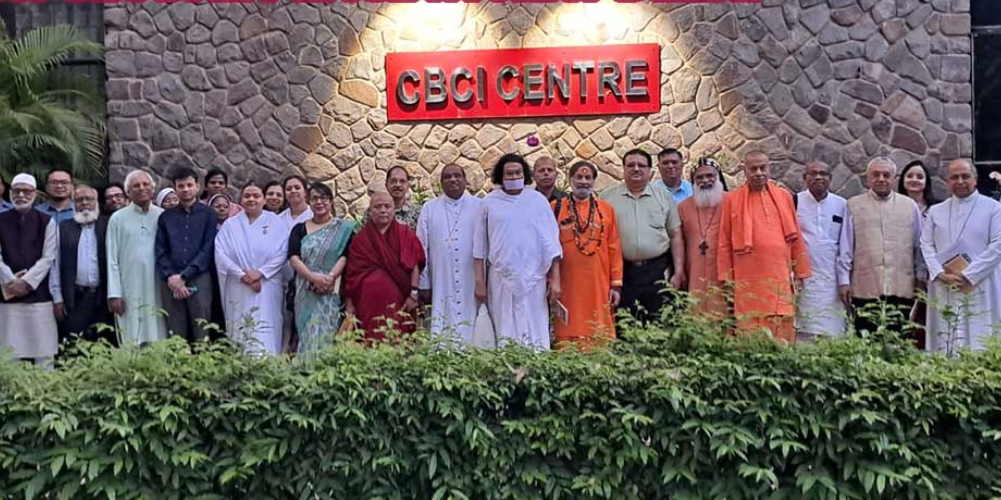
Every year on the birth and death anniversaries of nationals leaders All Faith Prayer Meetings take place. On 27 May, the last day of May, the death anniversary of India’s first Prime Minister, Pandit Jawaharlal Nehru, a meeting was organised at Shantivan. Even before the programme started, religious leaders, scholars, and devotees from various religions had begun gathering. Most of them were the same faces who regularly attend similar prayer meetings at Rajghat on 2 October (Gandhi Jayanti) and 30 January (Martyr’s Day).
During the meeting, these participants read passages from the holy books of their respective religions.
For the past two to two-and-a-half decades, George Solomon has been reading from the Bible at both Shantivan and Rajghat. He is a priest at Trinity Church near Turkman Gate in Delhi. He is also associated with the management committee of St. Stephen’s Cambridge School in Delhi and Sonipat, Haryana. He says, “The fact that the Government of India organises All-Faiths Prayer Meetings is proof that this country belongs to everyone. The Bible too gives a message of love and brotherhood.”
These people truly represent the soul of India, where unity in diversity is alive. These prayer meetings repeatedly remind us that the India of Gandhi’s dreams belongs to all, and every religion is given respect here.
Maqsood Ahmed recites verses from the Quran at Shantivan and Rajghat. He has also participated in All-Faiths Prayer Meetings held on the passing of former Presidents K.R. Narayanan and Pranab Mukherjee, and Prime Minister Atal Bihari Vajpayee. Maqsood Ahmed, a biology teacher at Anglo-Arabic School, says that some mentally unbalanced people have started criticising even these prayer meetings.
Dr. Baldev Anand Sagar recites verses from the Gita during the prayer meetings on 2 October and 30 January. He says that the first time he participated in the meeting at Rajghat, he had an unforgettable experience that is still fresh in his mind. At Rajghat, he reads 5–6 verses from the Gita. On 30 January, he recites prayers to the five deities- Surya, Ganesh, Durga, Shiva, and Vishnu. He believes that worshipping all these deities is an essential part of the Sanatan tradition.
The beautiful idea of All-Faiths Prayer was given to the world by Mahatma Gandhi. It began during his lifetime and continues as a living tradition even today.
At these meetings, sacred texts from the Bahai, Jewish, Buddhist, Jain, and Sikh faiths are also recited. The concept of All-Faiths Prayer is very broad and important. It sends the message that people of different religions in India can sit together and share the core messages of their holy books
Participants in these prayer meetings receive an honorarium of Rs 5,100.
Brother George Solomon, who reads from the Bible at various government-organised prayer meetings, says that the Narendra Modi government treats everyone equally. The presence of these prayer meetings in official functions is proof of the government’s equal respect for all religions. All holy books, including the Bible, give messages of love and brotherhood. Mahatma Gandhi had the opportunity to deeply understand the Bible and Christianity during his time in South Africa.
Eighty-five-year-old Katsu San is a permanent presence at all government-organised prayer meetings. She has read from Buddhist scriptures in the presence of Presidents such as Shankar Dayal Sharma, K.R. Narayanan, A.P.J. Abdul Kalam, Pranab Mukherjee, and Ram Nath Kovind, as well as Prime Ministers Indira Gandhi, Atal Bihari Vajpayee, and Narendra Modi.
“An All-Faiths Prayer Meeting was also held during the foundation ceremony of the new Parliament building. In these meetings, representatives of each religion are given 5-6 minutes to speak.” Brother Solomon indorms.
Secularism does not mean that a country should abandon its religious traditions and cultural beliefs. That is also impossible. The original copy of the Indian Constitution has a picture of Lord Krishna giving the Gita’s teachings to Arjuna. Lord Buddha is shown preaching peace. Images of Hindu symbols such as the lotus, Lord Ram, Lord Krishna, and Nataraj are also present. If these pictures were put up today, some so-called intellectuals would call them communal and protest.
All-Faiths Prayer Meetings are a beautiful expression of India’s shared culture and inclusive democracy. They keep reminding us that diversity is our strength and unity is our resolve.


[[comment.comment_text]]