Brownfield Over Greenfield: Questions and Concerns

 1 year, 3 months ago
The Indian government has decided to abandon a major scheme proposed by the 15th Finance Commission to build eight greenfield cities. The ambitious plan, which earmarked ₹8,000 crore for the creation of entirely new urban centres, has now been shelved. Instead, the funds are likely to be redirected towards enhancing infrastructure in smaller cities with populations of up to 100,000. This decision marks a pivotal moment in India’s urban planning discourse and raises important questions about how the country should approach its rapid urbanisation.
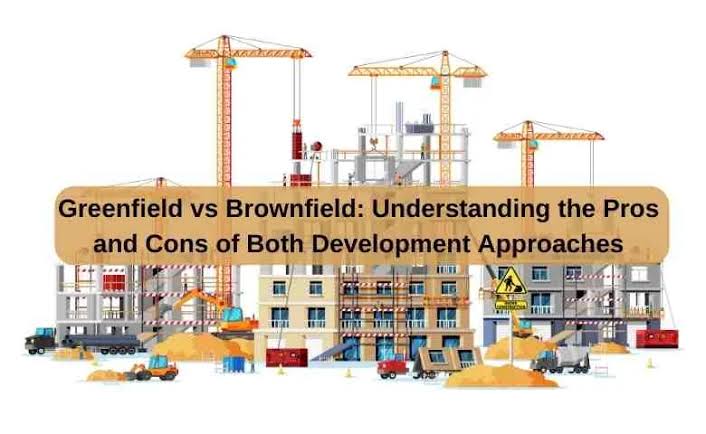
At the heart of the matter lies the longstanding binary between greenfield and brownfield development — the former involving construction from scratch on previously undeveloped land, and the latter focused on upgrading existing urban infrastructure. In India’s unique context, this dichotomy is becoming increasingly meaningless and outdated.
India is urbanising at an unprecedented pace. As per UN estimates, by 2035, nearly 43% of the Indian population will reside in urban areas. This surge places enormous stress on existing cities, many of which are already buckling under the weight of overpopulation, inadequate infrastructure, and poor urban planning. Cities such as Delhi, Mumbai, Bengaluru, and Chennai face daily challenges ranging from traffic congestion and water shortages to poor air quality and strained public services.
This urban burden is not confined to megacities alone. Even Tier-2 and Tier-3 cities are seeing a demographic explosion, fuelled by migration, industrialisation, and the growth of the services sector. In this scenario, the logical policy priority should be to strengthen and retrofit existing urban areas — a brownfield approach — rather than embarking on the complex, costly, and uncertain task of building new cities from the ground up.
Greenfield city projects, while attractive on paper, have rarely translated into sustainable, livable realities in India. The challenges are manifold: land acquisition disputes, displacement of communities, ecological concerns, and high capital investment without guaranteed returns. Lavasa and Amaravati — two high-profile greenfield city attempts — stand as cautionary tales. Both projects struggled due to bureaucratic hurdles, financial mismanagement, and lack of public buy-in.
While the idea of creating smart, well-planned cities from scratch is appealing, it does not adequately address the immediate and pressing needs of the urban population. Moreover, urban growth in India is rarely linear. The spatial continuum between villages, towns, and cities is becoming increasingly blurred. Urban sprawl is extending into peri-urban areas, creating conurbations — large, continuous urban areas comprising multiple municipal units. In such a setting, creating new, isolated urban nodes often fails to integrate with the organic growth of surrounding regions.
The government’s move to repurpose the ₹8,000 crore towards improving infrastructure in smaller cities and towns is a pragmatic one. These areas, often neglected in national urban policy, are on the frontlines of India’s urban transition. Small and medium towns are absorbing migrants, serving as economic hubs, and bridging the rural-urban divide. Yet, they often lack even the basic infrastructure — water supply, sewage systems, waste management, and public transport.
Schemes like the Jawaharlal Nehru National Urban Renewal Mission (JNNURM) and its successor, the Atal Mission for Rejuvenation and Urban Transformation (AMRUT), have made some headway in addressing infrastructure gaps. However, much remains to be done. Redirecting funds to these towns not only aligns with the broader goals of balanced regional development but also yields higher returns in terms of social and economic impact.
India’s urban policy needs to move beyond binaries and towards a more integrated approach. The choice is not simply between building new cities or upgrading old ones. Instead, the focus must be on creating a resilient urban ecosystem that can absorb growth sustainably. This includes investing in infrastructure, affordable housing, public transport, digital connectivity, and environmental sustainability.
Moreover, decentralised governance and empowered urban local bodies are essential for effective implementation. The success of any urban initiative, be it greenfield or brownfield, depends on local participation, transparent administration, and strong institutions.
The shelving of the greenfield city scheme is more than just a budgetary reallocation; it reflects a deeper understanding of India’s urban challenges. As the country stands at the cusp of a massive urban transformation, it must resist the temptation of flashy, top-down solutions and instead invest in the lived realities of its people. Strengthening existing urban and semi-urban spaces is not a compromise — it is a necessity. Only through sustained, inclusive, and context-sensitive planning can India build cities that are truly future-ready.
(Author, a Ph.D. in Sociology, is a well-recognised author and columnist. For past over three decades, he has served in various administrative and academic capacities at Banaras Hindu University.)






[[comment.comment_text]]