Missing Children: A Pervasive Human Rights Challenge

 an hour ago
The disappearance of children remains a persistent social and human rights challenge in India. Almost every day, reports emerge of children going missing under circumstances that expose them to abuse, exploitation, neglect and, in the worst cases, human trafficking. Despite improvements in education, transportation, communication and law enforcement, the problem continues to demand urgent attention.
A child is considered missing when his or her whereabouts are unknown. For the family, this immediately triggers an agonising period of anxiety, uncertainty and helplessness. Children, who should grow up in a safe, supportive and nurturing environment, become particularly vulnerable when separated from their families. The possibility of exploitation and trafficking makes their disappearance even more alarming.
Only parents and guardians who have experienced such a tragedy can truly understand the emotional trauma involved. In many cases, the search becomes a long, exhausting and deeply distressing ordeal, with little certainty about when, or whether, the child will return.
THE CONTINUING CYCLE OF EXPLOITATION
In some cases, a missing child is located relatively quickly, but poverty and financial constraints prevent the family from pursuing the matter further. This is particularly true of families from economically disadvantaged regions of eastern India and Nepal, whose limited resources make it difficult to travel, approach authorities or undertake legal proceedings.
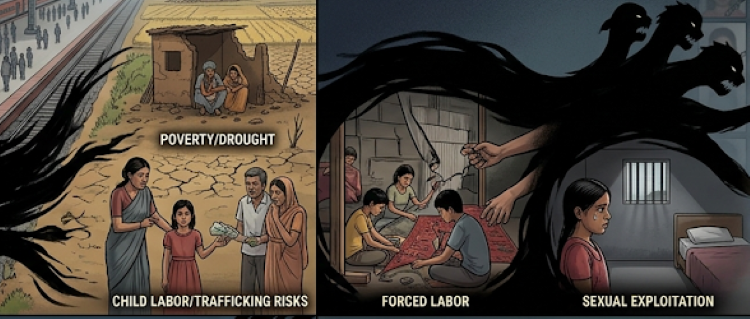
Such circumstances create opportunities for exploitative networks to operate with impunity. Children are pushed into hazardous and illegal occupations, including bidi-making, firecracker manufacturing, domestic work and other forms of child labour. Some are trafficked into prostitution or forced to work in restaurants, bars, hotels and other establishments.
Deprived of basic facilities such as proper accommodation, sanitation and safe drinking water, many child workers are compelled to sleep on pavements, verandahs and rooftops of railway stations. They are also vulnerable to police suspicion and harassment, particularly when criminal incidents occur in their vicinity.
The recovery of a child, therefore, cannot be treated as the end of the problem. It must be followed by protection, counselling, rehabilitation and appropriate educational or vocational support.
SEARCH, RESCUE AND REHABILITATION
The immediate reporting of a missing child is critical. Police stations, child protection authorities and other relevant agencies must coordinate their efforts to ensure that information reaches district, state and national-level institutions without delay.
The involvement of neighbours, schools, Panchayats, community organisations and local authorities can significantly strengthen search and rescue operations. Such participation helps identify unusual circumstances, mobilise local resources and accelerate the tracing of missing children.
However, rescue alone is not enough. Children who have experienced trafficking, abuse, forced labour or prolonged separation often require sustained psychological and social support. Their rehabilitation must include access to education, healthcare, counselling and a secure family or institutional environment.
A GLOBAL CONCERN, AN ALARMING INDIAN PICTURE
Missing children are a worldwide concern. The United States, the United Kingdom, Germany and Canada report substantial numbers of missing-child cases every year. However, international comparisons must be treated cautiously because countries follow different definitions, reporting systems and recording procedures.
India’s figures are equally disturbing. According to the National Crime Records Bureau (NCRB), 1,47,175 children were reported missing in 2024, compared with 1,38,609 in 2023, representing an increase of approximately 6.2 per cent.
Girls accounted for 75.6 per cent of the reported cases, while 51.3 per cent involved children in the vulnerable age group of 16–18 years. These figures underline the particular risks faced by adolescent girls and the need for targeted preventive measures.
The state-wise distribution also reveals significant regional variations. West Bengal, Maharashtra, Odisha and Madhya Pradesh have reported substantial numbers of missing children. Kerala and Delhi also record considerable cases, although their recovery performance has been relatively encouraging.
Jharkhand presents another dimension of the problem. Children from economically weaker families are frequently taken to Delhi and other metropolitan centres for domestic work and other forms of employment. The circumstances in which they are recruited, transported and employed often remain unclear, making it difficult to establish whether they have been voluntarily relocated or exploited.
Although recovery rates have reportedly improved, tracing a child does not necessarily mean that the child has been reunited with the family or restored to a safe environment. Effective rehabilitation and long-term monitoring remain equally important.
WHY DO CHILDREN GO MISSING?
There is no single explanation for the disappearance of children. Some run away voluntarily because of family disputes, domestic violence, abuse, neglect, emotional distress or pressure arising from difficult circumstances at home.
Others become separated from their families in crowded public places, railway stations, fairs and religious gatherings. Adolescent relationships and elopement are also reported reasons in certain cases.
An emerging concern is online grooming. Through social media platforms and digital communication channels, vulnerable children may be manipulated by strangers who exploit their emotional needs, build false relationships and eventually persuade them to leave home or meet them in unfamiliar locations.
Seasonal migration and the increased movement of people during holidays can further complicate the search process. These factors call for greater parental awareness, community vigilance and effective monitoring mechanisms.
SUPREME COURT GUIDELINES AND INSTITUTIONAL RESPONSE
The Supreme Court has played an important role in strengthening the response to missing-child cases. In its judgment in Horilal v. Commissioner of Police, Delhi, dated 14 November 2002, in Writ Petition No. 610 of 1996, the Court issued directions aimed at improving the investigation and tracing of missing children.
These efforts contributed to the establishment of a special cell in the Central Bureau of Investigation and the constitution of a high-powered committee by the National Human Rights Commission in 2007.
An important safeguard is that every missing-child complaint must be treated with urgency. Police are required to register an FIR and investigate the possibility of kidnapping or abduction rather than dismissing the complaint or delaying action on the assumption that the child may have left voluntarily.
The National Human Rights Commission, the National Commission for Protection of Child Rights and their state-level counterparts also have an important monitoring and advisory role. They must ensure that complaints receive timely attention and that concerned authorities remain accountable. Regular reviews, preferably on a monthly basis, can help identify delays and systemic shortcomings.
The Department of Women and Child Development in Delhi also undertakes monitoring and publishes information relating to missing and separated children.
Despite the involvement of government agencies and non-governmental organisations, however, serious gaps remain between policy and implementation. Trafficking networks continue to exploit children for forced labour, domestic servitude, sexual exploitation and other criminal activities. The vulnerability of children from poor and marginalised families makes the challenge even more complex.
THE NEED FOR A STRONGER COMMITMENT
The problem of missing children cannot be addressed through periodic meetings, conferences and administrative reviews alone. It requires sustained coordination among the police, child protection institutions, educational establishments, local governments, civil society organisations and communities.
Particular attention must be paid to the identification and rescue of children engaged in domestic work, bonded labour and other exploitative occupations. The low rate of conviction in identified cases, reportedly less than one per cent in some assessments, points to serious weaknesses in investigation, prosecution and enforcement. Such figures, however, need to be examined against reliable case-specific data.
The international recognition of child rights activist Kailash Satyarthi, who received the Nobel Peace Prize jointly in 2014 for his efforts against child labour and exploitation, raised hopes of a stronger global commitment to protecting children. His work, including the rescue of thousands of children from forced labour and trafficking, has helped bring this issue into the public consciousness.
The Government of India and various state governments have since undertaken several initiatives. Yet the persistence of missing-child cases and the continued exploitation of vulnerable children demonstrate that much more needs to be done.
Ultimately, a child’s safety cannot be measured merely by the registration of a complaint or the completion of a rescue operation. It must be measured by whether the child is protected, rehabilitated and given an opportunity to live with dignity.
Children are not merely the future of the country; they are its present responsibility. Allowing them to remain trapped in exploitation, insecurity and misery is a failure of society as much as it is of the state. The question we must ask ourselves is simple: Do we genuinely care about the future of our children, or have we become accustomed to their suffering?







[[comment.comment_text]]