In the Courtyard of Maa Moulakshi, Maluti’s History Awakens

 2 hours ago
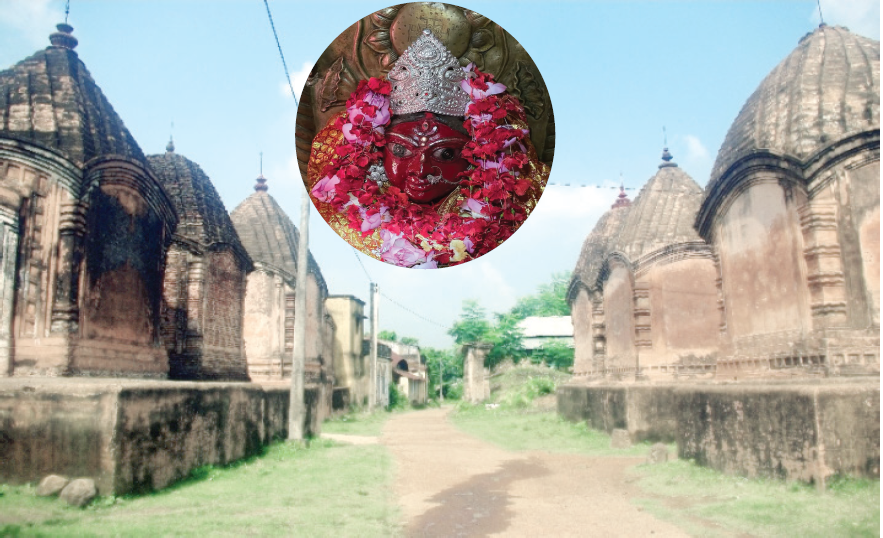
At dawn during Navratri, Maluti does not simply wake up. It remembers. The first rays of the sun fall softly on the tiled roofs and old brick walls of the village temples. A conch shell breaks the morning silence. Somewhere, a bell begins to ring. The fragrance of incense moves through the narrow lanes, while devotees walk towards the shrine of Maa Moulakshi with folded hands. For a few moments, the village seems to exist outside the ordinary rhythm of time. Here, history does not lie quietly in a museum. It breathes in the sanctum of a temple, travels through an old story told by a priest, survives in the hands of an artisan and returns every year with Navratri. At the heart of this living memory is Maa Moulakshi.
Maluti in Shikaripara block of Dumka district in Jharkhand, lies about 55 kilometers s from the district headquarters. Known for its remarkable concentration of temples, the village has often been called the “Gupt Kashi” of eastern India. But the phrase, however evocative, tells only part of the story. Maluti is not merely a village of temples. It is a landscape in which faith, folklore, architecture and memory have remained intertwined for centuries.
The shrine of Maa Moulakshi gives this landscape its spiritual centre. For devotees, Maa Moulakshi is not simply a deity preserved inside an old temple. She is a jagrit shakti — an awakened divine power. The goddess is worshipped in the form of Durga, particularly as Singhavahini, the goddess riding a lion. In the sanctum, the principal darshan is of the goddess’s head, installed on a raised platform. During Sharadiya Navratri, this form acquires an even deeper emotional significance as devotees arrive seeking blessings, protection and fulfilment of their faith.
There is a deeply rooted local tradition connecting Maa Moulakshi with the famous Maa Tara of Tarapith in neighbouring West Bengal. According to local belief, Maa Moulakshi is regarded as the elder sister of Maa Tara. This should be understood as a matter of folk faith and cultural tradition rather than as an established historical fact. Yet dismissing such beliefs merely because they cannot always be verified through conventional historical records would be to misunderstand how Indian sacred geography has evolved. Faith often creates its own maps.
For the people of this region, Maluti and Tarapith are connected through a cultural memory that has travelled across generations. The relationship between the two shrines is not necessarily one that can be plotted through an archaeological survey. It is a relationship carried by stories, journeys, rituals and belief. The memory of Bamakhapa adds another layer to this connection. Local tradition holds that the famous saint associated with Tarapith worshipped Maa Moulakshi before going to Tarapith, and his trident is also believed to be installed at Maluti. Whether every element of this tradition can be historically documented is a question for scholars. But the persistence of the story itself is significant. A civilisation is not remembered only through documents. Sometimes it is remembered through a story repeated beside a temple for generations.
That is why Maluti deserves to be read not simply as an architectural site but as a living text. The village is believed to have once had 108 temples and 108 ponds. Around 72 ancient temples survive today. Their distribution in different groups reflects the religious and social history of the settlement. The temples are dedicated to Shiva, Durga, Kali, Vishnu, Dharmaraj, Manasa and other deities. Together they create an unusual sacred landscape in which the village seems to have been shaped around worship.
The architecture tells another story. Influenced strongly by the temple traditions of Bengal, many of Maluti’s temples follow the chala style. Thin bricks and lime-surkhi mortar were used in their construction. The shrines are modest in scale compared with the great monumental temples of India, but their beauty lies precisely in their intimacy. And then there are the terracotta panels. Look closely at the walls and another Maluti begins to emerge. There are gods and goddesses, mythological scenes, animals and decorative motifs. But alongside the sacred are fragments of everyday life. The walls seem to hold a conversation between religion and society.
This is what makes Maluti particularly valuable. Its temples are not only places of worship; they are visual records. A historian can read them for clues about the past. An architect can study their forms. A conservationist can examine their materials. An artist can see the extraordinary imagination of the terracotta craftsmen. And a villager can simply stand before a temple and remember. Perhaps this last act of remembering is the most important, because heritage is not only what experts identify. It is also what communities inherit.
This is where the question of conservation becomes difficult. Maluti needs protection. Its old bricks, terracotta surfaces and architectural details are vulnerable to age, weather and neglect. Conservation initiatives have rightly brought attention to the need to stabilise and restore the surviving temples, including their fragile terracotta surfaces. But conservation is not the same thing as beautification. The distinction matters.
A heritage site can be made visually attractive and yet lose its historical character. Old walls can be repaired so aggressively that the evidence of time disappears. New construction can gradually overwhelm an old settlement. Tourism can increase while the local community becomes less central to the heritage narrative. Maluti must not become a picturesque backdrop for visitors while its living traditions are reduced to folklore for tourists.
The village is not a museum. Maa Moulakshi is still worshipped. Navratri is still celebrated. The stories associated with Tara and Bamakhapa still live in popular memory. The temples remain part of the cultural life of the community. This living character should be at the centre of any conservation policy. The objective should not be to freeze Maluti in the past, but to allow its heritage to survive in the present without losing its authenticity.
That requires a sensitive partnership between conservation experts and the local community. Priests, residents, traditional artisans, historians and heritage professionals all have different forms of knowledge. None of them can preserve Maluti alone. The terracotta panels deserve particular attention. They are fragile, and their value lies in their original workmanship and historical context. Conservation should therefore be guided by the principle of minimum intervention.
The objective should be to preserve what survives, not to manufacture an artificially perfect past. A restored temple should still look old. Its age is not a defect. Its weathered surface is part of its biography.
This becomes even more important as Jharkhand increasingly looks towards heritage tourism as a means of local economic development. There is nothing inherently wrong with tourism. Properly planned, it can create livelihoods, encourage conservation and bring new attention to neglected cultural landscapes. But tourism must serve heritage, not consume it. Local people should benefit from visitors through homestays, guiding, traditional crafts, local food, cultural interpretation and other forms of community-based enterprise. The economic value generated by heritage should not bypass the people who have protected that heritage through generations.
Most importantly, the spiritual identity of Maluti must remain intact. The village cannot be reduced to the number of temples it possesses. Its real wealth lies in the relationship between those temples and the people who still give them meaning. That is why Navratri is perhaps the best time to look at Maluti again. The festival asks us to think about awakening. In Maluti, the word has a meaning beyond ritual.
What does it mean to awaken a heritage? Is it enough to repair a temple? Is it enough to build a road to it? Is it enough to put up a signboard describing its history? Or does awakening mean restoring the connection between a place, its people and the memory they carry?
The answer may lie in the courtyard of Maa Moulakshi. Here, the sacred and the historical do not compete with each other; they strengthen each other. The goddess gives the village its spiritual centre, the temples give form to its history, terracotta gives the past a visual language, and folklore gives memory a voice. The community keeps the entire story alive.
India’s heritage is full of such places — places that are neither wholly archaeological nor wholly religious, neither frozen monuments nor ordinary settlements. Their significance lies precisely in this overlap. Maluti belongs to that rare category. Its future, therefore, should not be imagined merely as the preservation of 72 surviving temples. Those temples are only the visible part of a much larger inheritance.
To save Maluti is to save the worship of Maa Moulakshi. It is to preserve the Navratri traditions. It is to respect the folk memory that connects Moulakshi with Tara. It is to record, without turning folklore into fact, the stories of Bamakhapa. It is to protect the terracotta panels and the craftsmanship behind them. And it is to ensure that the people of Maluti remain participants, rather than spectators, in the story of their own heritage.
As evening falls during Navratri, the temple bells slowly become quieter. The crowds begin to thin. The old brick walls absorb the last light of the day. But the village does not become silent. Its stories remain. Perhaps that is Maluti’s greatest lesson: a heritage survives not when it is merely preserved in stone and brick, but when it continues to live in the imagination and faith of a people. In the courtyard of Maa Moulakshi, history is not a thing of the past. It is still awake.
(The author, a senior journalist of Bihar, is a known commentator on governance, development, and diversity issues.)







[[comment.comment_text]]