The Dangerous Business of Social Media Trials

 57 minutes ago
In the age of instant opinions, facts are often the first casualty. Before investigators establish what happened, before evidence is examined and before a court hears the case, social media has already delivered its verdict. Political loyalties, religious beliefs, ideological preferences and personal prejudices increasingly determine who is guilty and who deserves sympathy. The disturbing question is no longer just whether the media is conducting trials before courts do, but whether society itself has become a courtroom where everyone is a judge, every opinion is a verdict and every disagreement is treated as a battle between right and wrong.
An accident, a criminal incident, a political controversy or a religious dispute is enough to trigger this parallel judicial process. Within minutes, photographs, videos, selective accounts and unverified claims begin circulating. People take sides, construct narratives and defend their preferred versions of the truth. The actual facts often become secondary to the desire to prove one's own position correct. What should ideally be a process of understanding an incident gradually turns into a contest of opinions, accusations and counter-accusations.
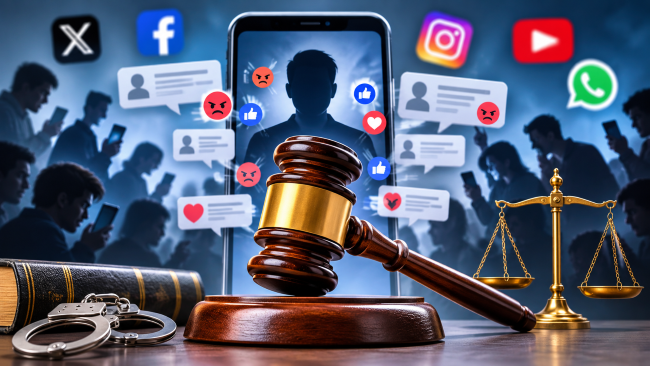
The expansion of social media has fundamentally changed the relationship between information, journalism and public opinion. Earlier, media trials were largely associated with television debates and sensational newspaper reporting. Today, the phenomenon has moved beyond professional newsrooms. Almost everyone with a smartphone and a social media account can participate in a public trial. Facebook, X, Instagram, YouTube and WhatsApp have become platforms where allegations are examined, reputations are judged and verdicts are delivered, often without the minimum requirement of verifying facts or hearing the other side.
The scale of India's digital expansion makes this development particularly significant. According to the Government of India's Economic Survey 2025–26, internet connections increased from 25.15 crore in 2014 to approximately 96.96 crore in 2024. The Survey also reported that 85.5 per cent of Indian households had at least one smartphone in 2025. It estimated that approximately 43 per cent of internet users accessed social media in 2024. These figures demonstrate how deeply digital communication has entered everyday life. Information that once travelled through established news organisations now reaches millions of people directly through social networks and messaging applications.
The Reuters Institute for the Study of Journalism's Digital News Report 2025 offers further insight into this transformation. Its India findings indicate that YouTube was used for news by 55 per cent of respondents, WhatsApp by 46 per cent, Instagram by 37 per cent and Facebook by 36 per cent. The report also found that 53 per cent identified WhatsApp as the channel posing the biggest threat in relation to false and misleading information. These findings relate primarily to its English-speaking online news sample and should not be treated as nationally representative. Nevertheless, they underline the growing influence of digital platforms in shaping public understanding.
The problem is not simply that more people are consuming news through social media. The deeper concern is that information is increasingly being consumed without sufficient verification, context or distinction between fact and opinion. A message received from a relative, a video shared by a friend or a post published by an account supporting one's political beliefs may appear credible simply because it comes from a familiar source. Familiarity, however, is not evidence, and popularity is not proof of authenticity.
Consider a road accident in which a short video showing a vehicle hitting a pedestrian becomes viral. Within minutes, the driver may be labelled reckless, intoxicated or criminal. Some users may circulate personal details and photographs of the individual. Others may blame the pedestrian without knowing the circumstances. The complete sequence of events, road conditions, vehicle speed, eyewitness accounts and police investigation become secondary. A few seconds of footage are treated as sufficient evidence to determine responsibility. Nobody appears interested in knowing what happened before or after the recording. The investigation becomes less important than the public verdict already delivered.
The same pattern emerges after railway accidents, industrial disasters and major fires. Before technical investigations begin, social media discussions start attributing responsibility to particular employees, departments or political authorities. One group alleges corruption, another claims sabotage, while a third attempts to defend the administration. The possibility of multiple contributing factors is often ignored. A serious accident may involve technical failure, inadequate maintenance, human error, regulatory negligence and institutional shortcomings. Establishing responsibility requires evidence, expert assessment and systematic investigation. Public scrutiny is essential, but premature conclusions can undermine the very process through which accountability should be established.
Religious and communal incidents reveal an even more dangerous dimension of social media trials. Old videos, unrelated photographs and selectively edited recordings are sometimes presented as evidence of a new incident. One group interprets an incident as an attack on its faith, while another presents a completely different narrative. Political and religious affiliations begin determining the nature of public reactions. The same people who demand strict action in one incident may find reasons to justify similar conduct in another. Instead of establishing the facts and protecting social harmony, the discussion becomes an exercise in defending collective identities. Such selective outrage can deepen divisions and create an atmosphere of mistrust.
Political controversies are no different. When an allegation is made against a political leader, opponents frequently treat it as established fact, while supporters dismiss it as a conspiracy without waiting for an investigation. The same people who demand accountability in one case may question the credibility of evidence in another simply because the accused belongs to a political group they support. This contradiction exposes the weakness of our public discourse. If allegations against political opponents are automatically accepted while allegations against political allies are automatically rejected, where is the space for independent judgment?
The same selective approach is visible in matters of caste, religion and community identity. An incident involving one community may attract widespread condemnation, while a similar incident involving another community may receive silence or justification. The moral position changes according to the identity of the people involved. This is a serious threat to democratic values. Wrongdoing should remain wrong irrespective of who commits it, and innocence should not become questionable merely because a person belongs to a disliked group. Justice cannot have different standards for different identities.
The commercial structure of digital media also contributes to this problem. Television channels compete for ratings, while digital platforms and content creators compete for views, engagement, subscriptions and advertising revenue. Controversy, emotional reactions and polarising narratives frequently attract greater attention than careful investigative reporting. A headline suggesting a major conspiracy may generate more clicks than a detailed report explaining the technical findings of an investigation. An aggressive television debate may attract more viewers than a discussion involving experts, documents and multiple perspectives. In this environment, the pressure to be first and sensational can overshadow the responsibility to be accurate.
UNESCO's global survey of digital content creators, published in November 2024, provides an important indication of the problem. Covering 500 creators across 45 countries, it found that 62 per cent did not undertake rigorous and systematic fact-checking before sharing information. Approximately 42 per cent considered the popularity of content, measured through likes and views, an indicator of credibility. The findings reveal a dangerous confusion between popularity and authenticity. A video receiving millions of views is not necessarily true, a widely circulated allegation is not necessarily supported by evidence, and a popular opinion is not automatically a correct opinion.
This growing culture of instant judgment also raises serious questions about professional journalism. The role of journalism is to investigate, question and expose. It must challenge official narratives, scrutinise administrative failures and bring uncomfortable facts into the public domain. However, investigative journalism and media trials are fundamentally different. A journalist must distinguish between an allegation, an established fact and a judicial finding. A television discussion should not become a substitute for a criminal investigation, and an anchor's confidence should never be confused with the credibility of evidence.
The presumption of innocence is an essential principle of the justice system. An accused person must have an opportunity to defend themselves, and guilt must be established through legally admissible evidence. The Indian Constitution protects life and personal liberty under Article 21, while the right to freedom of speech and expression under Article 19(1)(a) is also subject to reasonable restrictions. Media freedom is indispensable to democracy, but it must operate with responsibility towards individual dignity and the fairness of legal proceedings.
One of the most serious consequences of social media trials is the damage they can inflict on individual reputations. Imagine a person accused of involvement in a criminal incident. His photograph, personal details and family information circulate across social media platforms. Television debates discuss his alleged motives, and online commentators pronounce him guilty. His family faces social isolation, professional relationships suffer and personal dignity is damaged. Months later, an investigation may establish that the initial allegations were incorrect or that the available evidence does not support the accusation. But will those who circulated the allegations issue corrections? Will those who publicly declared the person guilty acknowledge their mistake? The original accusation may remain searchable long after it has been disproved. An allegation can travel across millions of screens in hours, but restoring an individual's reputation may take years.
The problem becomes even more serious in cases involving women, children, suicide and family disputes. Publishing private conversations, photographs or sensitive personal details can cause additional trauma to victims and their families. Such material should never be treated as entertainment or used merely to generate online engagement. The dignity and privacy of individuals must not become casualties of public curiosity.
Freedom of expression must also come with responsibility. Citizens must have the right to question governments, criticise institutions, challenge religious practices and express disagreement. A democracy cannot survive without open discussion and dissent. However, the right to express an opinion does not automatically make that opinion factual. Before forwarding a video or posting an accusation, users should establish its source, date, location and context. An old video presented as a recent incident can create serious misunderstanding, while an edited recording can completely reverse the meaning of a conversation.
Perhaps the most uncomfortable question is not about television channels, social media platforms or content creators. It is about ourselves. Do we genuinely want to know the truth, or do we merely want confirmation of what we already believe? If an allegation is made against someone we dislike, are we willing to accept it without verification? If the same allegation is made against someone we admire, do we suddenly demand evidence, context and investigation? If an incident challenges our religious or political beliefs, do we examine the facts objectively, or immediately search for arguments to defend our position?
These questions require honest answers. Being politically conscious, religiously devoted or socially active does not make anyone infallible. Faith and ideology may guide personal beliefs, but they should not become instruments for determining another person's guilt or innocence. The truth cannot have separate versions for separate communities, political parties or ideological groups. Evidence cannot change its meaning according to the identity of the person involved.
The responsibility of restoring balance lies with both professional media and society. News organisations must resist the temptation to convert every incident into a sensational debate. Investigative reporting, documentary evidence, expert analysis and balanced presentation should receive greater importance. The distinction between confirmed information and speculation must remain clear. Digital platforms should improve transparency in content recommendations and provide effective mechanisms for reporting manipulated and misleading material. Citizens, meanwhile, must learn to disagree without becoming abusive, question without becoming prejudiced and criticise without assuming the role of a judge.
The real crisis before us is not merely the increasing number of media trials. It is the growing social acceptance of prejudgment. We have become increasingly comfortable with declaring people guilty without knowing the complete facts. We are often more interested in defending our ideological positions than in understanding what actually happened. A democracy certainly needs an independent media, an informed citizenry and an environment where dissent is protected. But it also needs patience, fairness and respect for due process.
There should be criticism of institutions, questions about administrative failures and demands for accountability. There should be strong public debate on matters of national and social importance. But there must also be a clear distinction between questioning someone and convicting someone.
When every individual starts conducting a trial according to personal faith, political loyalty and ideological convenience, justice itself becomes the biggest casualty. The media must remain the watchdog of democracy, not its self-appointed judiciary. Social media must encourage dialogue, not become a platform for collective punishment. Citizens must understand that having an opinion is a democratic right, but treating that opinion as the final truth is intellectual arrogance.
Justice must be determined by evidence, not emotion; by law, not public anger; and by facts, not faith or prejudice. A society that stops searching for the truth and becomes obsessed with proving its own version of the truth is not moving towards justice. It is moving towards a dangerous culture of collective prejudice.
The real test of a democratic society is not how loudly its citizens express their opinions, but how fairly they judge others when facts are incomplete. Journalism must have the courage to question power, society must have the maturity to withhold judgment, and justice must have the patience to examine evidence. When everyone wants to become a judge, the greatest casualty is the truth itself.
(Author is senior journalist and commentator on current affairs.)




[[comment.comment_text]]