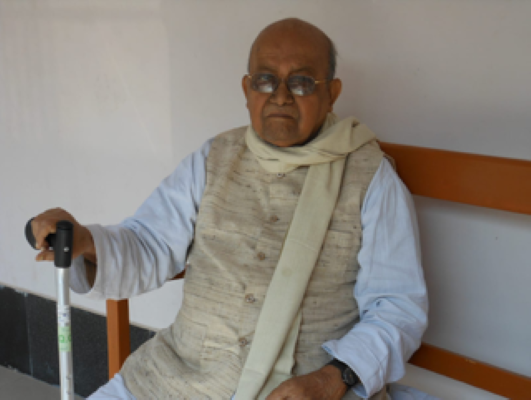
Tripurari Sharan: An Indefatigable Practitioner of Gandhi, JP and Sarvodaya

 45 minutes ago
The birth centenary year of Gandhian thinker and constructive worker Tripurari Sharan begins on November 26. The occasion offers an opportunity not only to remember his contributions but also to revisit a philosophy that placed khadi, village industries, rural self-reliance and Sarvodaya at the centre of social transformation. Sharan belonged to a tradition in which ideas were translated into practical efforts to improve the lives of villagers, artisans, women and working communities.
His life raises an important question: should development be measured merely through production, markets and consumption, or should it also encompass village-level economic independence, dignity of labour and the participation of disadvantaged communities?
Born in Khariha village in Bihar’s Aurangabad district, Sharan grew up during the final phase of the freedom struggle. As a teenager, he became associated with the Quit India Movement of 1942. In an old interview, he recalled participating in activities aimed at disrupting the colonial administration’s communication and transport networks. His involvement reflected the commitment of young people who regarded the struggle for independence as both a political and moral responsibility.
After Independence, the challenge was to translate political freedom into social and economic emancipation. Sharan pursued this objective through constructive work. He became associated with the Gram Nirman Mandal and Sarvodaya Ashram at Sekhodewra, institutions established in the tradition of Jayaprakash Narayan’s efforts towards rural reconstruction. The ashram became a centre for experiments in village self-governance, collective work, dignity of labour and self-reliance.
His association with JP was ideological as well as organisational. Influenced by Narayan’s commitment to social change, Sharan participated in the student-youth movement of 1974, which left a lasting imprint on Bihar’s political and democratic consciousness. For him, the movement represented more than a demand for a change of government. It reflected a larger aspiration for public accountability, ethical politics and people’s participation in democracy. Reports published after his death in 2013 described him as a close associate of JP and a participant in the movement.
One of Sharan’s most significant contributions was the development of the Tripurari Model Charkha. He viewed khadi not merely as a symbol of the freedom movement or an item of clothing, but as an instrument of local employment, decentralised production, dignity of labour and economic participation. His innovation sought to make spinning more productive and adaptable to changing requirements.
The model charkha enabled the preparation of different varieties of yarn, offering greater flexibility to weavers and facilitating the production of a wider range of khadi products, including sheets, curtains, shirts and towels. The experiment attempted to combine the traditional principles of khadi with practical improvements in production.
For Mahatma Gandhi, the charkha represented much more than a spinning device. It embodied self-reliance, dignity of labour and an alternative to excessive dependence on centralised industrial production. Sharan carried this philosophy forward by adapting the spinning wheel to contemporary needs. His objective was not to replace workers with machines but to improve the productivity and earning potential of spinners and artisans.
The Bihar State Khadi and Village Industries Board also linked the Tripurari Model Charkha with efforts to revive khadi production. Institutional records refer to the supply and distribution of multi-spindle charkhas through Gram Nirman Mandal and Sarvodaya Ashram, Sekhodewra. This indicates that his innovation received institutional attention beyond the boundaries of an individual experiment.
Women’s participation was another important dimension of his work. Rural women’s labour often remains unrecognised and inadequately remunerated. Spinning and weaving can provide opportunities for women to earn while remaining connected to their communities. Initiatives associated with the model charkha sought to involve women in these activities, offering economic recognition and opportunities for greater independence.
Khadi, however, cannot be understood merely through the sale of finished garments. Every piece of cloth represents an interconnected chain involving cotton growers, spinners, weavers, dyers, tailors and marketing workers. Unless each participant receives fair remuneration and sustainable employment, the social promise of khadi remains incomplete. Sharan’s approach therefore needs to be viewed within the wider framework of rural livelihoods and economic justice.
His work also demonstrated the importance of collective institutions. Through Gram Nirman Mandal and the Sarvodaya Ashram, constructive activities were pursued in rural areas. These institutions reflected JP’s vision of villages as active centres of development rather than passive recipients of policies formulated elsewhere. Sharan worked within this tradition, seeking to translate self-reliance into everyday practice.
His life also reminds us that Gandhian thought cannot be reduced to non-violence and moral preaching. Gandhi’s constructive programme addressed village economies, untouchability, gender equality, sanitation, basic education and the dignity of labour. JP similarly sought to connect democratic politics with broader social transformation. Sharan brought these traditions together through khadi, village industries and community-based economic activity.
The Bihar Government honoured him with the title of ‘Khadi Purush’, while the Jharkhand Government conferred on him the recognition of ‘Khadi Ratna’. These honours acknowledged his sustained contribution to the khadi sector. Even after his death in 2013, his work has continued to be remembered by organisations associated with Gram Nirman Mandal and the khadi movement.
Today, when development is frequently discussed in terms of large investments, mega projects, industrial expansion and market growth, Sharan’s centenary invites us to consider alternative indicators. Are rural young people finding dignified employment in their own regions? Are farmers and artisans receiving fair prices for their produce and labour? Are women gaining economic independence? Do small producers have access to technology, training and markets? Without addressing these questions, the promise of self-reliance remains incomplete.
Khadi and village industries face considerable challenges, including competition from cheaper industrial products, irregular availability of raw materials, high production costs, weak marketing networks and inadequate remuneration. Government schemes and financial assistance alone cannot revive the sector. Cooperatives need strengthening, production must be linked more effectively with markets, and artisans must receive better training and fair wages. Innovations such as the Tripurari Model Charkha deserve renewed research and adaptation.
Khadi must not remain confined to official ceremonies, political symbolism or special occasions. It needs to become relevant to everyday consumption through quality, design, affordability and reliable marketing. At the same time, its defining values of local employment, decentralised production and human dignity must be protected. Driven solely by market pressures and profit, khadi risks losing the social purpose that makes it distinctive.
The real significance of Sharan’s birth centenary will lie in taking his legacy beyond commemorative events. His life and experiments need systematic documentation. Research should examine the model charkha and its contribution to rural production. The experiences of Gram Nirman Mandal and Sarvodaya Ashram should be made accessible to younger generations. Concrete initiatives are also needed to connect rural youth and women with viable village industries.
Tripurari Sharan belonged to a generation that sought to preserve the spirit of the freedom movement through constructive action. He chose the difficult path of working beyond the glare of power and public prominence. Gandhi’s vision of Gram Swaraj, JP’s call for Total Revolution and the Sarvodaya ideal of the welfare of all converged in his life and work.
As his birth centenary year begins on November 26, remembering him must also mean advancing the unfinished agenda to which he devoted his life. The true tribute to Gandhi and JP lies in creating employment in villages, respecting labour, expanding economic opportunities for women and ensuring that disadvantaged communities have a meaningful share in development.
Sharan’s life reminds us that social transformation does not emerge only from corridors of power. It can begin in a village workshop, through an artisan’s tools, a woman’s labour and the collective resolve of a community. He was an indefatigable practitioner of this constructive transformation. His centenary should inspire renewed commitment to rural self-reliance, economic dignity and social justice.
(The author, a senior journalist of Bihar, is a known commentator on governance, develop ment, and diver sity issues.)






[[comment.comment_text]]