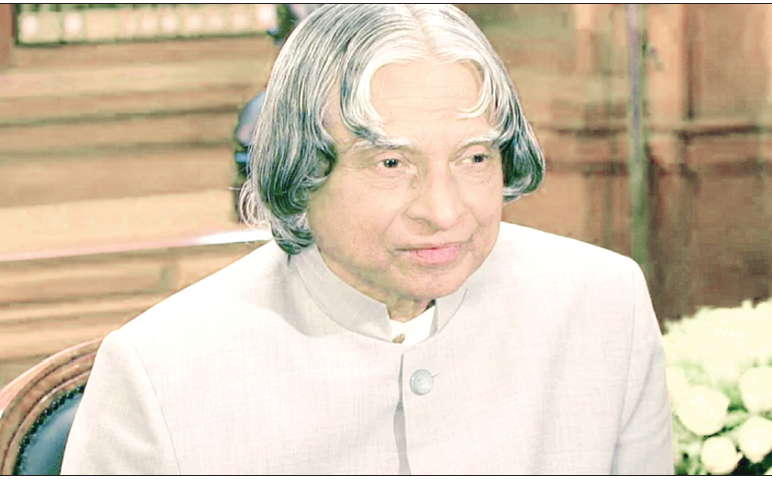
The Meeting That Changed A.P.J. Abdul Kalam’s Life
 2 hours ago
Remembering APJ Abdul Kalam on His 95th Birth Anniversary
A failed dream can sometimes become the beginning of a greater journey. For A.P.J. Abdul Kalam, the dream of becoming an Indian Air Force pilot did not materialise. Yet the disappointment that followed became a turning point in his life, helping him discover a different path—one that eventually led him to the forefront of India’s scientific establishment and, later, to Rashtrapati Bhavan.
The meeting that helped him confront this setback took place in Rishikesh, where he met Swami Sivananda Saraswati, the spiritual teacher and founder of the Divine Life Society. The encounter did not instantly transform Kalam’s circumstances, nor did it erase his disappointment. Its significance lay in the perspective it offered him: a failed ambition need not mean a failed life.
Kalam’s life is remembered for his contributions to aerospace engineering, India’s missile development programmes and the country’s space research efforts. He was also admired for his humility, spiritual inclination and ability to communicate with young people. Looking back at his journey, the meeting in Rishikesh offers an important insight into how he learned to accept uncertainty without surrendering his commitment to work.
Early Life
Born on 15 October 1931 in Rameswaram, Tamil Nadu, Kalam grew up in a modest family. His father, Jainulabdeen, was a boat owner, while his mother, Ashiamma, managed the household. The family’s limited means did not prevent Kalam from developing a strong interest in learning and science. His childhood was shaped by discipline, simplicity and close contact with people of different religious backgrounds.
After studying physics at St Joseph’s College in Tiruchirappalli, he pursued aeronautical engineering at the Madras Institute of Technology.
Young Kalam’s ambition was to fly aircraft and serve as a pilot in the Indian Air Force. For a young man who had devoted years to education and technical training, the prospect of joining the Air Force represented the fulfilment of a deeply cherished dream.
But life did not follow the course he had imagined.
In the late 1950s, Kalam appeared for the selection process for the Indian Air Force. He ranked ninth when only eight candidates were to be selected. The difference was painfully small, but the consequence was decisive: he could not join the Air Force as a pilot.
For someone who had invested so much hope in a single ambition, the rejection was a profound disappointment. It raised a difficult question familiar to many young people: what does one do when years of preparation do not lead to the future one has imagined?
Meeting with Swami Shivanand
Kalam travelled to Rishikesh during this period of uncertainty. There, he met Swami Sivananda Saraswati. The spiritual teacher listened to the young engineer and offered him counsel that encouraged him to look beyond the immediate disappointment.
The central lesson of the encounter was not that ambition was unimportant, or that failure should be accepted passively. Rather, it was that a person must not allow a single setback to define the whole of life. When one path closes, the challenge is to retain faith in one’s abilities and continue working towards a meaningful purpose.
For Kalam, this perspective proved valuable. His disappointment was real, but it did not become a permanent barrier. He gradually redirected his energies towards the opportunities available in science and engineering. The meeting with Swami Sivananda became part of the personal history through which he understood adversity and the need to move forward.
It would be misleading to attribute Kalam’s subsequent achievements to one meeting alone. His career was built through sustained study, technical competence, teamwork, institutional support and years of demanding work. Yet the Rishikesh encounter illuminates a dimension of his character: his willingness to reflect on setbacks and search for a constructive response.
Kalam joined the Directorate of Technical Development and Production, later associated with the Ministry of Defence, before moving into India’s emerging space programme. He became part of a generation of scientists who worked under difficult conditions to build the country’s technological capabilities.
His Role at ISRO
At the Indian Space Research Organisation, Kalam played an important role in the development of the Satellite Launch Vehicle-3 (SLV-3). The successful launch of the Rohini satellite in 1980 marked a significant milestone in India’s space programme, demonstrating the country’s growing capacity to launch satellites using an indigenous vehicle.
His career subsequently became closely associated with India’s guided missile development efforts. His contribution to major defence and aerospace projects earned him the popular title of “Missile Man of India.” He also played a prominent role in the country’s strategic scientific establishment during the period surrounding the 1998 Pokhran nuclear tests.
These achievements were not the result of individual effort alone. They depended on teams of scientists, engineers, technicians and public institutions. Kalam’s leadership lay partly in his ability to encourage collective effort and communicate a larger national purpose. He presented science not merely as a pursuit of technical excellence but as a means of expanding India’s possibilities.
Elected President of India
In 2002, Kalam became the President of India. His election was notable because he came from a scientific and academic background rather than the conventional world of electoral politics. During his presidency, he retained the image of a teacher at heart. He met students, answered their questions and urged them to cultivate curiosity, discipline and confidence.
For President Kalam, young people were not simply recipients of advice. They were partners in imagining the country’s future. He repeatedly encouraged them to dream, but his understanding of dreaming went beyond wishful thinking. A dream, in his view, had to be accompanied by knowledge, hard work, perseverance and a willingness to learn from failure.
This emphasis on learning and inner discipline also helps explain his interest in spirituality and yoga. Kalam’s spiritual outlook did not require him to abandon scientific reasoning. Instead, he appeared comfortable with the idea that scientific inquiry and the search for inner balance could coexist, provided neither became an excuse for intellectual complacency.
Presided Kalam’s Visits to Munger
President Kalam’s visits to Munger, Bihar, provide a memorable local dimension to this aspect of his life. The town is home to the Bihar School of Yoga, founded by Swami Satyananda Saraswati, a disciple of Swami Sivananda Saraswati. Under the later leadership of Paramahansa Swami Niranjanananda Saraswati, the institution continued to develop and disseminate the teachings of yoga.
Dr Kalam visited Munger in both 2002 and 2003. I was personally present during both visits, and they remain significant memories of his connection with the town. His presence brought together people from different walks of life, including those interested in science, education, spirituality and the development of children.
A particularly memorable episode took place on 14 February 2003 at Polo Ground in Munger, where Kalam met schoolchildren and local residents. At the time, Anand was the Public Relations Officer on duty for the programme. He is currently serving as Deputy Director in the Department of Information and Public Relations in Jharkhand. Anand coordinated Kalam’s interaction with the children, helping facilitate an exchange that went beyond a conventional public address.
Dr Kalam addressed the gathering, administered an oath to the children and took part in a question-and-answer session. He responded to the children’s questions, encouraging them to speak and engage directly with him. For those young participants, the occasion offered a rare opportunity to interact with a scientist who had helped shape India’s technological ambitions and who was then serving as the country’s President.
The children’s interaction with Kalam was especially meaningful because he did not treat them as a passive audience. He made space for their questions and responded to them with the patience of a teacher. Anand’s role in coordinating this interaction helped bring the President and the young audience together. The episode reflected an important feature of Kalam’s public life: his effort to make education, curiosity and confidence central to his engagement with people.
Paramahansa Swami Niranjanananda Saraswati remembers Kalam’s visits to Munger and has described him as not only a great scientist but also a deeply spiritual person. Kalam’s association with the town reflected his appreciation of yoga and its potential contribution to human development. Munger, known internationally for its yoga tradition, offered a setting in which his interests in scientific achievement, personal discipline and the development of young minds could find a natural meeting point.
It is important, however, not to confuse Kalam’s visit to the Bihar School of Yoga with the meeting in Rishikesh that shaped his response to the failure of his pilot ambition. The two belong to different moments in his life. The Rishikesh encounter took place when he was a young engineer confronting disappointment; the Munger visits came decades later, after he had established himself as a scientist and national figure. Together, they help illuminate the continuing place of spirituality, reflection and human connection in his life.
Dr Kalam’s association with Swami Sivananda also invites a broader reflection on the relationship between scientific temper and spiritual thought. In public discourse, the two are sometimes presented as opposites. Kalam’s life suggests a more nuanced possibility. Scientific work requires evidence, experiment and critical scrutiny. Spiritual reflection, when approached as a discipline of self-examination rather than a substitute for evidence, can help individuals cultivate humility, patience and a sense of responsibility.
The significance of Kalam’s life lies not in the idea that faith alone can overcome every obstacle. His achievements required rigorous training, institutional collaboration and practical decisions. What the Rishikesh meeting appears to have offered was a way of confronting disappointment without allowing it to destroy his confidence or narrow his sense of possibility.
The failed Air Force ambition did not end his journey. It redirected him towards a different field in which his abilities could find expression. Had he become a pilot, his life might have followed another course; history offers no way of knowing what that course would have been. What is clear is that the path he ultimately pursued brought him into the heart of India’s scientific development and later into the highest constitutional office of the country.
Dr Kalam died on 27 July 2015 while delivering a lecture at the Indian Institute of Management Shillong. Even in his final moments, he was engaged in teaching and communicating with students. That ending seemed consistent with the public life he had built: a life in which learning was not confined to classrooms and leadership was inseparable from the responsibility to inspire others.
Kalam’s story continues to matter because failure is a universal experience, while the ability to respond constructively to it is not automatic. Young people face rejection in examinations, careers and personal ambitions. Institutions, too, must learn that a setback can be an opportunity to reassess methods and discover new directions rather than a reason to abandon effort.
The meeting in Rishikesh did not write Kalam’s future for him. It helped him face a moment when his original dream had failed. The rest was the work of a lifetime—years of scientific endeavour, public service, learning and engagement with young people.
Perhaps that is the enduring lesson of A.P.J. Abdul Kalam’s journey: a closed door need not become the boundary of one’s life. Sometimes, the courage to accept disappointment and the determination to keep working can lead to a destination far beyond the one originally imagined.
(The author, a senior journalist of Bihar, is a known commentator on governance, development, and diversity issues.)











[[comment.comment_text]]