Government and Educational Leaders Chart Path for Multilingual Empowerment

 3 years ago
Groundbreaking Insights on Tech Integration in Teaching Indian Languages Emerge at Summit
Samridhi @ EW News
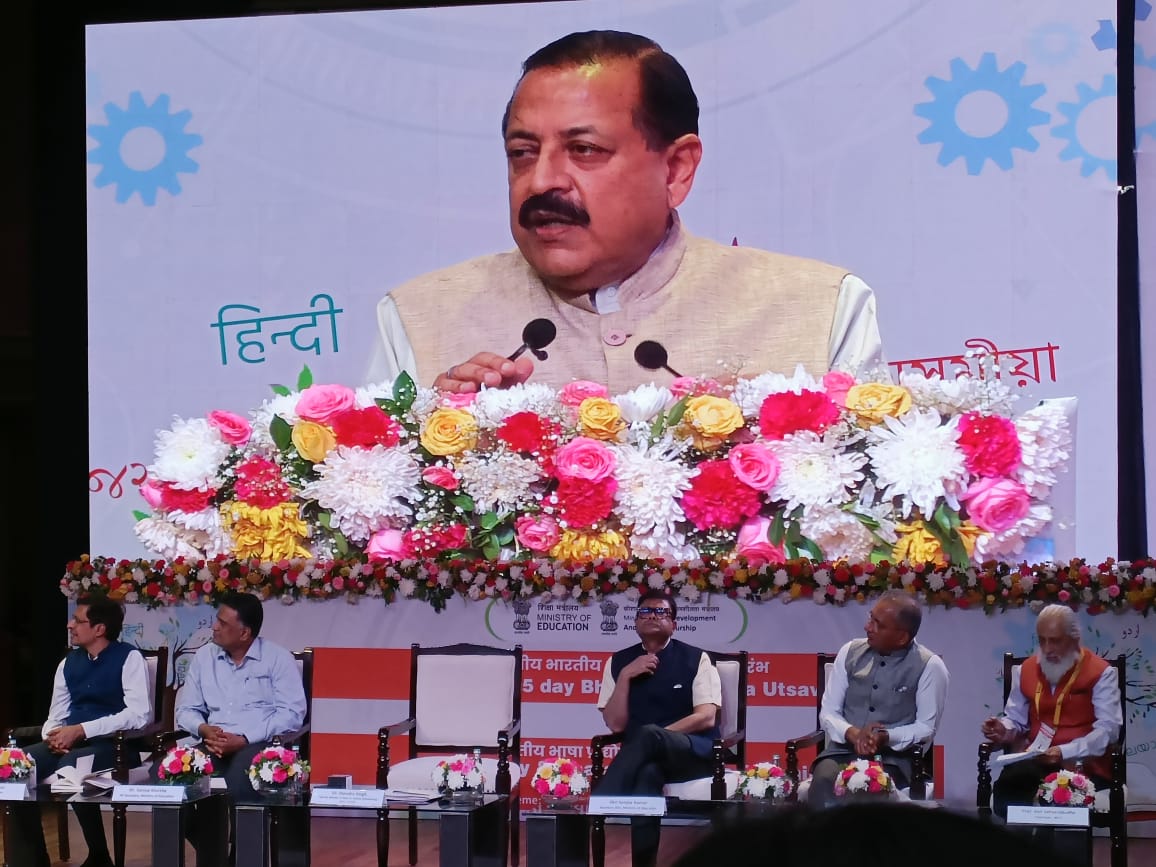
New Delhi, The Central Institute of Indian Languages (CIIL), Mysuru, in collaboration with prominent educational bodies including the University Grants Commission (UGC) and All India Council for Technical Education (AICTE), concluded the Bharatiya Bhasha Utsav and Technology & Bharatiya Bhasha Summit on October 1st, 2023, at the Dr. Ambedkar International Centre, New Delhi.
The valedictory session witnessed eminent personalities such as Shri Jitendra Singh, Hon’ble Minister of Science and Technology and Minister of State for Prime Minister's Office; Personnel, Public Grievances and Pensions; Department of Atomic Energy and Department of Space, Government of India, who delivered the valedictory address.
In his valedictory address at the two-day mega conference, Dr. Jitendra Singh, Union Minister of State for Science, PMO, Personnel, Public Grievances and Pensions; Department of Atomic Energy, said, "Embracing our Indian languages in education and science is not just a choice, but a necessity. Prime Minister Modi's steadfast promotion of our mother tongues at various levels signifies a pivotal shift. Let's ensure that translation is no longer a bottleneck, and together, let's envision a vibrant linguistic celebration in 2047, taking our heritage to unparalleled heights."
Prof. Anil Sahasrabudhe, Chairman of the National Educational Technology Forum (NETF), expressed his enthusiasm, saying, "The Bharatiya Bhasha Utsav and Technology & Bharatiya Bhasha Summit is a significant milestone in our endeavor to empower students with a strong linguistic foundation aided by cutting-edge technology. It is through such collaborative efforts that we can chart a course towards a multilingual and technologically advanced educational landscape."
Dr. Buddha Chandrasekhar, Chief Coordination Officer at AICTE, highlighted the 'ANUVADINI,' a Global Voice, Video & Document AI translation tool developed by the AICTE. He mentioned that this tool offers various advantages, including translation in the format of the source text file and speech-to-text typing. Dr. Chandrasekhar emphasized that with the collective efforts of experts, they aim to drive innovation in language technology across schools, higher education, skill development, and industry sectors in the next five years.
The technical sessions during the Bharatiya Bhasha Utsav and Bharatiya Bhasha Summit were insightful and diverse, focusing on the integration of technology with Indian languages. The inaugural session featured esteemed guests and dignitaries, including Shri Dharmendra Pradhan, the Hon’ble Minister of Education, Skill Development, and Entrepreneurship. Keynote addresses by luminaries like Shri Sridhar Vembu, Chairman of the Board of Governors at IITDM Kanchipuram, and Founder and CEO of Zoho Corporation, set the stage for discussions.
These technical sessions aimed to explore pivotal areas like leveraging technology for teaching Bharatiya languages, language proficiency assessment, and the seamless transition to digital classrooms. Eminent experts, including Prof. Pushpak Bhattacharyya from IIT Bombay, Dr. Nongmeikapam Kishorjit Singh from IIIT Manipur, and Ms. Natasha Jog from Meta, led the panel discussions. These sessions laid a robust foundation for the integration of technology in language education, with further topics covering translation accuracy, machine learning, and the localization of operating systems and digital content platforms.
Representatives from various sectors, including education, technology, and governmental bodies, converged to share insights and strategies for the next five years to propel the integration of technology in the promotion of Bharatiya languages.
"Empowering every citizen, regardless of their language, is paramount. Embracing technology for speech-to-text conversion and language translation is essential. In a nation with 22 official languages, inclusivity is key. Let's ensure no one is left behind," said Veezhinathan Kamakoti, Ph.D., Director of the Indian Institute of Technology, Madras.
The Bharatiya Bhasha Utsav and Technology & Bharatiya Bhasha Summit poised to be a groundbreaking event that will shape the future of language education in India. The presentation of the unique utilitarian tool, 'ANUVADINI,' by Dr. Buddha Chandrasekhar at the conference was a notable highlight of the event, showcasing the innovative strides being made in language technology.
Stay tuned for more updates on the evolution of language education and technology in India.





[[comment.comment_text]]