DELHI JAL BOARD (DJB)GOVERNMENT OF NCT OF DELHI**

 5 years, 2 months ago
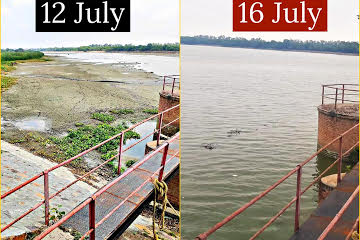
Delhi Jal Board Vice-Chairman and Rajinder Nagar MLA, Raghav Chadha visited the Wazirabad Barrage to examine the water level situation of the Yamuna riverbed today. The water treatment plants of Delhi were operating at a reduced capacity as Haryana had earlier withheld Delhi’s share of water and after the discharge of the same the levels had risen back to optimum levels. The water level at Wazirabad was noted to be 674.5 feet and Shri Chadha remarked that the increased water levels could restore clean water drinking supply of Delhi, easing off the citizens of the city.
The Wazirabad Barrage is the same location that DJB Vice-Chairman had visited earlier this week and had found the river to be completely dry. Shri Chadha had said that “a few days back the situation of the riverbed was such that it was even possible for children to play hockey or cricket in this pond area”.
Shri Chadha further said that “Delhi has suffered and struggled a lot because of the shortage of the rightful share of water that the Haryana Govt. had withheld earlier “The real face of the Haryana Government has been exposed in the matter of stopping the discharge of the rightful share of water for the people of Delhi”, added Shri Chadha. First, the Govt of Haryana refused to transfer the water of Delhi’s right, which led to a significant decrease in the water levels of the riverbed which also led to drying up of the throats of the people of Delhi”.
“Delhi Jal Board under the leadership of the Chief Minister Shri Arvind Kejriwal had even moved the Supreme Court to file a petition earlier which built-up a pressure on the Haryana Government to release 16,000 cusecs of raw water through the Yamuna river to all the water treatment plants of Delhi this Tuesday”, added Shri Chadha.
“Now, that the struggle of the people of Delhi has achieved a win today and the thirst of the river and the people of Delhi will be quenched soon, Delhi Jal Board will be able to function at an optimum capacity to deliver clean drinking water to all the households in Delhi. These water treatment plants were working at reduced capacity due to a shortage of the rightful share of raw water from the Haryana Govt”, added Raghav Chadha.
“It has all been possible because of the efforts and sacrifices of the people of Delhi that the Haryana Government was forced to discharge the rightful share of 16,000 cusecs of water which was withheld for a long time. All our efforts have now turned out to be successful, and it is a win for the people of Delhi. Saluting the struggles of the people of Delhi I would like to congratulate them for this victory”, said Shri Chadha.
DJB Vice-Chairman in his address to the media said “it took 3 days for Delhi’s rightful share of raw water discharged by the Haryana Govt to reach Delhi today and the water levels of this riverbed which went down by 7.5 ft. are now back to the earlier optimum levels.
Shri Chadha added that the situation is now completely normal at the water treatment plants in Delhi and an increase in the water levels of this riverbed is clearly visible.
“It is the result of tireless hard work of day and night that the Delhi Jal Board and the people of Delhi have achieved this great win against the Government of Haryana,” he said.
“The Wazirabad riverbed was all dried up and the water levels reached a terrible mark of 667 feet a few days back. Now, after the discharge of Delhi’s rightful share of raw water through the Yamuna river by the Haryana Govt, the water levels at the Wazirabad Barrage have risen up to 674.5 feet, which is a moment of joy for all the people residing in Delhi,” said Shri Chadha.
DJB Vice-Chairman further added that Delhi now has taken its rightful quantity of water from Haryana and that he would like to thank the people of Delhi, the Chief Minister of Delhi, and the Supreme Court for standing with the people of Delhi in this tough time.
(Agencies)


[[comment.comment_text]]