Choice of past leaders for Bharat Ratan's is in tune with present politics

 2 years, 8 months ago
Manoj Kumar Pathak
The Bharat Ratna, the highest civilian honor of the country, has been conferred on 53 people since 1954, five of them within 2024, a maximum in a year so far. Till now, the maximum number of Bharat Ratnas were awarded in 1999 when four recipients were given the coveted award. Bharatiya Janata Party (BJP) leader LK Advani, late socialist leader, Karpoori Thakur, two Ex-Prime Ministers Chaudhary Charan Singh, and PV Narasimha Rao, and the 'Father of the Green Revolution', MS Swaminathan are the newest recipients. The making of national heroes is equally about the recipients as it is about its function as a stimulant of collective consciousness. It is often the collective that needs heroes to hold itself together. By placing leaders on a higher pedestal, the group seeks to reinforce the ideals represented by them. Mr. Advani has been a defining figure of modern Indian history.
As he reminisced, he joined the Rashtriya Swayamsevak Sangh at the age of 14. His role in the advancement of the Hindutva ideology has been the biggest of any single leader before Prime Minister Narendra Modi. He has been a mentor to Mr. Modi, with his campaign for a temple in Ayodhya definitively changing the course of Indian politics. The campaign pushed the limits of constitutional order, based on the claim that matters of faith cannot be subject to litigation. As it happens with an extraordinary assertion of popular sovereignty, the Ram Janmabhoomi movement changed the country at several levels; the Supreme Court of India, in 2019, unanimously ruled in favor of the temple that was inaugurated by Mr. Modi on January 22.
Thakur was a central figure in the social justice politics — a euphemism for the demand for better representation of intermediate castes — of Bihar and the larger Hindi belt, who challenged the Congress’s hegemony. He served two terms as the Chief Minister of Bihar in the 1970s. Social justice politics went through phases of self-discovery and scattered into numerous parties over the years. One strand is closely aligned with the BJP. There are social justice groups that are still opposed to it, but the BJP owes its current strength considerably to intermediate castes. That ongoing process is being reinforced by honoring Thakur. In 2015, AB Vajpayee, the first Prime Minister of the BJP, and Madan Mohan Malaviya, the founder of the Banaras Hindu University, were conferred the Bharat Ratna. In 2019, Pranab Mukherjee, Bhupendra Kumar Hazarika, and Nanaji Deshmukh were recipients. All these selections are in tune with the politics of the present — and how the history of the Bharat Ratna has always been. All India Anna Dravida Munnetra Kazhagam founder MG Ramachandran and BR Ambedkar were also conferred the award in the hope that their followers would, in turn, back the party or alliance ruling at the Centre.
Advani and Thakur represent the two legs of BJP politics, namely Hindu consolidation and higher representation for intermediate castes in all fields. By awarding the Bharat Ratna to Chaudhary Charan Singh, PM Modi tried to woo the politically strong Jat vote bank towards BJP folds in western UP and Haryana. Singh, a Jat leader from western Uttar Pradesh, was one of the pioneers of anti-Congress politics at a time when the Congress was the hegemonic political force. As far as PV Narasimha Rao is concerned, the highest civilian award to him is destined to give a big signal to the south, where BJP is trying to make its present felt. Bharat Ratna to renowned agriculture scientist MS Swaminathan has also political meaning in the Dravidian heartland of Tamil Nadu.
What does it stand for
The Bharat Ratna is the highest civilian award in the country. It is awarded in recognition of exceptional service or performance of the highest order in any field of human endeavor. It is treated on a different footing from Padma awards.
The recommendations for Bharat Ratna are made by the prime minister to the president. No formal recommendations for Bharat Ratna are necessary. It was given to three persons in a year on several occasions, including in 2019, 1997, 1992, 1991, 1955, and 1954. On several occasions, it was given to two persons including in 2015, 2014, 2001, 1998, 1990, 1963, and 1961, while there have also been years when the award was not conferred on anyone.
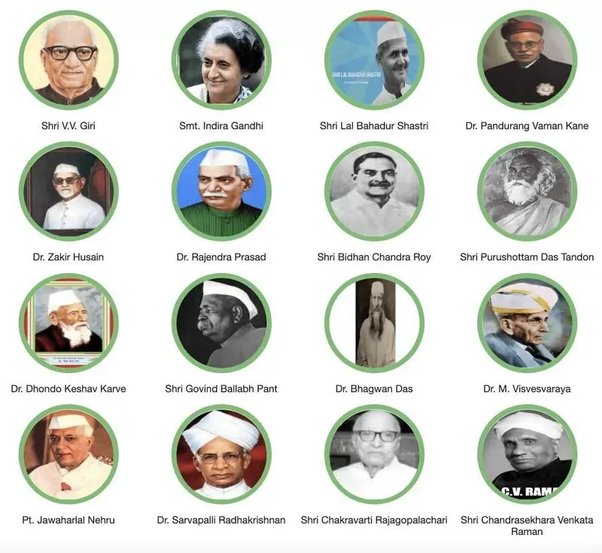
In the first year, the coveted award was conferred upon C Rajagopalachari, Sarvapalli Radhakrishnan, and Chandrasekhara Venkata Raman. Those conferred with this award in the past include Jawaharlal Nehru, Rajendra Prasad, Zakir Hussain, Lal Bahadur Shastri, Abul Kalam Azad, Indira Gandhi, K Kamraj, Mother Teresa, Vinoba Bhave, M G Ramachandran, B R Ambedkar, Nelson Mandela, Rajiv Gandhi, Vallabhbhai Patel, Morarji Desai, Satyajit Ray, A P J Abdul Kalam, Jayaprakash Narayan, Amartya Sen, Sachin Tendulkar, Atal Bihari Vajpayee and Madan Mohan Malaviya.
The other recipients are Bhagwan Das, M Visvesvaraya, Govind Ballabh Pant, Dhondo Keshav Karve, Bidhan Chandra Roy, Purshottam Das Tandon, Pandurang Vaman Kane, Varahgiri Venkata Giri, Khan Abdul Gaffar Khan, Jahangir Ratanji Dadabhai Tata, Gulzarilal Nanda, Bismillah Khan, M Subbulakshmi, Gopinath Bordoloi, Pandit Ravi Shankar, C N R Rao, Bhimsen Gururaj Joshi, Lata Mangeshkar, Chidambaram Subramaniam and Aruna Asaf Ali. On conferment of the award, the recipient receives a Sanad (certificate) signed by the President and a medallion. The award does not carry any monetary grant.




[[comment.comment_text]]