The Two Faces of Indian Agriculture: Excess Grains, Scarce Essentials

 3 months, 2 weeks ago
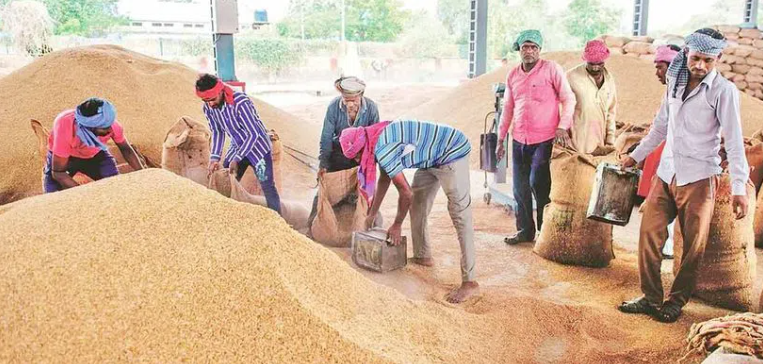
An unprecedented imbalance continues to define India’s agricultural economy. On one hand, the country enjoys a massive surplus of rice and wheat, consistently producing more than domestic requirements. India has emerged as the world’s leading producer of paddy, while government granaries remain stocked far above prescribed buffer norms. Even after sustaining one of the world’s largest food security programmes for nearly 800 million people, the country remains a major exporter of cereals and has increasingly diverted excess grain stocks toward ethanol production.
On the other hand, India faces chronic shortages in pulses and edible oils, two essential components of the national diet. Domestic production has failed to keep pace with rising demand, making the country heavily dependent on imports to bridge the gap. This growing reliance on international markets exposes consumers to global price volatility, supply disruptions, and geopolitical uncertainties, highlighting a structural weakness within an otherwise abundant agricultural system.
This dependency leaves India deeply vulnerable to global shocks. The country currently imports 15 to 20 percent of its pulses and a staggering 56 percent of its edible oils. Furthermore, the agricultural backbone relies on heavily imported crop nutrients: India imports 21 percent of its urea and 60 percent of other vital fertilizers. Even domestic urea production is an illusion of self-reliance, as 85 to 90 percent of its material inputs and 80 percent of its liquefied natural gas (LNG) feedstock are imported, historically sourced predominantly from the volatile Gulf region.
The financial toll of this vulnerability is staggering, as India is literally eating through its foreign exchange reserves. In FY26, the cumulative import bill for edible oils, pulses, and the fertilizer basket (including LNG) reached $51 billion (Rs 4.5 lakh crore), accounting for 5.2 percent of the nation's total imports. This bill is projected to swell to $56 billion (Rs 5.3 lakh crore) in FY27. While these may seem like unavoidable expenses at first glance, they are largely the structural consequences of policy choices made over several decades.
Recent geopolitical conflicts have made this underlying economic cost visible in a way that comfortable times usually conceal. On the eve of the Iran war, India’s foreign exchange kitty sat at a historic high of $728.49 billion (Rs 69 lakh crore), providing a comfortable 11-month import cover. However, the outbreak of conflict threw all economic calculations into disarray by spiking energy bills and shipping freights, while triggering a massive $30 billion (Rs 2.85 lakh crore) flight of foreign portfolio investment.
The resulting economic panic forced India to burn through the dollar reserves it had spent years accumulating. The rupee slipped to historic lows of 96 against the dollar, and the current account deficit faced immense pressure, culminating in a $30.8 billion (Rs 2.9 lakh crore) balance of payments deficit for FY26, followed by another $6.6 billion deficit in April alone. This period held up a harsh mirror to the built-in profligacy of India's farm imports, prompting Prime Minister Narendra Modi to issue an austerity appeal targeting a 10 percent cut in domestic edible oil consumption.
A significant part of the problem lies in distorted consumer and farmer habits driven by state subsidies. The average Indian now consumes 24 kg of edible oil annually, which is double the medically recommended limit. On the supply side, a bag of urea has been artificially priced at Rs 242 since 2018 despite costing ten times more to produce. The exchequer absorbs this 90 percent shortfall through a complex, leaky mechanism that cost a massive Rs 2.11 lakh crore in FY26 alone.
This pricing anomaly has created an eco-system of unintended consequences. Artificially cheap urea is turning farm soil sterile across the country as farmers stay addicted to cultivating paddy and wheat, the only two crops that offer guaranteed procurement at a Minimum Support Price (MSP). Meanwhile, pulses and oilseeds—which could dramatically reduce India's import bills—remain financially risky propositions that rational farmers choose to avoid, causing the current policy framework to actively defeat itself.
Fortunately, actionable solutions exist to correct this imbalance. India must aggressively pursue domestic fertilizer production, fast-tracking coal-based urea projects like the delayed Talcher plant in Odisha and modernizing its existing fleet of gas-based plants.
Geopolitically, the government must diversify its nutrient imports by tapping nations like Russia, Morocco, Australia, and Canada, while intelligently navigating the energy market to leverage competitive LNG sources closer to home.
Simultaneously, the domestic focus must shift toward sustainability and crop diversification. The PM-PRANAM scheme has already demonstrated success with a 3.5-fold jump in organic nutrient sales to 1.1 million tonnes this kharif season, a momentum that needs to be maximized. To ensure long-term protein security, India must prioritize pulses in a "Green Revolution 2.0" by unclogging the lab-to-market pipeline for superior seeds and expanding acreage through district-supervised intercropping, which requires no new land.
Undertaking fertilizer and MSP reform is admittedly politically treacherous and will face stiff resistance from vested interests.
However, the recent international disruptions have proven, at a considerable national cost, the danger of deferring foundational questions about food and energy security. Sixty years after surviving its last great famine, India’s old agricultural policies are now undermining the very food security they created; there is no better time than now for the government to push through these vital structural changes.
(Writer is a well-recognised author and columnist. For past over three decades, he has served in various administrative and academic capacities at Banaras Hindu University.)











[[comment.comment_text]]