Pietermaritzburg, 1893: The Night the Mahatma Was Born

 3 months, 3 weeks ago
How a Humiliating Act of Racial Discrimination Forged a Global Movement of Resistance!
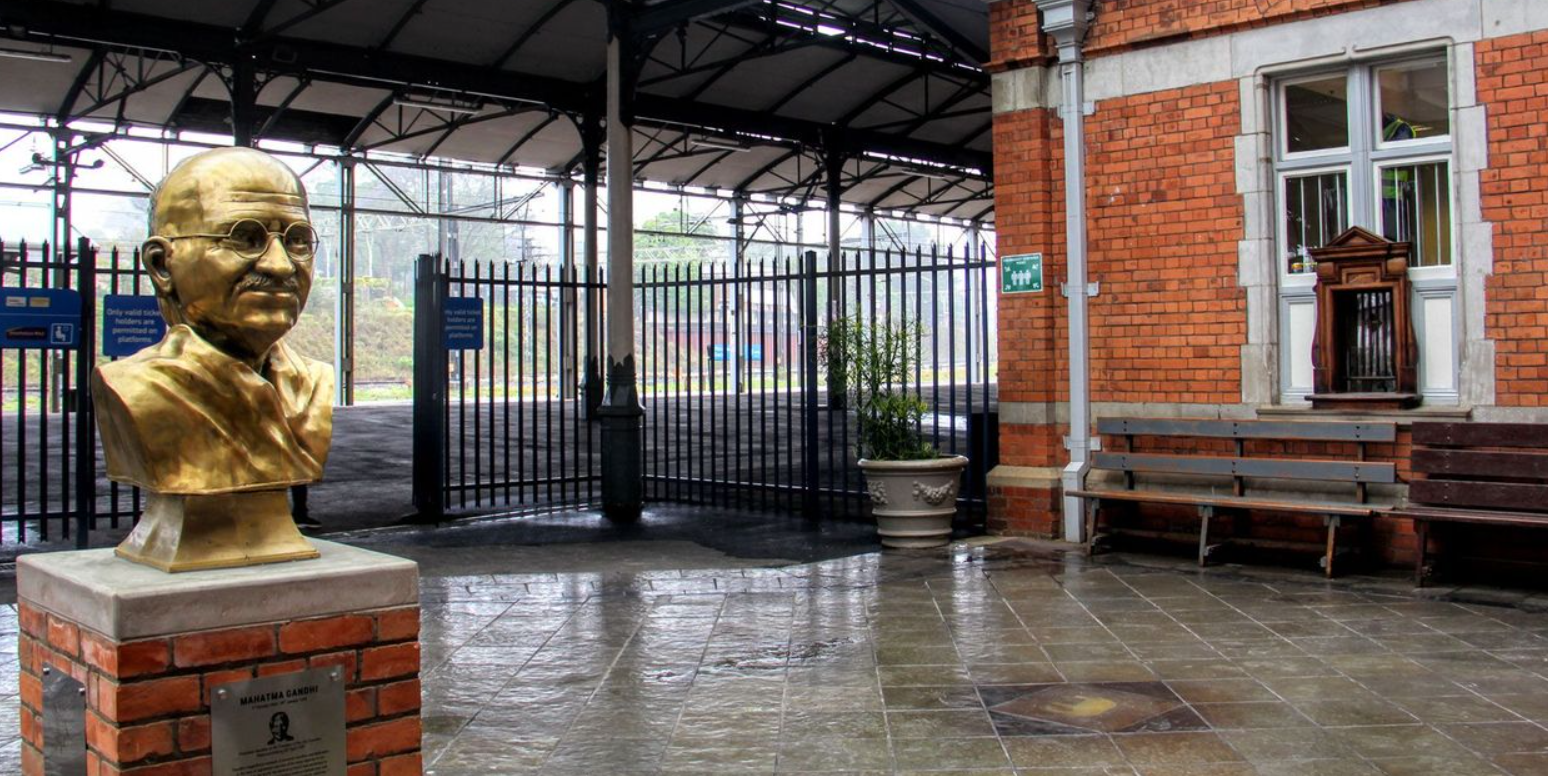
History is not always shaped in parliaments, battlefields, or royal courts. Sometimes it turns on a seemingly ordinary incident whose consequences only become visible decades later. One such moment occurred on a cold winter night at Pietermaritzburg railway station in South Africa on June 7, 1893. There, a young Indian lawyer named Mohandas Karamchand Gandhi was forcibly removed from a first-class railway compartment despite holding a valid ticket.
What appeared to be a routine act of racial discrimination would ultimately alter the political destiny of India and influence struggles for justice across the world. That night marked the beginning of Gandhi’s transformation from a shy barrister into one of history’s most influential leaders.
A Young Lawyer in an Unfamiliar World
When Gandhi arrived in South Africa in 1893, he was only twenty-three years old and far removed from the figure later revered as the Mahatma. His legal career in India had failed to take off, and he had accepted a one-year contract from the merchant firm Dada Abdulla & Co. to assist in a commercial dispute in Natal. His ambitions were professional rather than political. Yet South Africa was a society structured by racial hierarchy, where Europeans enjoyed privileges denied to Africans and Indians. Gandhi soon encountered a system designed to humiliate and exclude non-whites.
The defining confrontation came during a train journey from Durban to Pretoria.
The Incident That Changed History
Travelling with a legitimate first-class ticket, Gandhi occupied a first-class compartment. At Pietermaritzburg, a white passenger objected to sharing the compartment with an Indian. Railway officials ordered Gandhi to move to a lower-class section. When he refused, insisting on his legal right to remain where he had paid to travel, a policeman was summoned and Gandhi was forcibly ejected from the train.
His luggage was thrown out after him.
The young lawyer spent the freezing night in the station waiting room, shaken and humiliated. In his autobiography, The Story of My Experiments with Truth, Gandhi recalled reflecting deeply on the experience. He considered abandoning his assignment and returning to India. Yet as he sat there, another realization emerged: the insult directed at him was part of a larger system of racial oppression suffered daily by thousands of Indians in South Africa.
That night posed a fundamental question: should injustice be endured quietly, or challenged with determination?
Gandhi chose the latter.
From Personal Humiliation to Public Purpose
Biographers including Louis Fischer, Judith Brown, Rajmohan Gandhi, and Ramachandra Guha have identified Pietermaritzburg as the pivotal turning point in Gandhi’s life.
Louis Fischer famously remarked that had the railway official known the future consequences of his action, he might never have thrown Gandhi off the train. The observation captures one of history’s great ironies. An act intended to reinforce racial domination instead helped create one of the most formidable opponents of imperial power.
The incident awakened Gandhi to the realities of institutional discrimination. Rather than seeking personal redress alone, he began organising the Indian community in Natal. He studied discriminatory laws, drafted petitions, wrote extensively, mobilised merchants and workers, and sought ways to challenge injustice through collective action.
What distinguished Gandhi was his ability to convert personal suffering into a wider moral cause. He refused to allow bitterness or revenge to guide his response. Instead, he searched for a method of resistance capable of exposing injustice while preserving human dignity.
The Emergence of Satyagraha
The philosophy that would later become known as Satyagraha did not emerge overnight. It developed through years of struggle and experimentation. Yet its intellectual origins can be traced directly to the events at Pietermaritzburg.
Gandhi recognised that oppressed communities often lacked conventional instruments of power. They possessed neither armies nor wealth. What they did possess was moral strength and the capacity for collective action.
From this insight emerged a revolutionary political method combining truth, non-violent resistance, civil disobedience, and personal sacrifice. Instead of defeating opponents through force, Gandhi sought to confront injustice through moral courage and public conscience.
The aim was not the destruction of the adversary but the transformation of both oppressor and oppressed.
In South Africa, Gandhi tested these ideas through campaigns against discriminatory registration laws and restrictions imposed on the Indian community. By the time he returned to India in 1915, he had developed a powerful philosophy of resistance that would redefine anti-colonial politics.
South Africa: Gandhi’s Political Crucible
While Gandhi is remembered primarily as the leader of India’s freedom struggle, South Africa was the crucible in which his political character was forged.
During his twenty-one years there, he organised communities, founded newspapers, led protest movements, negotiated with governments, endured imprisonment, and refined his methods of non-violent resistance.
The transformation was extraordinary. The hesitant lawyer who had once struggled with public speaking evolved into a mass leader capable of mobilising thousands. The professional advocate became a moral and political visionary.
South Africa did not merely influence Gandhi; it created the Gandhi who would later lead India.
A Legacy That Crossed Continents
The significance of Pietermaritzburg extends far beyond the history of India or South Africa. Gandhi’s methods inspired some of the twentieth century’s most influential movements for justice and equality.
Martin Luther King Jr. drew extensively upon Gandhian principles during the American Civil Rights Movement. Nelson Mandela recognised Gandhi’s pioneering challenge to racial oppression in South Africa. Across Asia, Africa, Europe, and Latin America, countless democratic and human-rights movements adopted strategies rooted in non-violent resistance.
The ripple effects of that winter night in 1893 spread across continents and generations.
Few incidents in modern history demonstrate so clearly how a personal experience can evolve into a force with global consequences.
Why Pietermaritzburg Still Matters
More than a century later, the Pietermaritzburg incident remains relevant because it speaks to a universal human challenge: how individuals respond when confronted with injustice.
Gandhi’s greatness did not lie in the humiliation he suffered but in what he chose to do with it. He refused to allow prejudice to define him. Instead, he transformed a moment of personal indignity into a broader struggle for human dignity.
In an age marked by political polarisation, intolerance, and growing social divisions, that lesson retains remarkable relevance. Gandhi demonstrated that resistance need not be violent to be powerful and that moral courage can often prove more enduring than coercive force.
The Night That Changed the World
No crowds gathered at Pietermaritzburg station on that June night. No speeches were delivered, no banners unfurled, and no revolution announced. Yet history was quietly taking shape.
A young lawyer stood at a moral crossroads and chose resistance over resignation.
The British Empire believed it had merely removed an Indian passenger from a railway compartment. In reality, it had helped awaken a force that would challenge colonial rule, inspire global movements for justice, and reshape the political imagination of the modern world.
The night Gandhi was thrown off a train became the night a new idea of resistance entered history.
(The author, a former member of the history faculty at St. Xavier’s College, Mumbai, is a known commentator on history, culture, and society in South Asia.)








[[comment.comment_text]]