Youth: Power or Pawn?
 2 hours ago
Emiliano Zapata, a Mexican rebel, once said, "I would rather die standing than live on my knees." These statements are a statement of self-respect and independent thought, not just a call to rebellion.
Youth are a nation's greatest asset, yet they can also be used as political capital by special interests. Democracy is strengthened when young people oppose injustice, question authority, and confront those in positions of power. However, when their sincere worries are eclipsed by someone else's goal and their bravery serves as fuel for others' aspirations, a fundamental dilemma emerges: if the youth hold the power of a movement, then who chooses its course and destination?
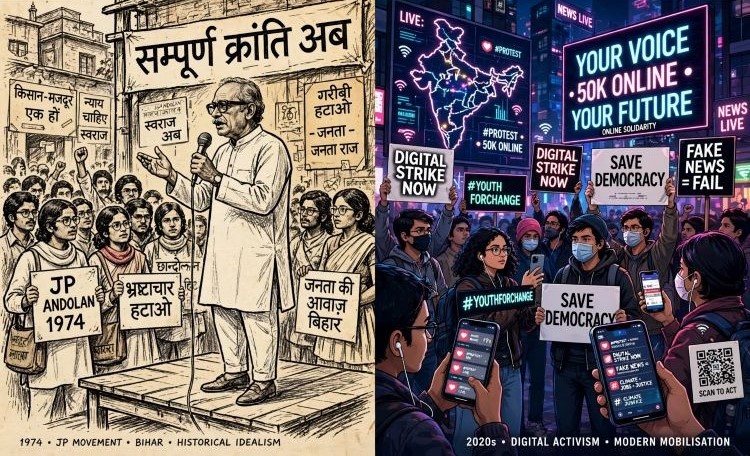
This question makes a comparison between the current Cockroach Movement and the 1974 Loknayak Jayaprakash Narayan movement pertinent. Examining their goals, leadership, organisation, political independence, and societal ramifications is the goal rather than elevating or demeaning either. The true question is not just why young people flock to the streets but also where their fury comes from, who crafts the screenplay, and who determines where their battle will ultimately end.
Dissent and Accountability
The ability of citizens to hold constitutional institutions accountable, demand answers from the government, and raise questions is what makes democracy strong. Therefore, a youth movement cannot be disregarded just because those in positions of authority find its demands inconvenient.
However, acknowledging the freedom to demonstrate is not the same as putting a movement's leadership, tactics, and political nature above criticism. Asking what a movement aims to accomplish, who makes its decisions, and who ultimately benefits from it is an exercise in democratic judgement, just as it is a citizen's right to demand answers from the government.
It is unfair to write off the rage of young people as a political plot. On the other hand, it is foolish to believe that any movement carried out in the name of youth is immune from criticism. There are serious issues that need to be addressed, such as unemployment, unequal opportunity, and dwindling institutional confidence. However, sincere dissatisfaction does not inevitably support every assertion or tactic used in its name. The crucial question is whether young people are fighting for themselves or if their struggle is being used as a tool for the political agendas of others.
JP Movement: Anger to Ideals
The 1974 Bihar revolution was more than just a student uprising against corruption, inflation, and poor administration. It represented a general desire for fundamental change as well as a rising disillusionment with the current political system. Loknayak Jayaprakash Narayan took over as leader in response to the Chhatra Sangharsh Samiti's appeal, emphasising nonviolence, discipline, and social transformation as the movement's moral pillars.
JP stood out not just for his capacity to inspire large audiences but also for his attempts to link their rage to logic and direction. For him, a movement aimed to alter social order, administrative procedures, and political culture in addition to the government. This larger idea was embodied in Total Revolution.
It is undeniable that political parties had some impact on the JP Movement, and its effects are still up for discussion. However, its main obstacle was evident: moral and social reform are inextricably linked to political change. The true measure of a movement is not just which government it opposes, but whether it turns young rage into a calculated desire for systemic change or lowers it to a tool of short-term political advantage.
Cockroach Movement: Youth or Political Tool?
A new trend in youth politics is shown by the emergence of the Cockroach Janata Party. In addition to calling for Chief Election Commissioner Gyanesh Kumar's resignation, the movement is active on issues pertaining to the Election Commission's operations, the revision of electoral records, and his accountability. Although it differs from previous movements in terms of vocabulary, symbolism, and protest style, it would be incorrect to discount it solely on that basis. Hashtags, viral videos, and digital platforms are now effective instruments for influencing public opinion.
However, originality does not always translate into credibility. The true test is whether the movement's leadership is answerable to youth, whether its goal is restricted to one person's resignation, or whether it is supported by a comprehensive, long-term plan for accountability and transparency in electoral institutions.
The movement must propose a plan for institutional transformation in addition to protest if it challenges the legitimacy of the electoral process. An organisation that claims to speak for youth must also maintain openness, democratic decision-making, and leadership accountability among its own members.
The purpose of comparing the JP Movement and the Cockroach Movement is to determine whether the former can turn its initial momentum into long-lasting institutional and societal change, not to disparage the former. A movement is characterised by the legitimacy of its questions and the direction of the change it aims to bring about, not by the noise it creates.
Who's agenda is youth anger?
In Indian politics, the utilisation of youthful energy is nothing new. Through student associations and large-scale movements, political parties have frequently increased their influence. This is an inherent characteristic of democracy. The issue emerges when young people's real problems are neglected and their movement is used as a tool for a party's immediate political agenda.
Just as professing to be nonpartisan does not guarantee immunity from political influence, supporting a political party does not inevitably turn a movement into its puppet. The true test is who sets the movement's priorities, makes its decisions, and eventually reaps the rewards.
Are young people capable of making their own decisions about matters that impact them? Can they confront their own political friends with challenging questions? When their interest conflict with those of a political party, will they keep fighting?
The difference between involvement and exploitation must be addressed if young people battle on the streets but are excluded from decision-making. The questions posed by a movement's supporters are just as important in determining its credibility as criticism from its detractors. Young people's dedication must be based on their commitment to their causes rather than their unquestioning faith in a leader. Only when they are able to hold the leaders of their own movement accountable will they have the guts to demand answers from the government.
From Digital Crowds to People’s Power
The internet, technology, innovation, and international communication are all accessible to today's youth—opportunities that were unthinkable in 1974. However, political maturity is not a prerequisite for technological competence. Information is being disseminated more quickly than before, but it's become harder to tell the difference between accurate and false information. A crowd may put pressure on those in authority, and a viral film can influence public opinion. However, evidence, logic, organisation, comprehension of policy, and persistent effort are necessary for institutional improvement.
The JP Movement's lasting lesson is this. Its spirit of public awakening, nonviolence, intellectual clarity, and dedication to long-term transformation must be internalised rather than mechanically duplicated. Today's young must acknowledge their own role in forming society in addition to demanding accountability from those in positions of authority. This does not imply keeping quiet about the shortcomings of the government. It entails tying opposition to insight, positive alternatives, and workable solutions. Because the future that a voice contributes to is the real indicator of change, not just the volume of a voice.
Youth Power: Who Holds the Reins?
The words of Emiliano Zapata represent struggle and dignity. However, advocating for a cause entails more than just opposing the powerful; it also entails maintaining one's independence, moral convictions, and judgement.
Whether young rage is developing into a vision of broader social transformation or staying limited to immediate political confrontation is the key question that separates the JP Movement from the Cockroach Movement. The solution must come from an analysis of a movement's behaviour, leadership, data, and results rather than from bias.
It is a democratic right to question the administration, and it is equally important to scrutinise the leadership of a movement. Young people must not give in to the sway of any leader or become mute out of fear of authority.
Young people are not affiliated with any political party. They have equal stakes in the future and present of the country. They must be given an equal role in making decisions and coming up with solutions rather than being employed only to mobilise crowds or positioned at the frontline of conflict.
Crowd size is not a reliable indicator of a movement's success. It must be evaluated based on how it transforms society, how it creates institutional accountability, and how it fosters young people's independence of thought. The best way to honour JP's legacy is for young people to challenge all governments, scrutinise all leaders, and refuse to prioritise partisanship over morality. Because the understanding that gives a revolution direction, rather than anger itself, is what gives it its true power.
(The author, a Doctorate in Laws, is a senior lawyer and civil society activist.)







[[comment.comment_text]]