Ram Mandir is the testament of people's faith in judiciary

 2 years, 8 months ago
Temple will be marked in history as India's continued re-discovery of its civilisational heritage
President Murmu in R-Day address calls Karpoori Thakur, who was awarded the Bharat Ratna, a tireless champion of social justice
Abhyansh Singh Rathore
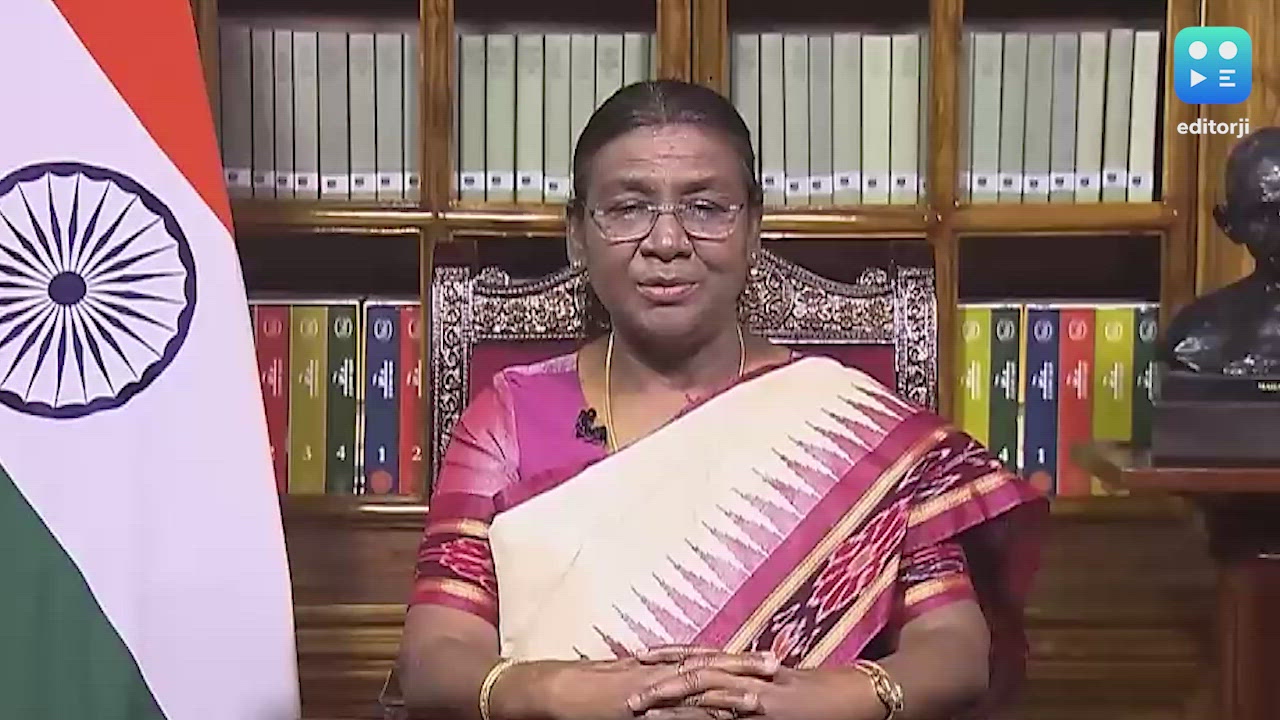
New Delhi: President Droupadi Murmu on Thursday said the Ram temple will be marked in history as "India's continued re-discovery of its civilisational heritage" and as a grand edifice, giving a befitting expression not only of people's faith but also as a testament to people's enormous trust in judicial process.
In her address to the nation on the eve of the 75th Republic Day, the president spoke on various issues including the welfare schemes initiated by the government and said it will be a proud day for the nation when it will be among those countries where homelessness "is a rarity".
She also touched on the conflicts that have emerged in several parts of the world and stressed at finding a way out in the light of reason.
"When each of the two conflicting sides believes that it is right and the other is wrong, the way out should be found in the light of reason. Unfortunately, instead of reason, fears and prejudices have fuelled passions, leading to relentless violence. There have been a series of humanitarian tragedies on a large scale, and we feel aggrieved over the human suffering," she said.
Citing the teachings of Vardhaman Mahavir, Samrat Ashoka and Mahatma Gandhi, the president said let's hope that the regions embroiled in conflicts will find a peaceful way to resolve conflicts and bring about peace.
Referring to the recent consecration rituals of Lord Ram at the newly-constructed temple at Ayodhya, she said when this event will be seen in the wider perspective, the future historians will consider it a landmark in India's continued re-discovery of its civilisational heritage.
"The construction of the temple commenced after the due judicial process and the decision of the highest court of the land. Now it stands as a grand edifice, giving a befitting expression not only of people's faith but also as a testament to people's enormous trust in the judicial process," she said.
Murmu said the "magnificent" G20 Summit hosted by India provided lessons for all in making citizens participants in strategic and diplomatic matters that are, in the final analysis, going to shape their own future.
Invoking BR Ambedkar and his role in framing the Constitution, she said democracy implies diversity of culture, beliefs and practices. Celebrating diversity implies equality, which is upheld by justice.
"Freedom is what makes it all possible. The totality of these values and principles is what makes us Indian," Murmu said.
Calling former Bihar chief minister Karpoori Thakur, who was awarded the Bharat Ratna, a tireless champion of social justice, she said he was one of the greatest advocates of backward classes who dedicated his life for their welfare.
The president also lauded India's quest in space through Moon mission, Solar explorer Aditya L1, deep space probe X-ray Polarimeter Satellite called XPoSat, under preparation man-mission Gaganyaan and other technological milestones.
"We have always been proud of our scientists and technology experts, but now they are aiming far higher than before and delivering too. India's space programme is aimed at expanding and deepening the role of science and technology for the benefit of the entire humanity," she said.
Murmu said the nation has progressed further towards the ideal of gender equality, when the Parliament passed the historic Women's Reservation Bill.
"I believe the Nari Shakti Vandan Adhiniyam will prove to be a revolutionary tool of women's empowerment. It will also go a long way in improving the processes of our governance.
"When more women will be involved in matters of collective importance, our administrative priorities will be more in tune with the needs of the masses," she said.









[[comment.comment_text]]