Indian handicrafts - a window into the soul of the nation

 1 month, 4 weeks ago
Every piece of Indian handicraft is a time capsule that encapsulates not only the aesthetic beauty of its form but also the stories of generations, the dynamics of societies, and the evolution of human creativity. These artifacts provide a portal into the past, offering us insights into the complexities of life, culture, and history that have shaped the world we live in today.
Time and again through our various trips to the artisans of rural India, we have realised that ‘a piece of craft can tell a thousand stories’. Sadly, the traditional craft form that have been passed down through generations is at a risk that threaten its existence. For years these artisans have been ‘Making it in India’ and yet dying its slow death. We need to consciously come forward with all our strength and create awareness, provide global markets to protect and nurture the soulful contributions of this section of rural India to our society.
Indian handicrafts serve as windows into the soul of a nation that embraces its past while embracing modernity. They capture the essence of India's cultural richness, spiritual depth, and artistic heritage, all while maintaining an aura of mystery that invites exploration and appreciation.
The present world is characterized by cosmopolitanism, ease of technological usages, narrowing down our day-to-day lifestyles. We are left with minimum scope for creativity or space to think, maximum unfocused works. We indeed are blessed with technology as it has penetrated our lives in its present form. But getting help at every step actually minimises our struggle which takes off pleasure to achieve something. Do we get intensely surprised by little things anymore!! Do we get excited by solving a difficult problem, or simply to search the internet and get multiple solutions to any and every problem on earth we encounter in our lives!!! What educated people do is simply validate and choose the best options.
Dhokra craftsman in Burdwan Dist. of West Bengal
But life is not that simpler for those who actually shaped existence of our country, the ethos of our soul. Beyond the urban and rural population, there are the masses who actually formed the backbone of our Bharat Varsha, from time immemorial, and fainted with time, with blurred geographical boundaries and neglected history. For example, the Hunza Tribe. They reside in the Himalayas at India's most northern region. They are renowned for having young elders and a natural ageing process that produces grownups with considerably more elegant appearances. The Dukpa Tribe, a rare type of tribe, primarily inhabiting in the hilly terrain of North Bengal, Bhutan, and Sikkim descending from Mongoloid ancestors.
We need to have a glimpse on tribal artisans’ extremely simple lifestyles in the lap of village of mother nature; their simple neat workshops where deploying highest level of imagination and complex calculations, they are still producing the finest creations. Despite numerous challenges and hardships for survival, the current generation of Artisans have not been robbed off humanity, sense of age-old hospitality, and passion for creativity. As we travel across the villages and remotest parts of our country, we simply get mesmerised by sharp contrast of the passion with which they are still clinging to their hereditary professions and struggles for survival owing to uncountable factors. The indomitable rich legacy of Bharatiyatwa, survived by those rural people, is in the threshold of extinction, over time, due to various factors. Lack of patronage, dwindling interest among younger generations, the erosion of traditional knowledge and skills, and the challenges faced by artisans in sustaining their livelihoods has resulted in disappearance of many of these art forms.
India’s handmade heritage is diverse, spanning small clusters that a large cross section of our population might not have discovered yet.Preserving Indian handicrafts requires a collective effort from various stakeholders, including the government, artisans, consumers, and organizations. By recognizing the value of these crafts and taking concrete actions to support and promote them, we can contribute to the sustainability and revival of Indian handicrafts.
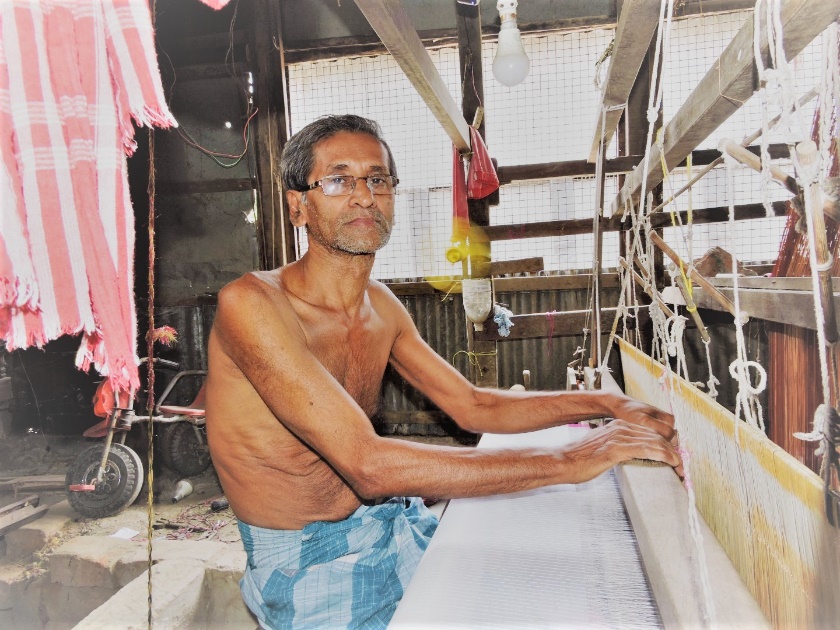
A Tanti in Bardhaman Dist., West Bengal
Most of the problems faced by rural artisans in India currently emerge from the conditions in which the artisans are forced into. Post Covid19 pandemic, the significance of handicraft items has decreased rapidly owing mostly to financial stress which hasn’t spared any sector except medical items. Utilitarian aspects of most handicraft products are limited. Collectors spend on such items as antiques may be limited to once in a life time. To top all these, the demand of handicraft articles is rapidly decreasing owing to poor and ingenuine quality of products which in turn is dependent on numerous factors.
Weak Financial Power and inability to get bank loans due to complex process shoot up production cost. Raw materials used for most handicraft products like mat, cloth, vegetable colours etc are purely seasonal in nature. Most artisans relinquish their very limited earning to continue household supply, children’s education, medical expenses in bare minimum way. They are hardly left with any disposable income to buy raw materials in bulk during season. “Dadan” concept is very much still into operation in this highly unorganised sector which is used either to book Artisans’ labour or produce in advance. This furthermore makes them penniless even after they are deployed in work as money taken in advance had already been consumed by artisans to meet their different needs.
Quality raw materials are becoming scarce and extremely costly. High raw material cost coupled with weak financial position and low bargaining power, forces rural artisans either settling for duplicate and cheap raw materials easily available in market, or to depend upon the middle men or dealers.These force rural artisans to gradually leave their hereditary profession to other fields even as labourers to various other sectors.
Silk sari being created at Tantipara, WB
Rural artisans mostly are uneducated and almost illiterate so far as English is concerned. Majority chunk of artisan population is female who were married very early without formal education. Lack of education and infrastructure make artisans more dependent on middlemen and traders who flock around mainly to exploit them financially. Lack of training and knowledge make it difficult for artisans to manage inventory, access government schemes, handle complex loan formalities, take advantages of digital marketing. Due to poor financial strength, rural artisans are unable to take advantages of advanced technology, industrial sophisticated machines, skill improvement training, and cope with modern trends.
Wages of the craft artisans are extremely insufficient and painful to talk about. Even the highest wages are relatively lower than those others in the agriculture or other non-firm activities. Politics-clad allowances are often irregular, conditional and meaningless in terms of inflation.
For example, in West Bengal, handloom weavers get Rs 70 to Rs 100 after full day of work. Same with Dokra artisans. Some of them are given Rs 1000 as monthly allowance. Apart from the unimaginable financial backwardness, these artisans are prone to different diseases like TB, respiratory disorder etc.
Though different local governments and some NGOs are waking up to provide artisans with venues, as opportunities to showcase their creativity, but constricted and cautious mindset of consumers, post demonetisation and particularly, post pandemic, has shown overall sloth demand.
The combination of low wages and insufficient demand in regressing market is pushing our age-old handicraft industry almost to perish with the passage of current generation. Next generation of artisans are no more interested in learning the art forms from their ancestors. They are prone to shift their attention to different fields works, even migrating to other place far away in search of alternative livelihood and better living.
Citizens, Governments- at all levels, and responsible corporate houses should come forward with all their strength and roadmaps to help our rural crafts economy survive. Handicrafts happened to be the second largest employment generation sector in rural India only after agriculture. It is having thousand years of rich legacy and still beholds Indian identity of her prestigious position in global platform.
We must do all our bit to identify these very talented gems hidden in villages, lanes and curves of our country; bring back their confidence; create awareness amongst customers; develop sustainable marketplace for the products; employ methods to assess training needs on continual basis; minimise intervention of middlemen; provide best quality raw materials, and save our Artisans from extinction and finally bring lost Indian glory back to world stage in arena of finest creations of hand-body, mind-n-soul!

[[comment.comment_text]]