Demographic Management: India’s Two-Child Dilemma

 an hour ago
The year was 1952. India, a newly independent nation brimming with the optimism of self-rule, became the first country in the world to launch a state-sponsored family planning programme. The architects of this policy, and those who have shaped its successors over the past seven decades, operated on a simple, compelling premise: a rapidly growing population would strain the country’s nascent resources, hindering the march towards development. This foundational logic, driven by a Malthusian anxiety, has persisted, morphing into a complex and often coercive apparatus of population control. At the heart of this apparatus lies a contentious and deeply problematic fixation: the two-child norm. This policy, in its many de facto and de jure forms, presents India with a profound dilemma, pitting the imperatives of demographic management against the fundamental rights and dignity of its citizens.
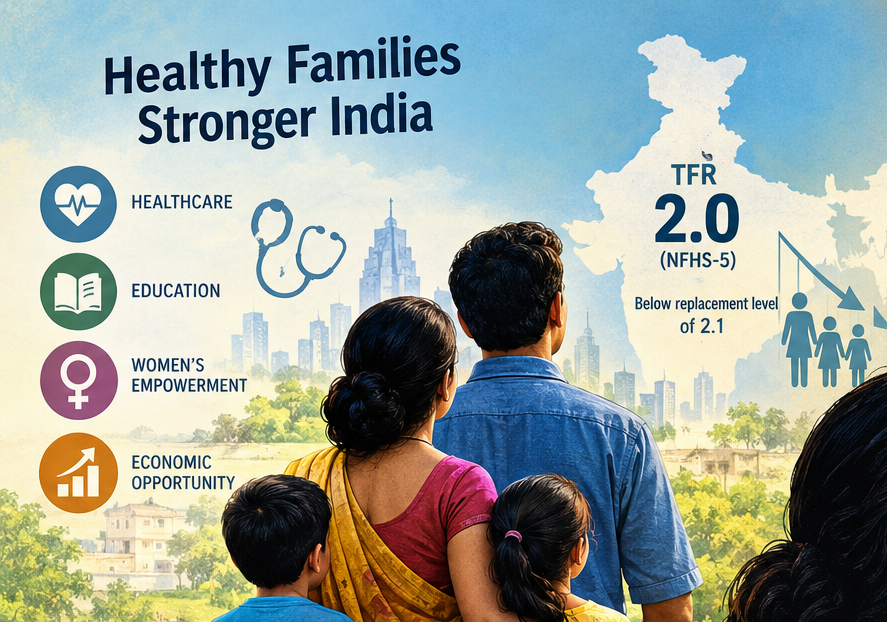
The narrative of overpopulation in India is a powerful one, but it is also increasingly anachronistic. The country has witnessed one of the most remarkable demographic transitions in modern history. According to the latest National Family Health Survey (NFHS-5), conducted between 2019 and 2021, India’s Total Fertility Rate (TFR) has dropped to 2.0, a significant milestone. This figure is not only below the replacement level of 2.1 but also marks a steep decline from a TFR of 3.4 in the early 1990s. The United Nations Population Fund’s (UNFPA) State of World Population 2022 report corroborates this, confirming that India’s population growth is stabilising. Furthermore, the National Population Policy of 2000 set a long-term objective of achieving a stable population by 2045. It is a triumph of social development, improved healthcare, and rising literacy, particularly among women, not of coercive policies.
Yet, an ugly paradox defines India’s policy landscape. Just as the stated national goal of population stabilisation appears to be organically achieved, the push for a stringent two-child norm continues with renewed vigour in many states. State assemblies have debated bills to bar individuals with more than two children from contesting local body elections, applying for government jobs, or receiving government subsidies. This approach, however, is a textbook example of a policy that is as flawed in its ethics as it is ineffective in its execution. The dilemma is not one of too many people, but of a policy that persists in being coercive when the demographic data no longer warrants such heavy-handedness.
The primary fallacy of the two-child norm is its assumption that population growth is a simple arithmetic problem. The great demographic scholar, Dr. S. Irudaya Rajan of the Centre for Development Studies, Thiruvananthapuram, has frequently argued that fertility reduction is an outcome of empowerment, not coercion. The states that first achieved replacement-level fertility—Kerala, Tamil Nadu, and Himachal Pradesh—did so not through punitive laws but through a virtuous cycle of female education, improved healthcare, and poverty reduction. As the NFHS-5 data shows, India’s TFR decline is a national phenomenon, but its drivers are local and deeply socio-economic. Better healthcare, sanitation, and a rise in the age of marriage for women are more potent contraceptives than any law.
The enforcement of this norm is also notoriously selective and disproportionately harms the marginalised. It places an unequal burden on women, who are often blamed for ‘exceeding’ the family size limit, leading to abandonment, domestic violence, and forced sterilisation. It targets the poor, who may have larger families due to a lack of economic security and a higher rate of child mortality, rather than a lack of contraceptives. As Dr. Sylvia Chant, a leading scholar on poverty and gender, has noted, policies that penalise large families ignore the reality that, for the world’s poorest, children are often the only source of old-age security and household labor. A policy that preys on the most vulnerable sections of society is not just unethical; it undermines the very social fabric it seeks to strengthen. Reports from organisations like Human Rights Watch have documented the devastating impact of such policies, particularly on Muslim communities, who often feel targeted by these demographic campaigns.
A landmark study on the impact of the two-child norm on women’s health and gender equity, often cited in development circles, noted a direct correlation between the implementation of coercive population policies and a rise in unsafe abortions and maternal mortality. The policy ignores the complex reality of reproductive choice. A woman’s decision to have a child is influenced by a web of factors, including her health, her economic situation, her support system, and her own aspirations. A state-mandated limit of two children curtails this fundamental freedom and treats women not as autonomous agents but as instruments of demographic policy.
While the Supreme Court of India, in judgments such as Javed v. State of Haryana, has upheld the constitutionality of the two-child norm for electoral eligibility, legal scholars have consistently pointed out the conflict between these laws and the fundamental rights of citizens, particularly the right to life and personal liberty under Article 21 and the right to equality under Article 14. Legal expert and advocate, Indira Jaising, has argued that such laws violate the principle of personal choice and create an environment of discrimination and stigma. They create a second-class citizenry of those with more than two children, a situation that is untenable in a modern, constitutional democracy.
The political economy of the two-child norm is another dimension to this dilemma. It is often used as a convenient scapegoat. When governments fail to provide adequate jobs, quality education, or basic healthcare, it is easier to blame “too many people” than to address deep-seated structural failures. Politicians use the population bogey to divert attention from their own inefficiencies and to whip up populist sentiment. This is a dangerous form of political theatre that threatens to erode the country’s social cohesion and its commitment to social justice.
It is time for India to reimagine its population policy. The success of the country’s demographic transition is a testament to the power of social development. The future lies not in penalizing families, but in empowering them. The state’s role should be to provide quality education and healthcare, ensure women’s entry into the workforce, and offer a robust social security net for the elderly. The focus must shift from controlling numbers to improving lives. As the world’s most populous nation, India’s strength will not be found in a smaller population, but in a healthier, better-educated, and more skilled one. A policy that trusts in the ability of its people to make responsible choices, while providing them with the means to do so, is the only path forward. The two-child norm is a relic of a bygone era; it must give way to a rights-based, development-centric approach that respects the dignity and aspirations of every Indian citizen.
(The author, a former Vice-Chancellor, Dr. Shyama Prasad Mukherjee University, Ranchi, Jharkhand, is a regular TEW columnist)










[[comment.comment_text]]