One Road, two temples and Gandhi's fight against untouchability

 2 weeks, 6 days ago
Mandir Marg runs through the middle of the capital like a sentence that keeps changing subject. Temples stand along it. So do schools. People who know the street will tell you it has more classrooms than any other road in Delhi. Whether that is strictly true matters less than what the eye already knows: this is a place built for instruction. It was also, for a time, the place from which Gandhi chose to teach a harder lesson than any syllabus could hold.
He had already left his mark here years before he moved in. On 12 March 1939 he inaugurated the Birla Mandir, the Laxminarayan Temple, only after the Birla family agreed that no one would be turned away at the gate because of caste. The promise still stands. A plaque near the entrance says as much.
Two houses of prayer on one street, both opened by the same man, both used as more than shrines. For Gandhi they were workshops. He believed that Hindus then called “low caste” had the same right to a temple as anyone else. The Birla Mandir was one half of that argument.
The other half came later, and looked nothing like a marble courtyard.
He did not live at the Valmiki Temple in one unbroken stretch. He first arrived on 1 April 1946, invited to Delhi by the Viceroy as the Cabinet Mission began its work, and stayed till 1 May 1946. He returned from 15 to 28 May, again from 9 to 28 June, and then for a long spell from 26 August to 28 October 1946, the weeks in which the Interim Government took office, and Patel, Rajendra Prasad and Jagjivan Ram came to the temple for his blessing before they were sworn in. In 1947 he was back from 31 March to 12 April, for a week from 1 to 7 May, and then from 25 May into the summer.
That last stay is usually closed, in popular memory, on 10 June 1947; the Gandhi Heritage record takes it through 30 July. Added together, the days come to the figure the temple still recites: 214. When he returned to Delhi on 9 September 1947, communal violence and refugee camps on the colony ground made the temple impossible. He went instead to Birla House.
Those months were among the most crowded in India’s political life. Talks on the transfer of power ran day after day. Congress leaders came to the colony to consult him. He still found time to sit with children who had never held a book.
When he arrived, many Valmiki families still lived in slums. They worked as sweepers in Gole Market, on Irwin Road (now Baba Kharak Singh Marg) and around Connaught Place. Gandhi went from house to house. He was pained to find that almost no one could read. He asked the families to send their children. He would teach them himself.
Classes ran morning and evening. He was strict enough with the clock that he sometimes put off meetings with leaders of the freedom struggle so a lesson could finish. Class began before the daily prayer. During both the lesson and the prayer he would not receive guests.
Louis Fischer learned this the hard way. He came from the Imperial Hotel for an interview and was made to wait until the prayer ended. Fischer spent more than a month in Delhi in 1946 gathering material for The Life of Mahatma Gandhi.
“The class that began with about thirty children grew to about seventy-five. Boys and girls walked in from Gole Market, Paharganj and Irwin Road. He taught them Hindi and English. The lesson was never only letters. It was a way of saying that no child was born unclean, and that no adult had the right to treat another as less than human,” informs Brother Solomon George who is part of the All Religion Prayer at Rajghat and Valmiki temple.
Step into the room today and the past is still arranged on the walls. Old photographs, yellow with time, show him with Lord and Lady Mountbatten, Acharya Kripalani, Khan Abdul Ghaffar Khan, C. Rajagopalachari, Sardar Patel, Maulana Azad and Jawaharlal Nehru. One faded painting tells the room’s real story: children clinging to Bapu’s feet. The painter’s name is lost. The feeling is not. A carpet covers the floor. In the centre stands the wooden table at which he wrote. To the right is the simple bed. Beside it sits a small spinning wheel. Nothing has been moved.
On Gandhi Jayanti an all-faith prayer meeting begins as it did in Bapu’s time. The bhajans Gandhi loved are sung. The little room is opened so that people can see the table, the bed and the charkha. Visitors look at the photographs and at the painting of children at his feet.
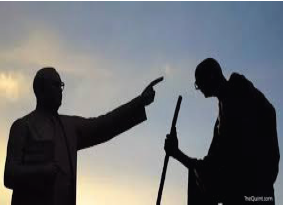
The schools on Mandir Marg may or may not have put teaching in his mind. What is certain is simpler. On this street he opened a temple to every caste, and then he sat on the floor and taught the children whom the city had left outside the classroom. The two acts belong together. One was the gate. The other was the lesson.
(Author is a senior Delhi-based journalist and commentator on culture, diversity, and pluralism.)




[[comment.comment_text]]